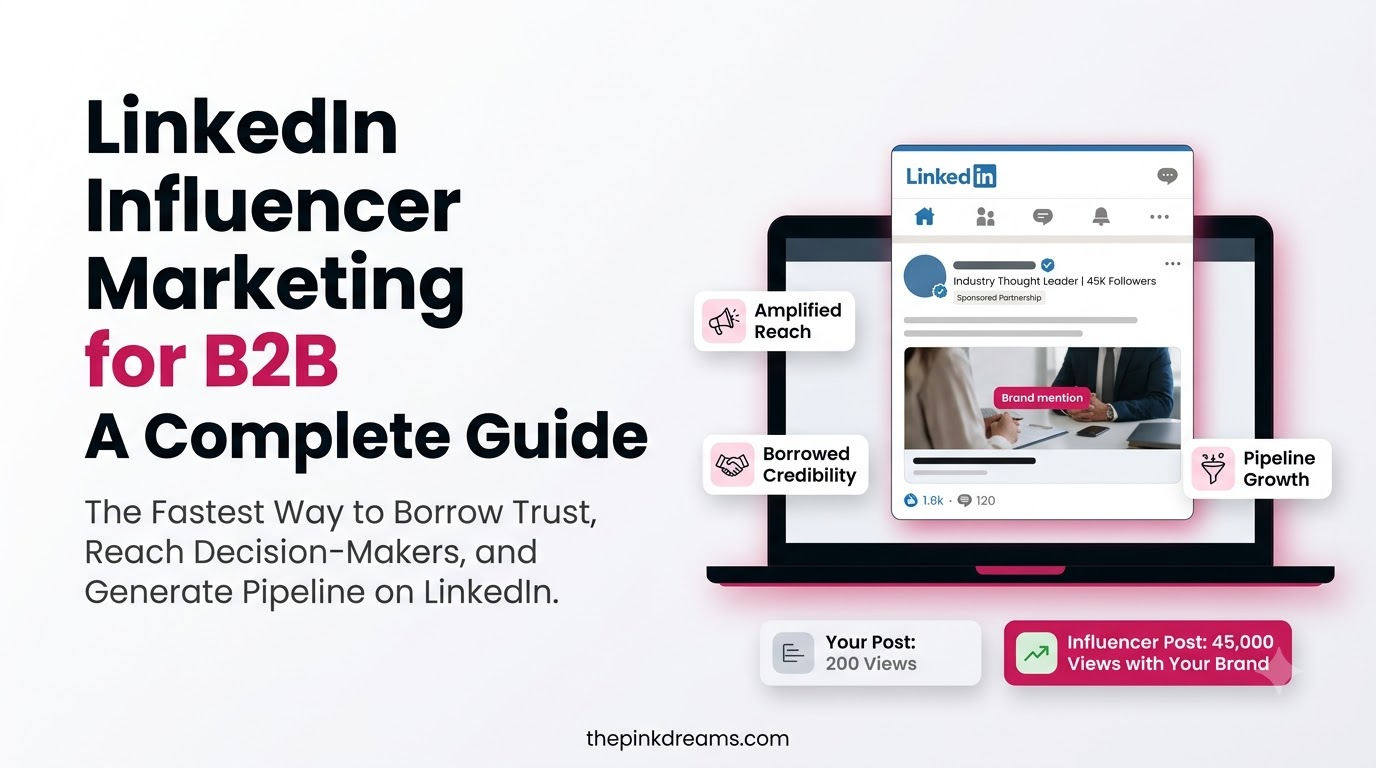
How B2B brands borrow credibility from LinkedIn creators, what it costs, and how to tell whether it worked.
B2B buyers trust practitioners more than brands. That is the entire mechanism, and it is why a post from a respected operator in your category outperforms the same message from your company page.
LinkedIn influencer marketing for B2B means paying credible practitioners to reach their professional audience on your behalf. It works because LinkedIn concentrates decision-makers by job title, industry, and seniority in a way no other platform matches. This LinkedIn influencer marketing guide covers creator selection, campaign structure, verified 2026 pricing, and measurement, and it assumes you are running it alongside your existing LinkedIn advertising services rather than instead of them.
Key Takeaways
- Audience relevance beats follower count. A 15,000-follower specialist can be worth more than a 150,000-follower generalist.
- Published rate cards and prices actually paid differ sharply. Negotiate from transacted data, not declared rates.
- One post is not a campaign. B2B buying cycles need multiple touches over weeks.
- The brief matters more than the creator. Over-scripted content is the most common reason campaigns underperform.
- Measure across three levels: reach, consideration, and pipeline. Stopping at impressions tells you nothing.
- Paid amplification through Thought Leader Ads is usually the cheapest performance improvement available.
- Disclosure of paid partnerships is a legal requirement, not a courtesy.
What Is B2B Influencer Marketing on LinkedIn?
B2B influencer marketing is a partnership where a brand pays a credible individual to create or share content with their professional audience. On LinkedIn that individual is usually a practitioner rather than a media personality: a founder, an operator, an analyst, or a specialist consultant with a following built on expertise.
This differs from consumer influencer marketing in three ways that change how you run it.
The audience is buying for an organization, so the content must survive scrutiny from colleagues and procurement, not just appeal personally.
The purchase cycle is long, so a single post rarely converts. Influence accumulates across months.
Credibility is technical, so an audience spots a creator talking outside their expertise immediately.
Worth knowing: You are renting trust, not reach. The moment the content stops sounding like the creator, the trust does not transfer.
Why LinkedIn Works for B2B Influence
Three characteristics make LinkedIn the default platform for B2B creator work.
Decision-maker concentration. LinkedIn is where senior professionals identify their own job title, industry, company size, and seniority. That is the most qualified audience data in digital media, and it is why LinkedIn commands a CPM premium of roughly two to four times Instagram’s for comparable reach. For more context on LinkedIn advertising costs, see our guide to LinkedIn Ads CPM.
An editorial format. Long-form posts, carousels, and newsletters suit explanation. B2B buyers want methodology and evidence, and LinkedIn’s formats accommodate both in a way short-form video platforms do not.
An algorithm that rewards relevance over virality. A post that lands with the right professional niche gets sustained distribution within that niche, which matters more than a large undifferentiated audience.
In practice: LinkedIn is the right platform when your buyer is identifiable by job title. If they are not, influencer marketing is probably the wrong channel entirely.
Who Counts as a LinkedIn Influencer for B2B
Choose creator type by which part of the buying committee you need to reach, not by follower count. The most useful way to categorise LinkedIn creators for B2B is by professional function.
| Creator type | Reaches | Best for |
| Founder and executive creators | Startup and SME leadership | Category creation, brand positioning |
| GTM operators (sales, marketing, RevOps) | Revenue teams | Marketing and sales tooling |
| Product and engineering practitioners | Technical buyers and users | Developer tools, infrastructure, security |
| HR and People Ops practitioners | People teams | HR tech, benefits, employee experience |
| Finance and operations creators | CFO office, procurement | Fintech, spend management, compliance |
| Independent analysts and consultants | Cross-industry senior buyers | Complex or regulated categories |
Follower tiers still matter for budgeting, but relevance decides performance. A cybersecurity practitioner with 15,000 enterprise-security followers and a career-advice creator with 50,000 general followers can quote similar rates and deliver completely different outcomes.
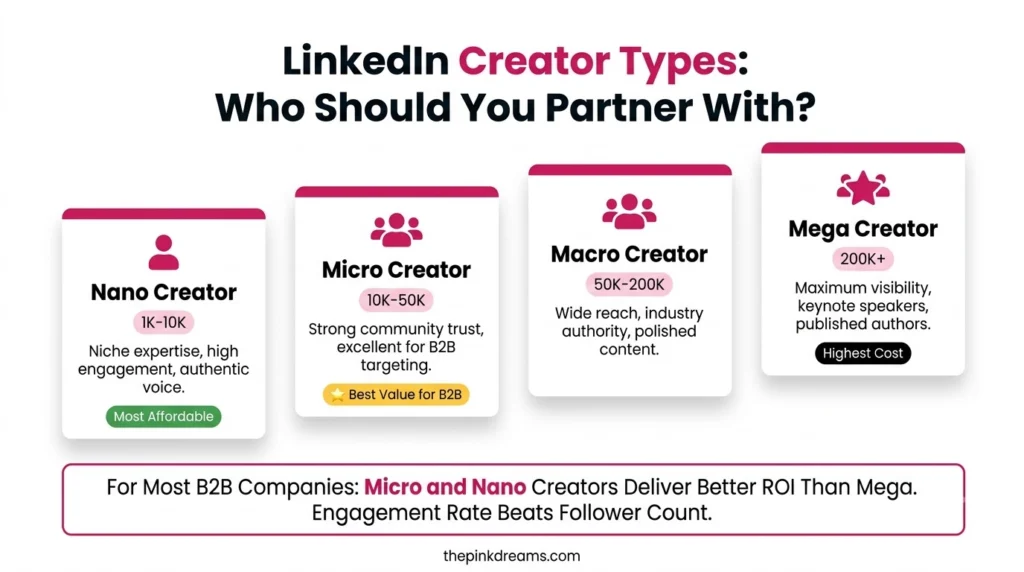
The filter: Ask who follows them, not how many.
How to Vet a LinkedIn Creator Before You Pay
Four checks separate a genuine partner from an expensive impression buy.
1. Sectoral relevance. Do they discuss your category, your buyer’s problems, and your use cases regularly, or would your brand be an anomaly in their feed?
2. Qualified engagement. Read the comments. Are the people commenting on your buyers, or are they other creators and job seekers? Comment quality is the single most revealing signal and takes ten minutes to check manually.
3. Editorial consistency. Creators posting two to three times a week over months have an audience that expects them. Sporadic posters get sporadic reach.
4. Positioning fit. Can they say what you need to say without contradicting what they have already said publicly? Check their archive before you approach them.
Ask for screenshots of recent post analytics covering impressions, unique reach, and audience job titles. Creators who work with brands regularly will have these ready. Reluctance to share is informative.
Shortlist rule: Three well-matched creators beat ten loosely relevant ones on the same budget.
Building a B2B Influencer Strategy: Five Steps
A B2B influencer strategy fails most often because it is treated as a media buy rather than a campaign. These five steps fix that.
1. Define one measurable objective
Brand awareness, demand generation, product launch, talent attraction, and repositioning need different creators, formats, and metrics. Pick one primary objective. A demand generation campaign needs explicit calls to action and dedicated landing pages; an awareness campaign should prioritise reach and storytelling.
2. Map the buying committee
Document who is involved, what each role cares about, what proof they need, and where they are in the cycle. B2B purchases involve several people, and a campaign aimed at “marketers” rather than at a specific role produces vague content.
3. Write a brief, not a script
Give the creator the message, the evidence, the non-negotiables, and the compliance requirements. Then let them write it. Over-scripted content is the most reliable way to destroy the authenticity you paid for, and LinkedIn audiences detect it immediately.
4. Plan multiple touches
One post is an impression. A sequence across four to six weeks is a campaign. Vary the angle: problem framing, methodology, objection handling, proof. Use different creators for different angles rather than repeating the same endorsement.
5. Amplify what performs
Once a post is live organically, put the budget behind the best performer through LinkedIn Thought Leader Ads, with the creator’s written permission. This extends reach to targeted audiences beyond their network while keeping the creator’s credibility intact, and it typically costs less than the original placement. Coordinate this with your wider PPC and paid search management so budgets are not competing.
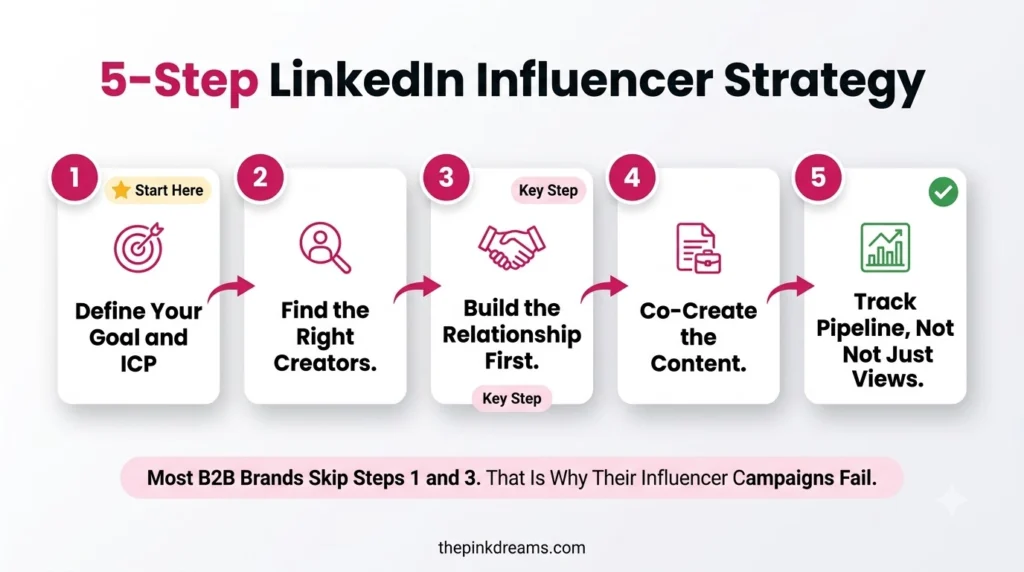
Start here: Objective, then buyer map, then creator. Choosing the creator first is the most common sequencing error.
Content Formats That Perform on LinkedIn
Analysis of B2B creator campaigns keeps surfacing the same four formats.
| Format | Why it works |
| Documented experience | “We tested this for six months, here is what happened” carries evidence, not claims |
| Expert counter-argument | Challenging received wisdom with reasoned data drives discussion and positions the brand |
| Methodology carousel | Step-by-step frameworks get saved and shared, which extends distribution |
| Practitioner conversation | Interviewing a customer or partner adds a third voice and humanizes the brand |
What consistently underperforms: promotional posts with external links placed at the top, reposted YouTube video, and anything that reads as a press release. Native formats without outbound links get materially better distribution.
What works: Content your buyer would save. If it is only useful to your brand, it will not travel.
LinkedIn Influencer Platforms and Discovery Tools
You can find creators manually, and for small campaigns you should. LinkedIn’s own search filters, industry groups, hashtags, and the Top Voices badge will surface candidates in most niches within an afternoon.
At scale, dedicated LinkedIn influencer platforms speed up discovery and verification. Tools in this space include Favikon, Influencer Hero, BuzzSumo, and Phyllo, alongside broader creator marketing platforms. What they provide is audience data, engagement benchmarks, and rate estimates that would otherwise take hours per creator to assemble.
Treat platform data as a shortlist mechanism rather than a decision. Manual review of the last twenty posts and their comment sections still tells you more about audience fit than any score, because relevance is contextual and tools measure it poorly.
Use tools to shortlist, humans to choose.
What LinkedIn Influencer Marketing Actually Costs
Rate cards and prices actually paid diverge more in this channel than in almost any other, so it is worth separating the two.
What creators say they charge. Favikon’s analysis of 136 LinkedIn influencers, spanning 200 to 700,000 followers, found roughly 81 percent of posts priced between USD 200 and 2,000, with the full range running from USD 10 to 7,500. Their survey of 125 B2B creators put the median sponsored post at USD 350, with event speaking around USD 1,500.
What brands actually pay. Favikon’s 2026 client collaboration data, covering 135 cleaned transaction records, puts the transacted median at USD 798 per post. Ahrefs’ influencer lead has publicly noted that most LinkedIn creators they sponsor in the marketing niche charge USD 500 to 2,000 per post, and an analysis of 300-plus B2B campaigns converged on USD 400 to 2,000.
Where the sources disagree. Some 2026 pricing guides place B2B thought leader rates far higher, at USD 2,000 to 15,000 per post. That gap reflects different slices of the market: specialist SaaS, fintech, and HR creators command significant premiums over general professional content creators, and macro creators sit in a different band entirely.
| Tier | Indicative range per post |
| Micro B2B creator (5,000 to 15,000 followers) | USD 200 to 1,000 |
| Mid-tier (30,000 to 150,000 followers) | USD 500 to 3,500, higher in premium niches |
| Macro (100,000 to 500,000) | USD 5,000 to 20,000 |
| Top voices (500,000+) | USD 15,000 to 50,000+ |
| Newsletter sponsorship | USD 500 to 8,000 per issue |
| Ongoing monthly partnership | USD 2,000 to 25,000 |
The post fee is not the campaign cost. Budget separately for content production, usage rights and repurposing, paid amplification, campaign management, and tracking. Amplification in particular is often underfunded, despite being the cheapest lever available.
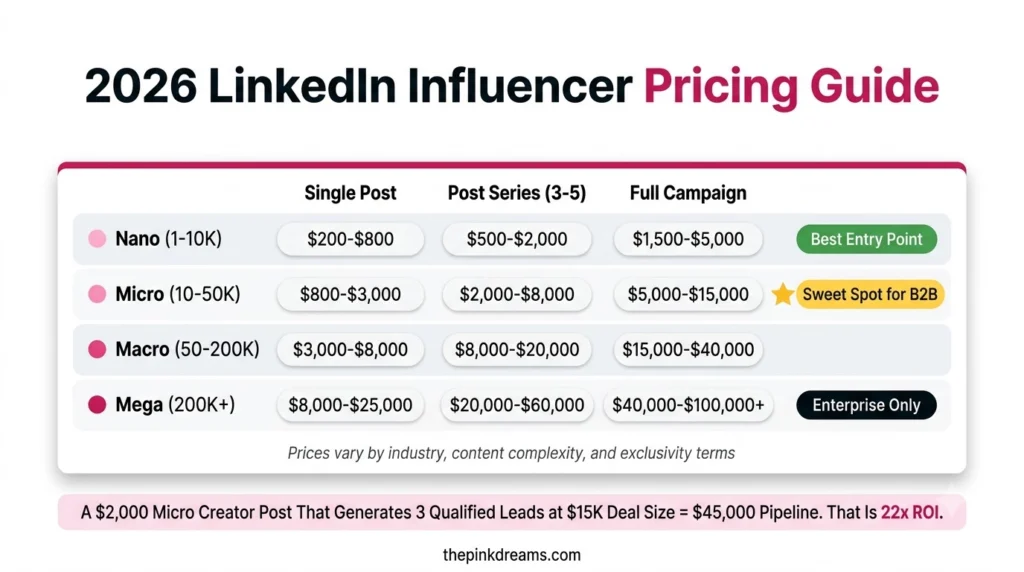
Budget reality: Use the transacted median as your negotiating anchor, not a published rate card. Verify current rates before committing, since this market is moving quickly.
Measuring a B2B Influencer Campaign
Impressions are not results, and pipeline is not visible in week one. Measure across three levels and expect different timelines from each.
| Level | Metrics | Timeline |
| Reach and engagement | Organic impressions, unique reach, engagement rate, comment quality | Days |
| Consideration | Brand profile visits, company page visits, referral traffic, gated downloads, event registrations | Weeks |
| Business outcome | Qualified leads, cost per lead, influenced pipeline, sales cycle impact | Months |
Two calculations worth running:
• CPM = (creator cost ÷ verified impressions) × 1,000. Use it to compare creators, not to judge success.
• ROI = ((attributed value − total campaign cost) ÷ total campaign cost) × 100. Define attribution windows and credit rules before launch, or this number becomes an argument rather than a measurement.
Set a baseline before the campaign starts. Without one, you cannot separate campaign effect from existing momentum, which is how most B2B influencer reporting ends up unfalsifiable.
Measure this: Comment quality in week one, referral traffic in month one, influenced pipeline in quarter one.
Common Mistakes to Avoid
Buying followers instead of relevance. Ten thousand of your buyers beats a hundred thousand of nobody’s.
Scripting the creator. The defensive instinct to control wording removes exactly what you paid for.
Running a single post. B2B needs repetition across weeks to register.
Skipping the pre-publication warm-up. Engagement in the first hour shapes distribution. Have colleagues ready to comment substantively.
Forgetting disclosure. Paid partnerships must be disclosed. Beyond the legal exposure, undisclosed partnerships that surface later damage both parties.
Measuring without a baseline. Any result can be attributed to the campaign if nothing was recorded beforehand.
Avoid: Treating creator selection as the whole job. Brief quality and amplification decide more outcomes than the name on the post.
The LinkedIn Influencer Marketing Playbook: One Page
Everything above, condensed to what you would actually do.
| Stage | Decision | Do not skip |
| Objective | One primary goal, one primary metric | Setting the baseline before launch |
| Audience | Which role on the buying committee | Mapping what proof that role needs |
| Creator | Three well-matched, not ten loose fits | Reading their comment sections manually |
| Deal | Anchor on transacted rates, not rate cards | Usage rights and amplification permission in writing |
| Brief | Message and evidence, not wording | Compliance and disclosure requirements |
| Campaign | Four to six weeks, multiple angles | More than one touch |
| Amplification | Thought Leader Ads on the best performer | Budgeting for it upfront |
| Measurement | Reach, consideration, pipeline | Attribution rules agreed before launch |
If you run only the first column, you will get impressions. The second column is where the pipeline comes from, and it is the part most brands cut when budgets tighten.
Start small. One objective, three creators, six weeks, a defined baseline. That is enough to learn whether the channel works for your category before committing a serious budget to it.
If the constraint is capacity rather than strategy, that is worth delegating. Pink Dreams is a digital marketing agency that runs creator and content programmes for B2B brands, combining social media marketing services with content marketing services so the campaign, the amplification, and the reporting stay joined up.
FAQ
How much does a LinkedIn influencer post cost?
Most sponsored LinkedIn posts transact between USD 200 and 2,000, with 2026 transaction data putting the median near USD 798. Specialist creators in SaaS, fintech, and HR command premiums well above that, and macro creators with 100,000-plus followers typically start around USD 5,000. Verify current rates before budgeting.
Does follower count determine the price?
It sets a floor, not a price. Audience relevance, niche, engagement quality, content format, usage rights, and exclusivity move rates far more than follower count. A 15,000-follower specialist reaching your exact buyer routinely costs more than a larger general-interest creator.
How many creators should a B2B campaign use?
Three well-matched creators across four to six weeks is a sensible starting point for a first campaign. Multiple creators covering different angles outperform repeated endorsements from one person, and a small first campaign tells you whether the channel suits your category before larger commitment.
How is LinkedIn influencer marketing different from LinkedIn Ads?
Influencer content borrows a third party’s credibility and reaches their audience organically first. LinkedIn Ads push your own message to a targeted audience. Influence performs better for credibility and consideration, advertising for reach and retargeting. The two combine well through Thought Leader Ads.
Do paid partnerships need to be disclosed?
Yes. Disclosure of paid partnerships is a legal requirement in most markets and a platform requirement on LinkedIn. Beyond compliance, undisclosed partnerships that later come to light damage the creator’s credibility and the brand’s, which defeats the purpose of the channel.

Digital Marketing Strategist & Business Coach
As a leading digital marketing strategist and business coach, he is responsible for helping entrepreneurs and brands grow faster in a smarter, more scalable way. With over 20 years of experience, Nagarajan specializes in practical coaching, automation-first marketing strategies, and technology-driven growth systems. His work focuses on enhancing brand visibility, improving performance, and building sustainable frameworks that enable long-term business success.