




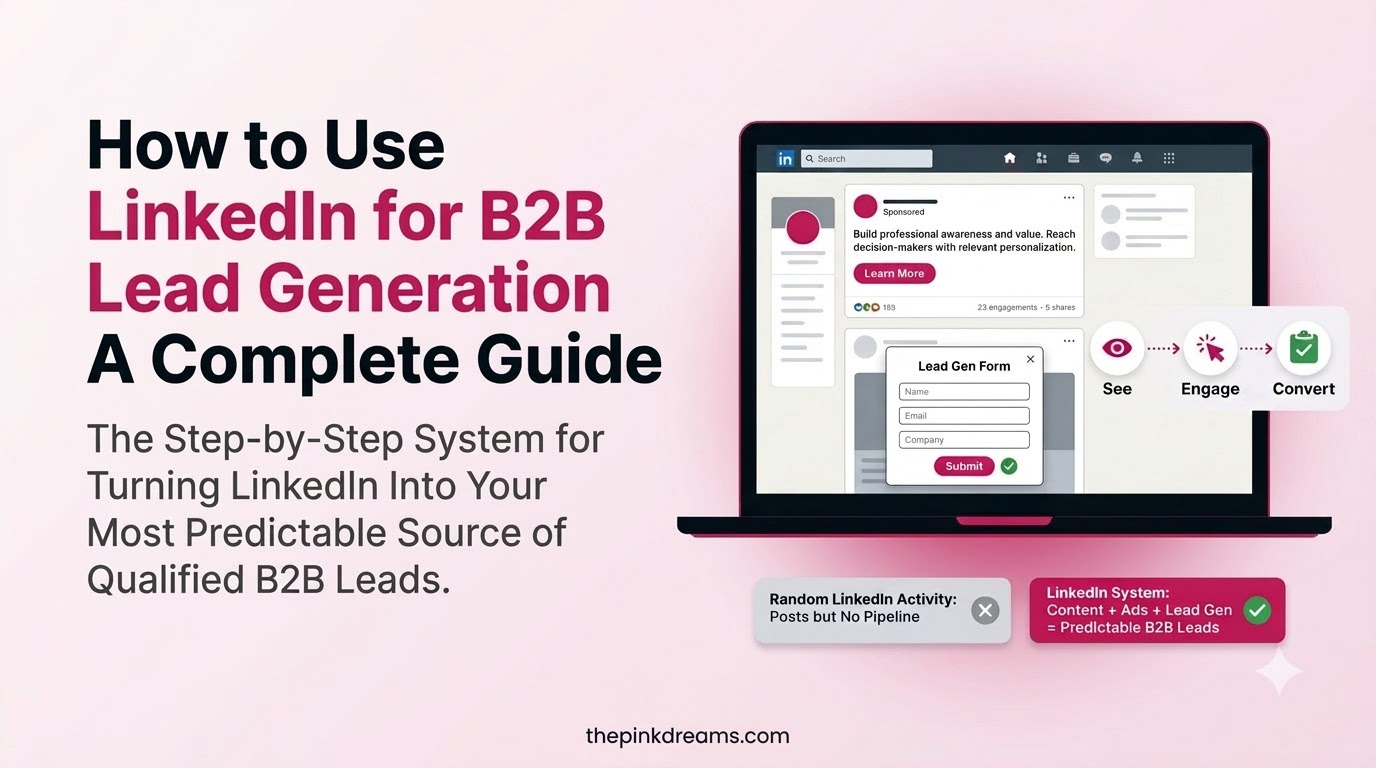
A practical system for turning LinkedIn into a source of qualified B2B enquiries, covering profiles, prospecting, outreach, content, ads, Sales Navigator, budget, and measurement.
Most B2B businesses use LinkedIn like a noticeboard. They post the award, connect with anyone who accepts, send a pitch three minutes after the request is accepted, and conclude the platform does not work.
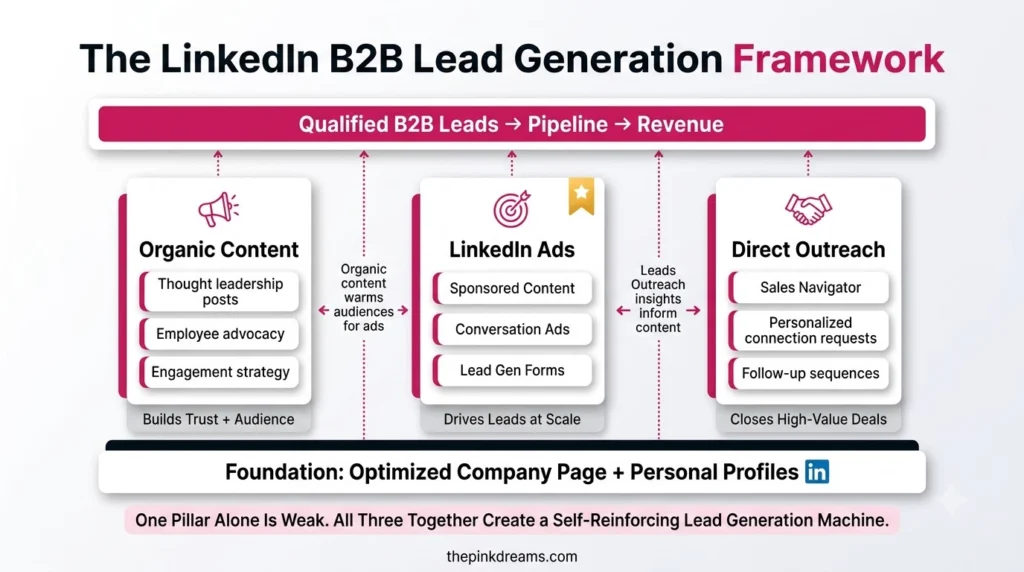
The businesses generating real pipelines are running a system instead. Learning how to use LinkedIn for B2B lead generation means treating it as a sequence: define exactly who you want, make your profile worth checking, find those people properly, warm them before you message, then give sales a reason to follow up. That sequence is what separates a channel that produces meetings from one that produces connection counts, and it works alongside the rest of your social media marketing services rather than replacing them.
This guide covers who LinkedIn works for, the eight-step process, whether Sales Navigator and paid ads are worth it, what to budget, best practices, and how to measure whether any of it is producing revenue.
Key Takeaways
- LinkedIn B2B lead generation works as a system, not a tactic. Assets first, then prospecting, then outreach, then content, then paid.
- Define the audience by job title, seniority, industry, company size, and geography before creating anything.
- Personal profiles out-reach company pages substantially, so people carry the outreach while the page carries credibility.
- Warm prospects through engagement before messaging. Cold pitches immediately after connecting are the most common reason the channel fails.
- LinkedIn Lead Gen Forms convert better than landing pages because there is nothing to type, but the low friction reduces lead quality.
- Sales Navigator earns its cost when outbound is a real part of your strategy, and wastes it when you only need occasional prospecting.
- Measure meetings booked and pipeline sourced, not connections accepted or post impressions.
Is LinkedIn Marketing Right for Your Business?
LinkedIn works best when your buyer can be identified by job title, industry, or company size, and when your deal value justifies a longer nurture cycle. It works poorly for low-value transactional sales, consumer products, and businesses whose buyers are not defined by their profession.
It is a strong fit for professional services, agencies, consultants, recruiters, software companies, and B2B service providers with deal values high enough to justify weeks of relationship building.
It is a weak fit in three situations:
• Low deal value. If the sale is worth very little, the time cost per conversation cannot be recovered.
• Consumer audiences. When your buyer is defined by lifestyle rather than profession, the targeting advantage disappears.
• Nobody senior enough to be visible. The channel depends on real people posting and replying. If nobody in the business will do that, paid is the only route and it will underperform without organic credibility behind it.
Key Takeaway: LinkedIn suits businesses selling considered purchases to identifiable professionals. Be honest about fit before investing months in it.
Building a LinkedIn Lead Generation Strategy Before You Start
A LinkedIn lead generation strategy answers four questions before any activity begins: exactly who you are targeting, what problem you solve for them, what you want them to do next, and how you will know whether it worked. Skipping this is why most LinkedIn efforts produce engagement without enquiries.
Write these down on a single page.
• The audience. Job titles, seniority, industries, company size ranges, and locations. If you cannot describe them in one sentence, you cannot target them.
• The problem. What those people are already trying to solve, in their words rather than yours.
• The offer. One primary action: a reply, a booked call, an audit, a download. Asking for everything gets none of it.
• The measure. Agree upfront that meetings and pipeline matter, and that impressions are diagnostic.
Then check the audience actually exists. Run your criteria through LinkedIn search and look at the number. A few hundred people is too narrow to sustain activity. Hundreds of thousands is too broad to write usefully for.
Key Takeaway: One page defining audience, problem, offer, and measurement prevents most of the wasted effort that follows.
How to Generate B2B Leads on LinkedIn: An 8-Step Process
This is the sequence that produces meetings. Work through it in order, because each step depends on the one before it. Outreach before profile optimization wastes your best prospects, and paid before organic amplifies a message you have not tested.
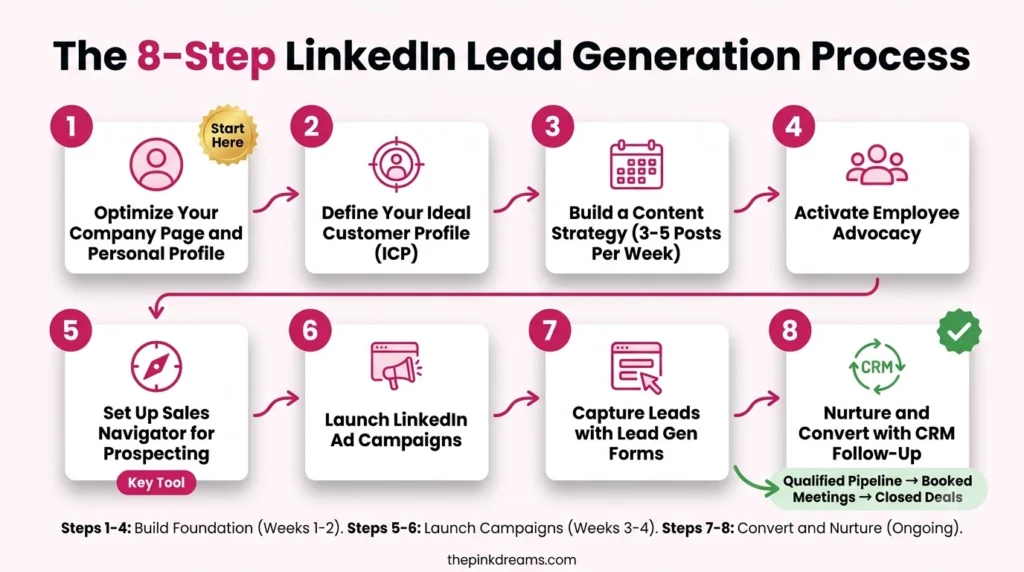
1. Define the audience and the offer
Start with the list from your strategy page. Be specific enough that you could write one message that lands with every person on it. If a message would need to change substantially between two prospects, they belong in different segments with different messaging.
2. Rebuild your personal profile as a landing page
Every prospect checks your profile before replying. Write the headline for the buyer rather than the employer: what you do, for whom, and what changes as a result. Use the About section to describe the problem you solve, not your career history. Add a professional photo, a banner that states what the business does, and featured links to pages you want people to visit. Then check it on a phone, because that is where most people will see it.
3. Fix the company page
The page rarely drives reach, but prospects use it to verify a real business exists behind the person messaging them. An abandoned page undermines everything else. Complete every field, describe clearly what you do and who you serve, keep the branding current, and post often enough that it does not look dormant.
4. Build a prospect list properly
Use LinkedIn’s filters rather than accepting whoever appears in your feed. Filter by title, seniority, industry, company size, and location, then save the search. Better sources of prospects than cold search include people engaging with competitors’ posts, attendees of relevant events, members of active groups, and people who viewed your profile.
5. Warm prospects before you message them
This is the step most businesses skip and the one that changes reply rates most. Follow the prospect, engage genuinely with two or three of their posts over a week or two, and let your name become familiar. A message from a recognised name is a different proposition to a message from a stranger.
6. Send connection requests and messages that earn replies
Connection requests without a note perform poorly, and templated pitches perform worse. Reference something specific: a post they wrote, a shared group, a problem their sector is facing. Ask a question rather than pitching, and do not attach a calendar link to a first message. Follow up once with something useful, then stop. Persistence past that point damages the reputation you spent months building.
7. Publish content that does the selling for you
Outreach converts far better when prospects have already seen you being useful. Publish practical how-to posts, lessons from real projects including what went wrong, clear positions on industry debates, and occasional proof in the form of results and examples. Company news performs poorly because it serves you rather than the reader. This runs best from the same plan as your wider content marketing services. For more practical ideas, see our guide to LinkedIn marketing strategies and our guide on how to use LinkedIn for marketing, which covers the publishing side in more depth.
8. Follow up, qualify, and hand off
Decide in advance what happens when someone replies positively. Who responds, how quickly, and what the next step is. Leads go cold within days, and the most common failure at this stage is a warm reply sitting unanswered in an inbox nobody owns.
Key Takeaway: Assets, then list, then warming, then outreach, then content. The order matters more than the effort you put into any single step.
LinkedIn Sales Navigator for B2B Leads: Is It Worth It?
Sales Navigator is worth it when outbound prospecting is a genuine part of your strategy rather than an occasional activity. It earns its subscription through advanced search filters, saved lists, lead recommendations, and alerts that surface trigger events. It wastes money when nobody uses it weekly.
What you get beyond the free version is precision and automation of research. Filters go well beyond standard search, including seniority, function, company headcount, growth signals, and recent job changes. Saved searches keep producing new prospects matching your criteria without you rebuilding the query each time.
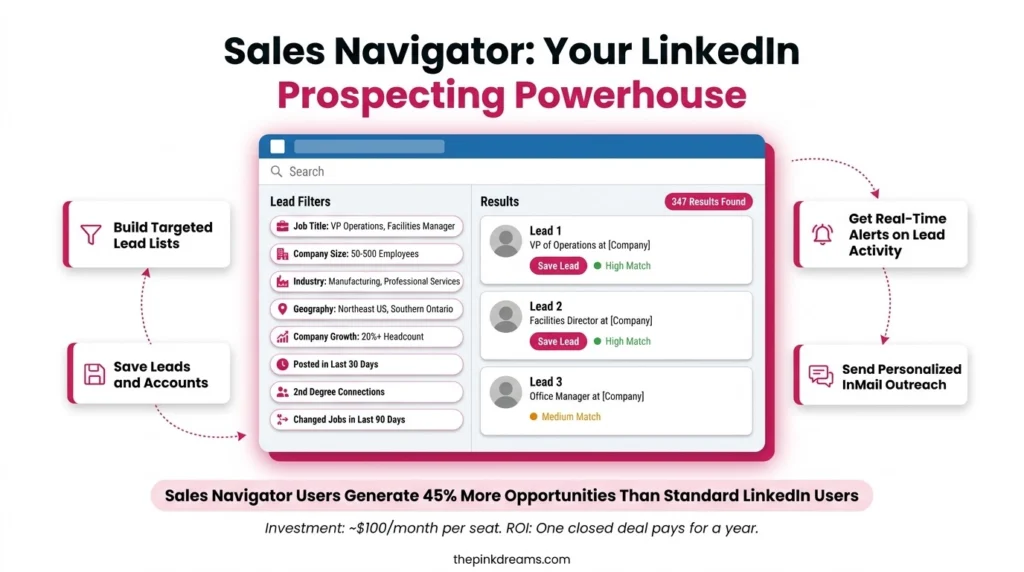
The honest test is volume. If someone in the business will spend a few hours a week prospecting and messaging, the hours saved on manual research usually justify the cost quickly. If prospecting happens sporadically when the pipeline looks thin, the free search filters will cover you.
Check current pricing directly on LinkedIn, since tiers and features change and vary by region.
Key Takeaway: Sales Navigator pays for itself when outbound is a habit. It is an expensive convenience when it is an afterthought.
LinkedIn Ads and Lead Gen Forms: When Paid Is Worth It
Paid LinkedIn is most reliable when it amplifies content that already earned engagement organically. You know the message resonates, so the budget simply extends reach to people who do not follow you. LinkedIn Lead Gen Forms then remove the friction of a landing page by pre-filling details from the prospect’s own profile.
| Format | Best for | Watch out for |
| Sponsored Content | Reaching cold audiences with your best-performing posts | Promoting sales-heavy posts nobody engaged with organically |
| Lead Gen Forms | Capturing details with minimal friction | Volume without quality, because low friction attracts casual sign-ups |
| Message Ads | Direct offers such as event invitations or demos | Cost per send, and irritating people if it reads like a template |
| Dynamic Ads | Follower growth and personalised sidebar visibility | Limited creative space and lower intent than feed placements |
| Text Ads | Cheap testing of messages and audiences | Low visibility, so treat it as a testing channel |
| Video Ads | Explaining a complex offer or building familiarity | Losing viewers in the opening seconds if the hook is weak |
Lead Gen Forms deserve a specific warning. Conversion rates are usually higher than equivalent landing pages because there is nothing to type, but the same low friction means some submissions are casual. Qualify quickly and follow up fast, because a lead that sits for three days is usually gone. Managing this properly alongside your other paid search and paid social management keeps budget flowing to the formats actually producing meetings.
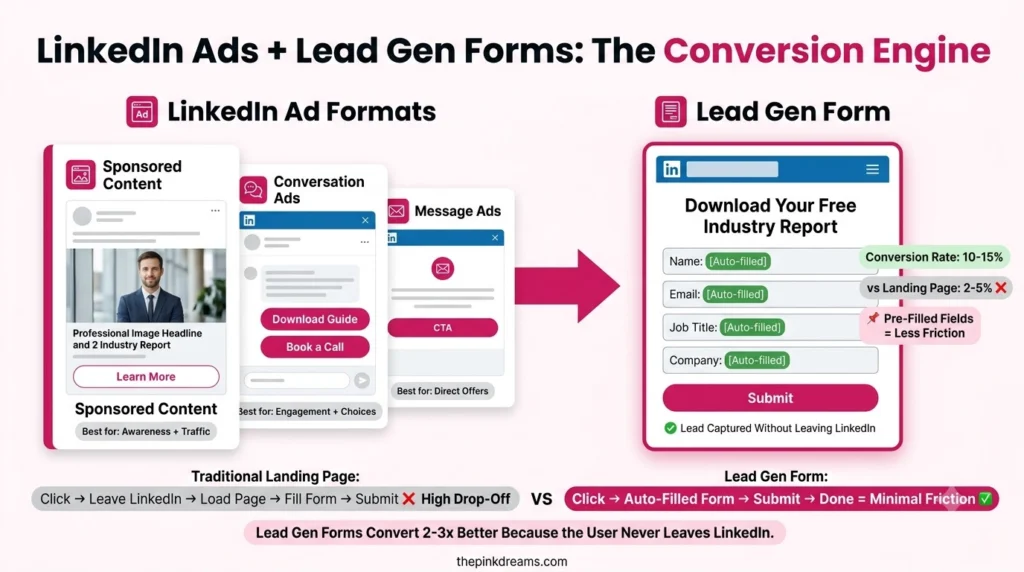
Key Takeaway: Use paid to scale a proven message and Lead Gen Forms to reduce friction, then qualify hard because friction was doing some filtering for you.
LinkedIn Lead Generation Price: What Should You Budget?
There is no single LinkedIn lead generation price, because the cost is assembled from four separate things: platform subscriptions, advertising spend, tooling, and the time or agency fees to run it. Costs per click on LinkedIn are typically higher than other social platforms, so the sensible approach is to work out what a qualified meeting is worth before committing.
The four cost components:
• Subscriptions. Sales Navigator or similar, priced per seat and varying by region and tier.
• Ad spend. Optional, but if used, budget enough for a single format and audience to gather usable data rather than spreading it thin.
• Tooling. CRM integration, scheduling, and reporting. Automation tools exist but carry account risk if used aggressively.
• People. Either internal hours, realistically several hours a week, or an agency retainer.
To judge whether the numbers work, calculate backwards. Take your average deal value and gross margin, apply your meeting-to-close rate, and work out how many meetings per month cover the total cost. For most B2B businesses with meaningful deal values, break-even lands at a small number of meetings, which is a far more useful benchmark than any published average cost per lead.
Key Takeaway: Ignore headline cost-per-lead figures and calculate how many meetings per month justify your own total spend.
LinkedIn Lead Generation Best Practices
These LinkedIn lead generation best practices separate accounts that produce meetings from accounts that produce activity.
• Post from people, not only the page. The feed favours person-to-person connection, so a small group posting in their own voice will out-reach the company page consistently.
• Comment daily on your audience’s posts. It puts you in front of prospects without asking for anything and is the cheapest form of warming available.
• Reply to every comment on your own posts, quickly. The first couple of hours substantially affect how far a post travels.
• Give employees topics, not scripts. Six colleagues posting identical copies on the same morning is obvious and does more harm than silence.
• Keep the opening two lines strong. For most readers they are the entire post, so the hook decides whether anyone clicks “see more”.
• Use native formats. Documents, carousels, and native video hold attention better than posts pushing people off the platform. Put links in the first comment where possible.
• Segment before you personalise. Genuine personalisation at scale comes from tight segments, not from inserting a first name into a template.
• Route replies to a named owner. Every warm reply should have somebody responsible for answering it the same day.
• Stay consistent. Three useful posts a week sustained for a year beats fifteen a week abandoned in March.
Key Takeaway: Consistency, real conversation, and tight segmentation account for most of the difference between accounts that work and accounts that do not.
How to Measure LinkedIn Lead Generation Performance
Measure LinkedIn on meetings booked and pipeline sourced, not on impressions or connections accepted. Engagement figures explain what is happening and why, but they are diagnostics. A modest audience of exactly the right people outperforms a large one that will never buy.
| Stage | What to track | What it tells you |
| Reach | Impressions and unique members reached | Whether content is being distributed at all |
| Engagement | Comments and saves rather than likes | Whether the content was worth someone’s professional reputation |
| Audience quality | Job titles and companies of followers and engagers | Whether you are reaching buyers or other marketers |
| Outreach | Connection acceptance and reply rates | Whether targeting and messaging are working |
| Conversion | Meetings booked from LinkedIn | Whether interest is becoming opportunity |
| Pipeline | Opportunities and revenue sourced from LinkedIn | Whether any of it is producing money |
Attribution on LinkedIn is unreliable, so ask every new enquiry how they found you. Someone may read your posts for four months and then arrive through a Google search of your company name, which analytics will credit to search. Feeding those answers back into your lead generation records corrects more errors than any tracking configuration will.
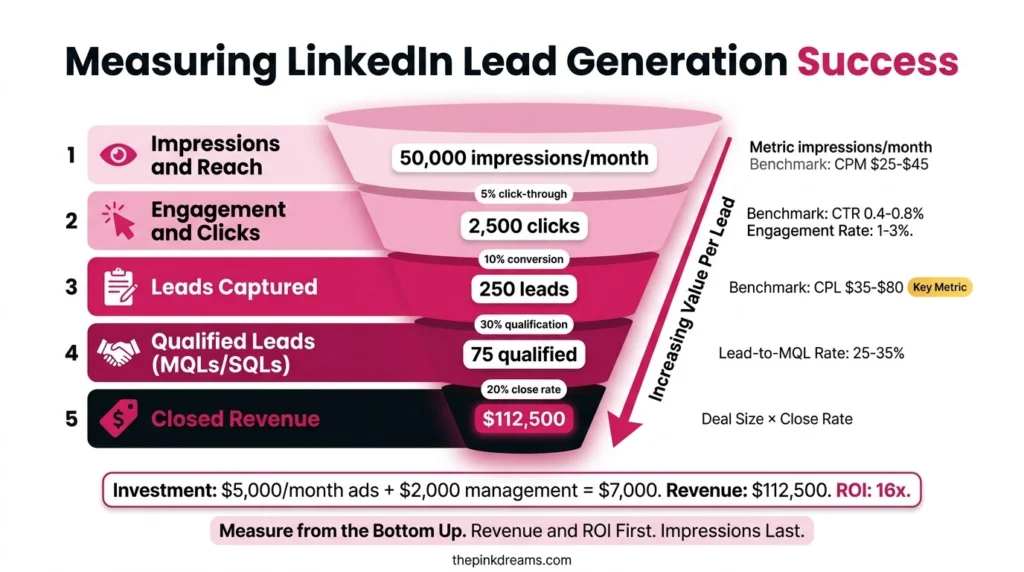
Key Takeaway: Judge LinkedIn on meetings and pipeline. Impressions explain performance; they do not measure success.
Common LinkedIn Lead Generation Mistakes
• Pitching in the first message: it converts poorly and burns a contact you cannot easily approach again.
• Automating connection requests carelessly: it risks the account and builds an audience that never engages.
• Relying on the company page alone: you are choosing the format with the least reach.
• Posting only company news: announcements serve you rather than the reader, and the feed responds accordingly.
• Posting and disappearing: the first two hours of replies materially affect distribution.
• Targeting everyone: broad audiences produce content that resonates with nobody worth reaching.
• Running four ad formats on a small budget: the data is too thin to learn from, which is why most businesses conclude LinkedIn ads do not work.
• Ignoring warm replies: the most expensive mistake on this list, because the hard work was already done.
• Quitting at week six: results usually appear between month three and month six.
Key Takeaway: Most LinkedIn failure is impatience or self-interest. Useful content, real conversation, and a reply process solve almost all of it.
Making LinkedIn Lead Generation Work for Your Business
Using this LinkedIn lead generation guide comes down to sequence rather than secrets. Fix the profile and page so people who check you out are reassured. Define precisely who you are talking to. Warm them before you message. Publish things those people find useful. Answer every reply quickly. Then, once you know what resonates, pay to put it in front of more of the right people.
None of that requires a large budget or a marketing department. It requires somebody in the business willing to be visible and a schedule that survives a busy month. That is the actual barrier, and it is why so few competitors do this consistently, which is precisely what makes it worth doing.
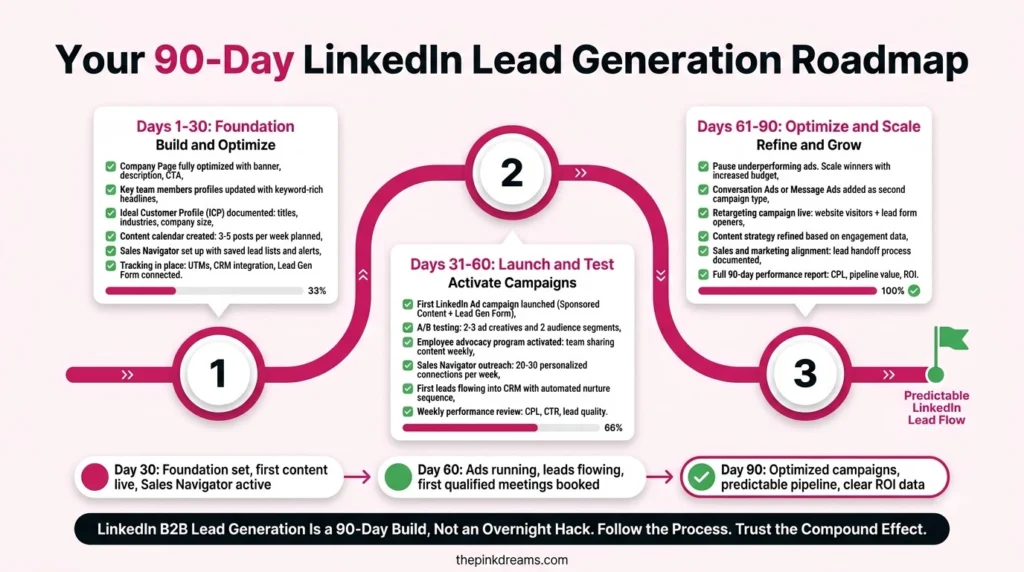
Your First 90 Days
| Period | Focus | What should exist by the end |
| Weeks 1 to 2 | Foundation | Optimised profiles and company page, written audience definition, offer defined |
| Weeks 3 to 6 | Organic | Saved prospect searches, daily commenting habit, two to three posts a week |
| Weeks 7 to 10 | Outreach | Segmented lists, tested connection and follow-up messaging, reply owner assigned |
| Weeks 11 to 13 | Paid and review | One ad format on one audience, first reply-rate and meeting data reviewed |
Start with one step and add the next. Attempting all eight at once produces a burst of activity and no habit.
And if you would rather have specialists build and manage your LinkedIn lead generation strategy, Pink Dreams can help. Pink Dreams helps B2B businesses use LinkedIn marketing, content, outreach, and paid campaigns to reach the right decision-makers and generate qualified leads. Our wider digital marketing services help turn that visibility into measurable pipeline and booked conversations. Request a free digital presence audit to see where you stand.
FAQ
How long does LinkedIn lead generation take to produce results?
Expect early replies and conversations within four to six weeks if outreach is running, and a steady flow of meetings between month three and month six. Organic content compounds slowly, so the businesses that succeed are usually the ones still posting when competitors have stopped. Paid can produce leads faster but performs better once organic credibility exists.
Are LinkedIn Lead Gen Forms better than sending people to a landing page?
Lead Gen Forms usually convert at a higher rate because the form pre-fills from the prospect’s profile and there is nothing to type. The trade-off is quality: the reduced friction attracts casual sign-ups, so qualify quickly and follow up within hours. Landing pages filter harder but lose volume.
Do I need a Sales Navigator for B2B lead generation on LinkedIn?
Not to start. The free search filters are sufficient for building an initial prospect list and testing messaging. Sales Navigator becomes worthwhile once someone is prospecting weekly, because the advanced filters, saved searches, and lead recommendations save hours of manual research every month.
How much should I budget for LinkedIn lead generation?
Costs come from subscriptions, ad spend, tooling, and time or agency fees, and vary considerably by market. Rather than chasing an average, calculate how many meetings per month would cover your total spend using your deal value, margin, and close rate. If break-even is one or two meetings, the investment usually makes sense.
Can LinkedIn lead generation be automated?
Parts of it can, such as scheduling posts, saved searches, and CRM syncing. Automating connection requests and messages carries real risk, including restrictions on your account and an audience that never engages. The steps that produce meetings, warming and replying, are the ones automation handles the worst.

Digital Marketing Strategist & Business Coach
As a leading digital marketing strategist and business coach, he is responsible for helping entrepreneurs and brands grow faster in a smarter, more scalable way. With over 20 years of experience, Nagarajan specializes in practical coaching, automation-first marketing strategies, and technology-driven growth systems. His work focuses on enhancing brand visibility, improving performance, and building sustainable frameworks that enable long-term business success.