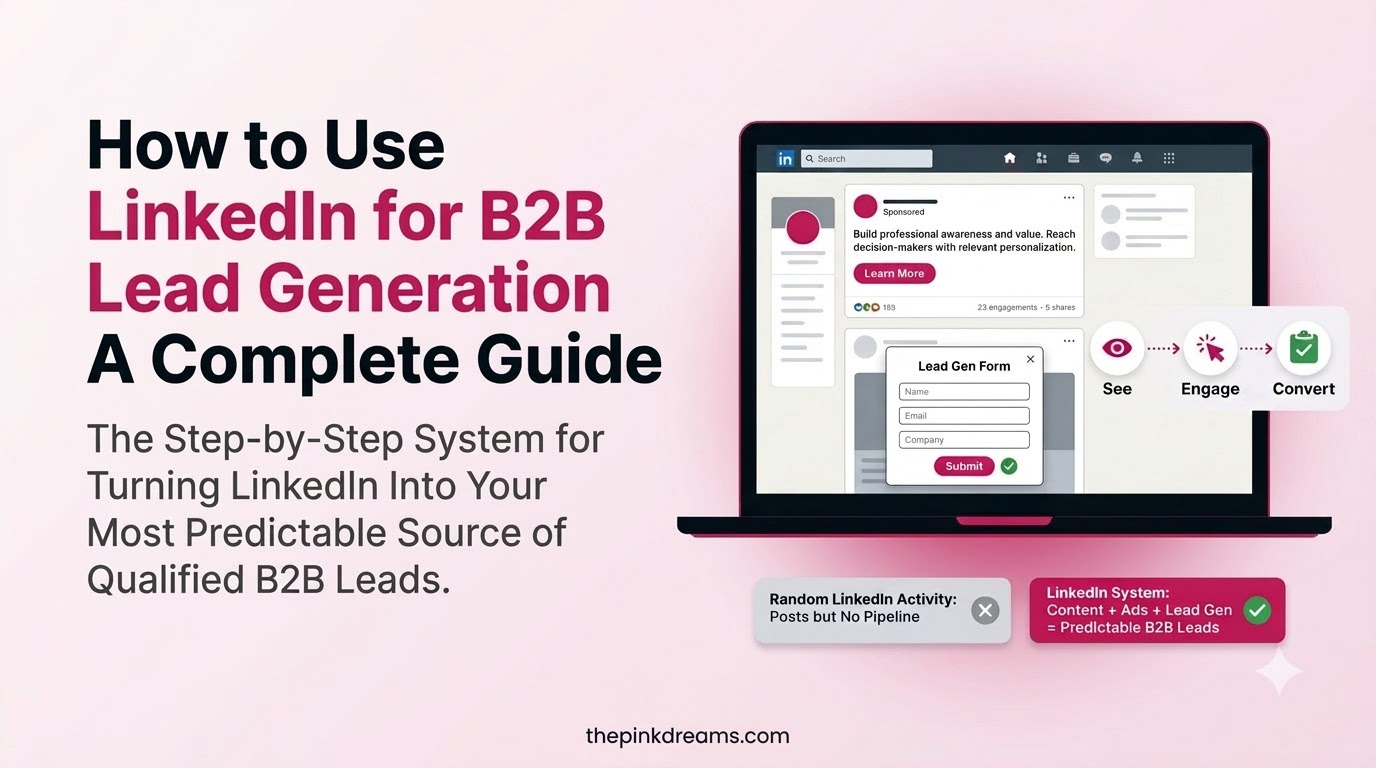




How to use LinkedIn for marketing to build trust, generate qualified leads, and turn consistent content into a predictable B2B pipeline.
Most businesses treat LinkedIn as a place to announce things. Post the award, post the new hire, post the office photo, wonder why nobody enquires. The businesses generating real pipelines are doing something structurally different.
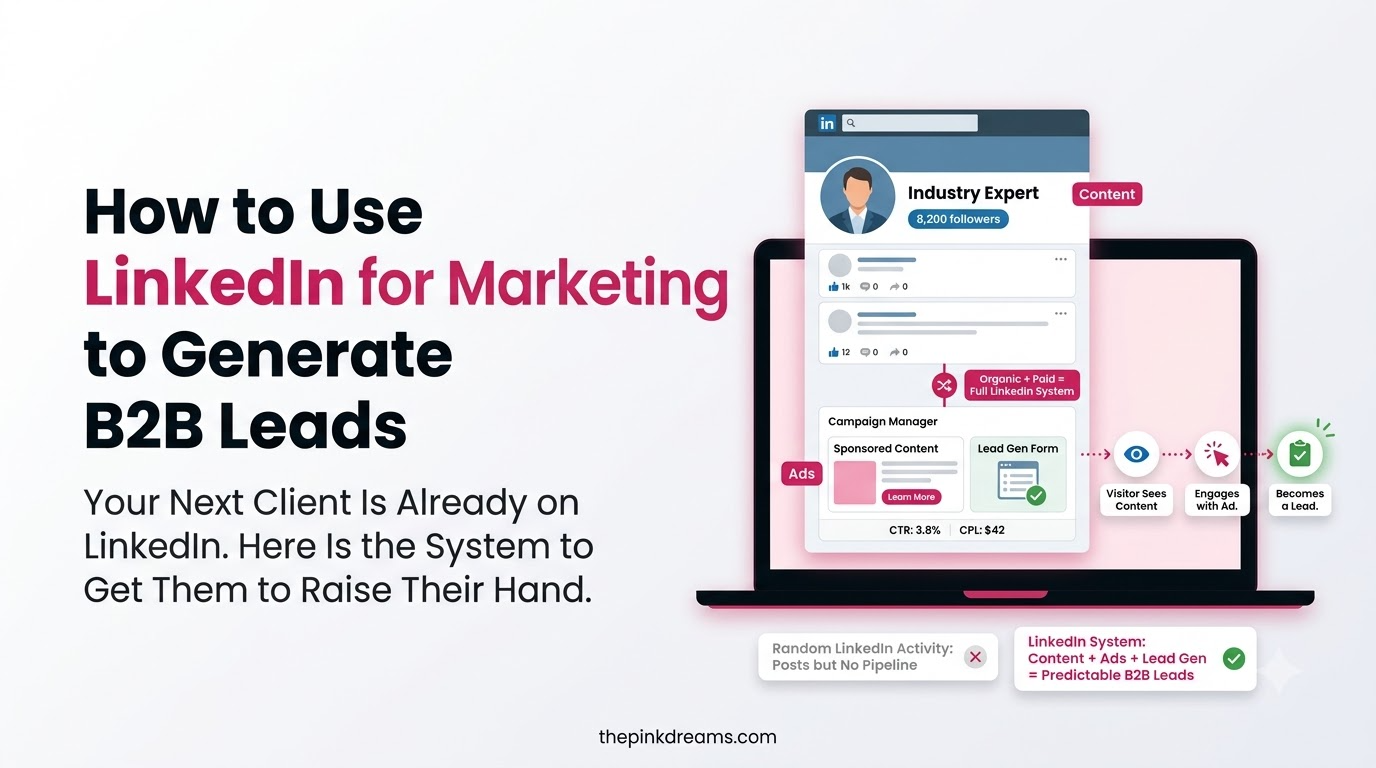
Here is how to use LinkedIn for marketing in practice: optimize the profile and page people land on, define exactly who you want to reach, publish content those people find useful, engage in conversations rather than broadcasting at them, and use paid formats to amplify what already works. LinkedIn marketing rewards consistency and relevance more than budget, which makes it one of the few channels where a small team can beat a large one. It also sits naturally alongside the rest of your digital marketing services.
This guide covers twelve strategies, which ad formats to use, how much time it realistically takes each week, and how to measure whether any of it is working.
Key Takeaways
- LinkedIn marketing works when it is treated as a publishing and relationship channel, not an announcement board.
- Personal profiles consistently out-reach company pages, so the page supports credibility while people carry the reach.
- Define the audience before creating anything. Content aimed at everyone reaches nobody worth reaching.
- Comments and saves matter more than likes, because they signal genuine professional value.
- Paid works best when it amplifies posts that already earned engagement organically.
- Consistency beats volume. Three useful posts a week beats fifteen forgettable ones.
- Measure pipeline, not vanity metrics. Impressions without enquiries mean the audience or the message is wrong.
How LinkedIn Marketing Actually Works
LinkedIn marketing is the practice of using LinkedIn’s profiles, pages, content formats, messaging, and advertising tools to build visibility with a professional audience and turn that visibility into enquiries. It covers both organic activity and paid campaigns, and it works because people arrive on LinkedIn in a work mindset rather than a leisure one.
It suits businesses selling to other businesses, professional services, recruiters, consultants, software companies, and anyone whose buyer can be identified by job title, industry, or company size. It suits consumer businesses far less well, because the targeting advantage disappears when your buyer is defined by lifestyle rather than profession.
The distinction that matters most is intent. People do not open LinkedIn to buy. They open it to learn, hire, network, and stay current. Marketing that respects that mindset performs. Marketing that ignores it gets scrolled past.
Key Takeaway: LinkedIn is a professional discovery channel, not a purchase channel. The goal is to be known and trusted before the buying conversation starts.
Building a LinkedIn Marketing Strategy Before You Post
A LinkedIn marketing strategy answers four questions before any content is created: who you are trying to reach, what those people need to know, what you want them to do next, and how you will tell whether it worked. Skipping this stage is why most LinkedIn activity produces engagement but no enquiries.
• Define the audience precisely: job titles, seniority, industries, company sizes, and locations. If you cannot describe them in a sentence, you cannot target them.
• Identify what they need to know: the questions they ask before buying, the mistakes they make, the decisions they are weighing.
• Choose one primary action: a reply, a booked call, a download, a follow. Content that asks for everything gets none of it.
• Decide how you will measure: agree upfront that enquiries matter and impressions are diagnostic, not the goal.
Write this down in a single page and revisit it quarterly. Most LinkedIn strategies fail quietly because nobody wrote down who the audience was, so the content gradually drifts toward whatever gets applause from peers rather than attention from buyers.
Key Takeaway: One page defining audience, message, action, and measurement prevents most of the wasted effort on LinkedIn.
How to Use LinkedIn for Marketing: 12 Proven Strategies
These twelve strategies cover the full sequence: the assets people land on, the content that earns attention, the conversations that create opportunities, and the paid formats that scale what works. Work through them in order, because the later strategies depend on the earlier ones being in place.
1. Rebuild your personal profile as a landing page
Your profile is not a CV. It is the page every person you engage with will check before deciding whether you are worth replying to. Write the headline for the buyer rather than the employer: what you do, for whom, and what changes as a result. Use the About section to describe the problem you solve, not your career history.
Add a professional photo, a banner that states what the business does, and featured links to the pages you actually want people to visit. Then check it on a phone, because that is where most people will see it.
2. Build a company page that survives scrutiny
The company page rarely drives reach on its own, but it is where prospects verify that a real business sits behind the person they are talking to. An empty or half-finished page undermines everything else. Complete every field, add a clear description of what you do and who you serve, keep the logo and banner current, and post consistently enough that the page does not look abandoned.
This is the foundation of how to promote your company on LinkedIn: not the page doing the promoting, but the page confirming you are credible when someone checks.
3. Optimize both profile and page for search
People search LinkedIn the way they search Google, and LinkedIn pages sometimes surface in Google results too. Include the terms your buyers actually use in your headline, About section, page description, and specialities. Avoid internal jargon and invented job titles, because nobody searches for those.
Link to the page from your website and encourage staff to list the company correctly on their own profiles, which strengthens the association between people and business.
4. Define and build your target audience list
Before publishing anything, build a clear picture of who you want in the audience. Use LinkedIn search filters to see how many people actually match your criteria. If the number is tiny, your targeting is too narrow. If it is enormous, it is too broad to write usefully for.
This list becomes the reference point for everything else: what content to write, who to connect with, and how to configure ad targeting later.
5. Publish content your buyers actually need
The content that performs answers a real question, shares something learned the hard way, or takes a clear position on something contested in your industry. Company news performs poorly because it serves you rather than the reader. Plan a simple mix and stick to it, which is far easier when it feeds from the same plan as your wider content marketing services.
• Practical how-to posts that solve a specific problem
• Lessons from real projects, including what went wrong
• Clear opinions on industry debates, argued properly
• Explainers that make a complicated decision simpler
• Occasional proof: results, examples, and client outcomes
6. Use the formats the feed rewards
Native formats consistently outperform posts that push people off the platform. Document posts and carousels hold attention because people swipe through them. Native video works when the first few seconds give a reason to keep watching. Text posts still perform well when the opening line earns the click on ‘see more’.
Put links in the first comment rather than the post body when you can, and write the opening two lines as if they are the whole post, because for most readers they are.
7. Post from people, not only from the page
Personal profiles reach dramatically further than company pages, because the feed favours person-to-person connection. The most effective approach is a small group of people inside the business posting in their own voice, with the company page supporting rather than leading.
Give employees topics, not scripts. An identical copy posted by six colleagues on the same morning is obvious and does more harm than silence.
8. Turn engagement into conversation
This is where LinkedIn marketing and networking overlap, and where most businesses stop too early. Commenting thoughtfully on posts from your target audience puts you in front of them without asking for anything. Do it consistently and people recognise your name before you ever message them.
Reply to every comment on your own posts, ideally within the first couple of hours while distribution is still being decided. A post with a real conversation underneath it travels considerably further than one with silent likes.
9. Use Groups and Events to build an audience you own
LinkedIn Events are underused. A recurring short webinar or clinic gives people a reason to register, gives you a list of interested professionals, and creates content you can reuse for weeks afterwards. Groups work when you participate genuinely and badly when you treat them as a place to drop links.
Both work because they attract people who self-select as interested, which is a much better starting point than cold outreach.
10. Send messages that earn replies
Connection requests without a note perform poorly, and templated pitches perform worse. Reference something specific: a post they wrote, a shared group, a problem their industry is facing. Ask a question rather than pitching, and do not attach a calendar link to a first message.
Follow up once, add something useful, and stop. Persistence past that point damages the brand you spent months building through content.
11. Run ads that amplify what already works
The most reliable use of LinkedIn advertising is promoting content that already earned engagement organically. You already know the message resonates, so paid distribution simply extends the reach to people who do not follow you yet. Targeting by job title, industry, seniority, and company size is the platform’s genuine advantage, and it is worth managing properly alongside your other paid search and paid social management.
Costs per click are typically higher than other social platforms, so calculate what a qualified inquiry is worth to you before deciding whether the maths works.
12. Use Lead Gen Forms to remove friction
Lead Gen Forms let someone submit their details inside LinkedIn using information already on their profile, rather than being sent to a landing page. Conversion rates are usually higher because there is nothing to type.
The trade-off is quality. Low friction means some sign-ups are casual, so qualify quickly and follow up fast. A lead that goes cold for three days is usually gone.
Key Takeaway: Assets first, then content, then conversation, then paid. Advertising before the first three are in place amplifies a message that was not working.
Which LinkedIn Ad Format Should You Use?
LinkedIn offers several ad formats and they solve different problems. Sponsored Content suits reach new people in the feed, Lead Gen Forms suit capturing details with minimal friction, and Message Ads suit direct offers to a narrow, well-chosen list. Choose the format by the objective, not by what looks impressive.
| Ad format | Best for | Watch out for |
| Sponsored Content | Reaching a cold audience in the feed with your best-performing posts | Promoting sales-heavy posts that nobody engaged with organically |
| Lead Gen Forms | Capturing details without sending people to a landing page | Volume without quality, since the low friction attracts casual sign-ups |
| Message Ads | Direct, personal offers such as event invitations or demos | Cost per send, and irritating people if the message reads like a template |
| Dynamic Ads | Follower growth and personalised sidebar visibility | Limited creative space and lower intent than feed placements |
| Text Ads | Cheap testing of messages and audiences | Low visibility, so treat it as a testing channel rather than a main one |
| Video ads | Explaining a complex product or building familiarity | Losing viewers in the opening seconds if the hook is weak |
Start with one format and one clearly defined audience. Running four formats at once with a small budget produces data too thin to learn from, which is the most common reason businesses conclude that LinkedIn ads do not work for them.
Key Takeaway: One format, one audience, one message, until you have enough data to judge it. Then expand.
Personal Profile or Company Page: Which Actually Drives Reach?
Personal profiles reach further than company pages, and it is not close. The feed is built to connect people to people, so a post from a named individual with a face attached will typically outperform the identical post from a company page. This changes how you should allocate effort.
That does not make the page pointless. It does a job the profiles cannot: it confirms the business is real, holds the credentials and case studies, hosts your ads, and gives prospects somewhere to check you out quietly before making contact. Think of the page as the shop front and the profiles as the people standing outside talking to customers.
Practically, this means the founder and two or three client-facing colleagues should carry most of the posting, with the page publishing less often and focusing on proof, announcements, and content that supports what the people are saying.
Key Takeaway: People carry reach, pages carry credibility. Resource them accordingly instead of pouring everything into the page.
How Much Time Does LinkedIn Marketing Actually Take?
Realistically, LinkedIn marketing takes about four to six hours a week to do properly for a small business, spread across posting, replying, commenting, and outreach. Most of that time is content creation. The businesses that fail usually underestimate the commenting and replying, which is where the compounding actually happens.
| Activity | Frequency | Time needed | Who does it |
| Publish a post from a personal profile | 3 to 5 times a week | 20 to 40 minutes each | Founder or subject expert |
| Publish from the company page | 2 to 3 times a week | 15 minutes each | Marketing |
| Reply to comments on your posts | Daily, first two hours after posting | 15 minutes a day | Whoever posted |
| Comment on other people’s posts | Daily | 15 minutes a day | Anyone client-facing |
| Connection requests and follow-ups | Weekly batch | 45 minutes a week | Sales or founder |
| Review analytics and adjust | Monthly | 1 hour | Marketing |
| Review and optimize ads | Weekly while running | 30 minutes a week | Marketing or agency |
The single most common failure is doing this intensively for three weeks and then stopping. LinkedIn rewards sustained presence, and the results generally arrive somewhere between month three and month six. A schedule you can maintain for a year beats an ambitious one you abandon in March.
Key Takeaway: Budget four to six hours a week and protect it. Consistency over six months matters more than intensity over six weeks.
Organic or Paid: When to Post and When to Pay
Organic LinkedIn builds trust slowly and costs time. Paid LinkedIn buys reach immediately and costs money. Most businesses need both, but in a specific order: organic first to find out what message works, then paid to put that proven message in front of people who have never heard of you.
• Start organic if: you are unsure what message resonates, your budget is limited, or you are building personal authority from scratch.
• Add paid if: you have posts that consistently earn engagement, a defined target audience, and a clear value per enquiry.
• Use paid alone if: you have a hard deadline such as an event, and accept the cost per lead will be higher without organic credibility behind it.
The mistake is treating them as alternatives. Paid campaigns perform noticeably better when the person or brand in the ad is already familiar to the audience, which is exactly what organic activity produces.
Key Takeaway: Organic tells you what to say. Paid decides how many people hear it. Doing paid first means paying to distribute an untested message.
How to Measure LinkedIn Marketing Properly
Measure LinkedIn on whether it produced conversations and enquiries, not on impressions. Reach and engagement are diagnostic figures that explain what is happening, but they are not the goal. A post with modest reach among exactly the right people is worth more than a viral post read by nobody who could ever buy from you.
| Stage | Metric to watch | What it actually tells you |
| Reach | Impressions and unique members reached | Whether the algorithm is distributing your content at all |
| Engagement | Comments and saves, not likes | Whether the content was worth someone’s professional reputation |
| Audience quality | Follower job titles and companies | Whether you are reaching buyers or just other marketers |
| Interest | Profile views and page visits after posting | Whether content is prompting people to check you out |
| Conversion | Website clicks, form fills, and connection acceptances | Whether interest is turning into contact |
| Pipeline | Enquiries and opportunities sourced from LinkedIn | Whether any of the above is producing revenue |
Track where enquiries actually came from by asking every new contact directly, because attribution on LinkedIn is unreliable. Someone may read your posts for four months and then arrive through a Google search of your company name, and analytics will credit that to the search.
Key Takeaway: Judge LinkedIn on enquiries and audience quality. Impressions explain performance; they do not measure success.
LinkedIn Marketing Mistakes That Waste Your Time
• Posting only company news: announcements serve you, not the reader, and the feed treats them accordingly.
• Pitching in the first message: it converts poorly and burns a contact you cannot easily approach again.
• Relying on the company page alone: you are choosing the format with the least reach.
• Automating connection requests carelessly: it risks the account and produces an audience that never engages.
• Posting and disappearing: the first two hours of replies substantially affect how far a post travels.
• Writing for peers instead of buyers: applause from your own industry is not a pipeline.
• Advertising before testing organically: paying to distribute a message you have not validated.
• Quitting at week six: results typically appear between month three and month six.
Key Takeaway: Most LinkedIn failure is impatience or self-interest. Useful content, real conversation, and six months of consistency solve almost all of it.
Making LinkedIn Marketing Work for Your Business
Knowing how to use LinkedIn for business marketing comes down to a sequence rather than a trick. Fix the profile and page so people who check you out are reassured. Decide precisely who you are talking to. Publish things those people find genuinely useful. Reply to everyone. Then, once you know what resonates, pay to put it in front of more of the right people.
None of that requires a large budget or a content team. It requires someone in the business who is willing to be visible, and a schedule that survives a busy month. That is the actual barrier, and it is why so few competitors do this consistently, which is precisely what makes it worth doing.
Start with one strategy from the twelve, run it for a month, and add the next. Twelve at once produces a burst of activity and no habit. One at a time produces a system.
And if you would rather have specialists build and manage your LinkedIn strategy, Pink Dreams can help. Pink Dreams helps B2B businesses use LinkedIn marketing, content, and lead generation strategies to reach the right decision-makers and turn professional visibility into qualified leads. Our social media marketing services and wider growth work audit your current visibility, build a customized roadmap, and execute the content, campaign, and lead generation work that turns LinkedIn activity into booked conversations. Request a free digital presence audit to see where you stand.
FAQ
How do I use LinkedIn for marketing if I have no followers?
Start by commenting consistently on posts from people you want to reach, rather than posting into silence. Commenting puts you in front of their audiences before you have one of your own. Combine it with three useful posts a week and targeted connection requests, and a usable audience typically builds over two to three months.
How do I promote my business on LinkedIn without paying for ads?
Post consistently from personal profiles rather than the company page, answer questions your buyers actually ask, comment daily on posts from your target audience, and use Events to attract people who self-select as interested. Organic LinkedIn works well precisely because most businesses give up before it compounds.
How often should I post on LinkedIn?
Three to five times a week from a personal profile and two to three times from the company page is a sustainable rhythm for most small businesses. Consistency matters more than frequency. Three good posts every week for a year outperforms daily posting for six weeks followed by silence.
Does LinkedIn marketing work for small businesses?
Yes, often better than for large ones, because personal profiles out-reach company pages and a founder posting in their own voice is more credible than a corporate account. The constraint is time and willingness to be visible rather than budget.
Are LinkedIn ads worth it?
They can be, when the value of a qualified enquiry justifies the cost per click, which tends to be higher than other social platforms. They work best amplifying content that is already performed organically, and they work poorly as a first step before you know what message resonates with your audience.

Digital Marketing Strategist & Business Coach
As a leading digital marketing strategist and business coach, he is responsible for helping entrepreneurs and brands grow faster in a smarter, more scalable way. With over 20 years of experience, Nagarajan specializes in practical coaching, automation-first marketing strategies, and technology-driven growth systems. His work focuses on enhancing brand visibility, improving performance, and building sustainable frameworks that enable long-term business success.