




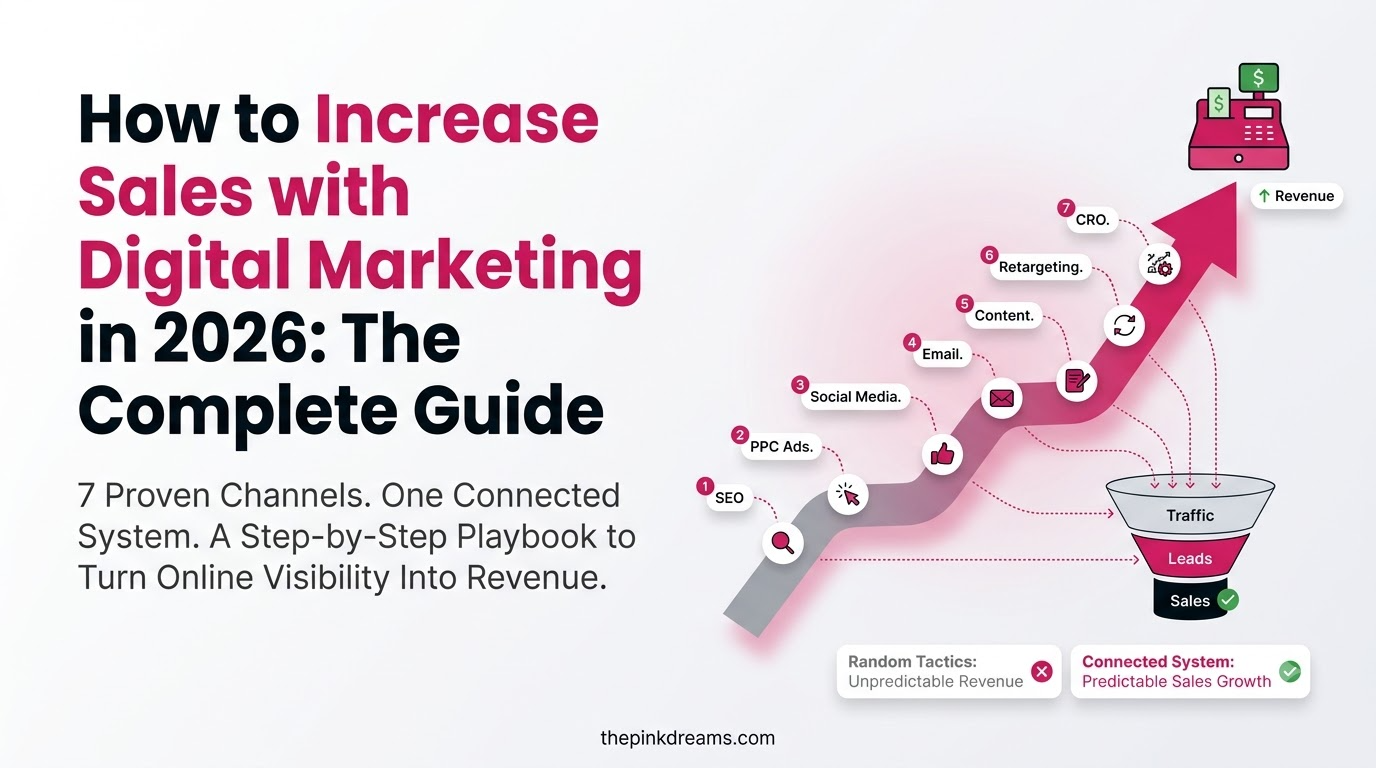
How to increase sales through digital marketing, which strategies produce results fastest, and how to turn more online activity into revenue.
How to increase sales through digital marketing, which strategies produce results fastest, and how to turn more online activity into revenue.
Most businesses asking how to grow online are actually asking the wrong question. They want more traffic. What they need is more of the traffic they already have turning into sales.
The short version of how to increase sales through digital marketing is this: capture people already searching for what you sell, remove the friction stopping them from buying, follow up with the ones who nearly did, and sell again to the ones who already have. Traffic growth is the slowest of the four and the one most businesses start with. Getting the sequence right is what separates digital marketing services that produce revenue from activity that just produces reports.
This guide covers ten strategies that increase sales, which channels produce results fastest, how to map activity to your sales funnel, and how to measure whether any of it worked.
Key Takeaways
- More traffic is the slowest route to more sales. Fixing conversion is usually faster and cheaper.
- Capture existing demand before spending to create new demand.
- Most lost sales happen after the click, in the checkout, the form, or the follow-up.
- Retargeting and email recover revenue you have already paid to attract.
- Selling more to existing customers costs less than winning new ones.
- Paid search sells fastest. SEO sells longest. Most businesses need both, in that order.
- Measure revenue and cost per acquisition, not impressions, or you will scale the wrong thing.
How Does Digital Marketing Actually Increase Sales?
Digital marketing increases sales in four ways: it puts you in front of people already looking to buy, it removes the friction that stops interested people from purchasing, it recovers buyers who left without completing, and it brings existing customers back. Everything else supports one of those four mechanisms.
This matters because most marketing budgets are spent on the first mechanism alone. Attracting more visitors is visible, measurable, and satisfying. But if your website converts poorly, doubling traffic simply doubles the number of people who leave without buying, at twice the cost.
The businesses that grow fastest usually improve the middle two first. They cost less, work faster, and make every subsequent pound spent on traffic worth more.
Key Takeaway: Attract, convert, recover, retain. Most businesses only fund the first one and wonder why the numbers do not move.
Before You Spend Anything: Three Things That Block Sales
No amount of digital marketing fixes a weak offer, an undefined audience, or a website that does not sell. If any of these three is broken, marketing spend accelerates the problem rather than solving it. Check all three before adding budget to any channel.
1. The offer
If people visit and do not buy, the problem is often the offer rather than the marketing. Is the price defensible against what else they can buy? Is the guarantee reassuring enough to remove the risk? Is it clear within seconds what they get? Marketing amplifies an offer. It does not repair one.
2. The audience
Marketing to everyone converts nobody. You should be able to describe your best customer in a sentence: who they are, what problem brings them to you, and what they compare you against. Without that, targeting is guesswork and the messaging stays generic.
3. The website
Slow pages, unclear navigation, hidden pricing, long forms, and no obvious next step all cost sales quietly. Open your own site on a phone and try to buy something or send an inquiry. Most businesses find at least two obstacles they had never noticed.
Key Takeaway: Offer, audience, website. Fix these first, because every pound spent on traffic multiplies whatever is already there, good or bad.
How to Increase Sales Through Digital Marketing: 10 Strategies for 2026
These ten strategies are ordered by how quickly they typically produce revenue. Start near the top if you need sales this quarter, and work down as the faster wins are exhausted. Most businesses can implement the first four within a month.
1. Capture the demand that already exists
People searching for what you sell are the warmest audience available, and they cost the least to convert because you do not have to convince them they have a problem. Make sure you appear for those searches through both paid results and organic ones. Solid SEO services take longer to work but keep producing sales after the budget stops, which is why the two belong together rather than in competition.
2. Turn your website into something that sells
Most business websites describe the company. Selling websites answer the buyer’s questions: what this costs, why it is better, what happens next, and what if it goes wrong. Put the answer to each of those within reach on every important page, and put a clear action at the end of every one.
3. Remove friction from checkout and enquiry forms
Every extra field, every unexpected charge, and every forced account creation costs sales. Reduce forms to what you genuinely need, show total costs early, offer the payment methods your buyers expect, and make sure the whole flow works cleanly on a phone. This is the cheapest sales increase available to most businesses.
4. Use paid ads to buy information before buying sales
Paid campaigns produce results within days, which makes them useful for learning as well as selling. Run them to discover which messages, products, and audiences convert, then apply those findings to your organic content and website. Managed properly, paid search and paid social management funds itself while teaching you what the rest of your marketing should say.
5. Win the trust decision with proof
Buyers rarely hesitate because they do not understand the product. They hesitate because they are not sure about you. Reviews, case studies, named testimonials, real photography, clear guarantees, and visible contact details all resolve that doubt. Collect reviews systematically rather than hoping for them.
6. Build an email list and actually sell to it
Email is the only audience you own outright, and it consistently produces revenue at a lower cost than paid channels. Give people a genuine reason to subscribe, then send useful messages rather than constant promotions. Automate the essentials: a welcome sequence, a post-purchase sequence, and a lapsed-customer sequence.
7. Recover the sales you nearly made
Most people who visit will leave without buying. Retargeting brings them back, and abandoned cart or abandoned enquiry emails recover a meaningful share of them. This is revenue you have already paid to attract, which makes it the highest-return activity in most accounts. Keep the frequency sensible so it feels like a reminder rather than pursuit.
8. Use short-form video to shorten the decision
Video answers objections faster than text and builds familiarity before the first conversation. A demonstration, a walkthrough, an honest answer to a common concern, or a customer explaining their result will each do more selling than a polished brand film. Fold it into your existing content marketing services rather than treating it as a separate project.
9. Optimize for AI answers, not only for Google
A growing share of buyers now ask an AI assistant before they search. Those systems draw on clear, well-structured, trustworthy content and consistent business information across the web. Answer real questions directly, use structured data, and keep your business details identical everywhere so AI systems describe you accurately.
10. Sell more to the customers you already have
Winning a new customer costs considerably more than selling again to an existing one. Post-purchase email, related product recommendations, service reminders, loyalty offers, and simply asking for the referral all increase revenue without increasing traffic. Most businesses ignore this entirely.
Key Takeaway: Strategies one to four produce sales within weeks. Five to ten compounds. Start at the top and work down rather than attempting all ten at once.
Which Digital Marketing Channel Increases Sales Fastest?
Paid search produces sales fastest because it puts you in front of people actively searching to buy. Conversion optimization is close behind and costs less. SEO and content take three to six months but keep producing sales after spending stops. The right mix depends on how quickly you need revenue and how long you can invest.
| Channel | Speed to sales | Cost profile | Increases sales best when |
| Paid search | Days | High and ongoing | People are already searching for what you sell |
| Conversion optimization | Days to weeks | Low, mostly time | You already have traffic that is not converting |
| Email and automation | Weeks | Low | You have a list or a customer base to sell to again |
| Retargeting | Weeks | Moderate | Enough people visit but leave without buying |
| Reviews and social proof | Weeks | Free to low | Buyers hesitate because they do not trust you yet |
| Paid social | Weeks | Moderate to high | You need to create demand rather than capture it |
| SEO and content | 3 to 6 months | Moderate | You want sales that continue after spending stops |
Read this urgently. If you need sales this quarter, the top four rows are where the budget belongs. If you are building something durable, the bottom rows matter more, because paid channels stop the moment the card stops.
Key Takeaway: Fast channels buy time. Slow channels buy independence. Run both, but fund the fast ones first if cash flow is the constraint.
Mapping Digital Marketing to Your Sales Funnel
Sales increase when every stage of the buying journey is covered. Most businesses fund awareness and purchase while leaving consideration, recovery, and retention empty, which is why traffic rises without revenue following. Each stage needs different activity and a different measure of success.
| Stage | What the buyer is doing | What increases sales here | Metric |
| Awareness | Realising they have a problem | Search content, video, paid social | Reach and new visitors |
| Consideration | Comparing you against alternatives | Comparison pages, reviews, case studies | Return visits, time on page |
| Intent | Actively looking to buy | Paid search, product pages, clear pricing | Add to cart, enquiries |
| Purchase | Deciding to complete | Checkout speed, trust signals, guarantees | Conversion rate |
| Recovery | Leaving without buying | Retargeting, abandoned cart email | Recovered revenue |
| Retention | Deciding whether to buy again | Email, loyalty offers, post-purchase care | Repeat rate, lifetime value |
The two stages that most often sit empty are recovery and retention, and they are the two with the best economics because the customer already knows you. If you only fix one gap this quarter, fix one of those.
Key Takeaway: Find your empty funnel stage before adding budget anywhere else. That gap is usually where the missing revenue is.
Conversion Rate Optimization: The Cheapest Way to Increase Sales
Conversion rate optimization increases revenue without increasing traffic, which makes it the cheapest growth available to a business that already has visitors. A modest improvement in conversion rate raises revenue from every channel simultaneously, including the paid traffic you are already buying.
• Speed: slow pages lose buyers before they see the offer, and mobile is where most of the damage happens.
• Clarity: if a visitor cannot tell what you sell and what to do next within seconds, they leave.
• Friction: every additional form field, step, or required account costs a percentage of buyers.
• Trust: reviews, guarantees, secure payment marks, and real contact details near the point of decision.
• Cost transparency: surprise shipping or fees at the final step is among the most common reasons carts are abandoned.
Start where the money leaks. Look at which pages get traffic but produce no action, and which step of your checkout or enquiry process loses the most people. Fix those before redesigning anything.
Key Takeaway: Improving conversion lifts revenue from every channel at once. It is almost always cheaper than buying more traffic.
How to Test What Actually Increases Sales
Testing replaces opinion with evidence. Run one change at a time against the current version, send comparable traffic to both, and let it run long enough to produce a meaningful result rather than stopping the moment one looks better. Most early leads reverse.
• Test one variable at a time, or you will not know which change caused the result
• Run for a full sales cycle, including weekends, before deciding
• Prioritise high-traffic, high-value pages, because tests on low-traffic pages take forever to conclude
• Test the things that affect the decision: headline, offer, price presentation, call to action, form length
• Record what you learned even when the test fails, because knowing what does not work has value
Testing is not only for websites. The same approach applies to email subject lines, ad creative, landing pages, and pricing presentation. Small, repeated improvements compound faster than occasional redesigns.
Key Takeaway: One change, enough time, an honest result. Testing turns marketing from opinion into a system that improves.
How to Measure Sales from Digital Marketing
Measure digital marketing on revenue, cost per acquisition, and return on spend rather than traffic and impressions. Reach explains what is happening, but it does not tell you whether the business made money. These are the numbers that should determine where next quarter’s budget goes.
| Metric | What it tells you | Act on it when |
| Revenue by channel | Which activity actually produced sales | One channel carries everything and the rest drain budget |
| Conversion rate | Whether traffic turns into buyers | Traffic rises but sales stay flat |
| Cost per acquisition | What each new customer costs to win | It approaches or exceeds your gross margin |
| Return on ad spend | Revenue produced per unit of ad spend | It falls below the level your margins can sustain |
| Average order value | How much each sale is worth | You need more revenue without more traffic |
| Customer lifetime value | What a customer is worth over time | Deciding how much you can afford to pay to acquire one |
| Cart or form abandonment | Where buyers give up | It rises after any website or checkout change |
Attribution is imperfect, so support the data by asking every new customer how they found you. Someone may read your content for months and then arrive through a branded search, and analytics will credit the sale entirely to search.
Key Takeaway: If a channel cannot be tied to revenue or cost per acquisition, you cannot make a budget decision about it.
Why Digital Marketing Fails to Increase Sales
• Chasing traffic instead of conversion: more visitors to a site that does not sell simply costs more.
• Spreading budget across too many channels: six channels run thinly produce less than two run properly.
• No follow-up system: enquiries that go unanswered for two days are usually lost to whoever replied first.
• Ignoring existing customers: the cheapest revenue in the business goes unclaimed.
• Judging slow channels on fast timelines: cancelling SEO at week eight guarantees the investment is wasted.
• Measuring the wrong things: impressions and followers feel like progress but do not pay wages.
• Sending paid traffic to the homepage: buyers need the page about the thing they clicked, not a general introduction.
• Changing everything at once: when results move, nobody knows which change did it.
Key Takeaway: Most failures are structural rather than creative. Fix the sequence and the follow-up before rewriting the ads.
How Long Before Digital Marketing Starts Increasing Sales?
Paid advertising can produce sales within days. Conversion improvements usually show within two to four weeks. Email and retargeting take four to eight weeks to build enough audience to matter. SEO and content typically take three to six months, and longer in competitive markets.
That spread is why sequencing matters. A business that needs revenue now should start with paid search and conversion work, then use the cash flow those produce to fund the slower channels. A business that starts with SEO alone often runs out of patience before the results arrive.
Set expectations accordingly with whoever controls the budget. Most marketing that gets cancelled was not failing. It was being judged on a timeline that never applied to the channel in question.
Key Takeaway: Days for paid, weeks for conversion and email, months for SEO. Fund the fast channels first if you need results this quarter.
Increasing Sales with Digital Marketing in 2026
Knowing how to increase sales through digital marketing comes down to sequence rather than secrets. Make sure the offer, the audience, and the website are sound. Capture the people already searching. Remove whatever is stopping interested people from buying. Follow up with the ones who left. Then sell again to the ones who already bought.
None of that requires a large budget. It requires deciding what to fix first and resisting the temptation to run everything at once. The businesses that grow are rarely the ones doing the most marketing. They are the ones who found the specific gap between visitor and buyer and closed it.
Pick the single biggest gap in your own funnel and fix that this month. Then find the next one.
And if you would rather have specialists find and close those gaps for you, Pink Dreams can help. Pink Dreams helps businesses increase sales through SEO, content, digital marketing, and lead generation strategies designed to attract the right customers and drive measurable growth. We audit your current visibility and conversion path, build a customized roadmap, and execute the search, content, and lead generation work that turns visitors into revenue. Request a free digital presence audit to see where you stand.
FAQ
How can digital marketing increase sales quickly?
The fastest routes are paid search, which reaches people already searching to buy, and conversion improvements to your website and checkout, which increase revenue from traffic you already have. Both can show results within days or weeks. Retargeting and email follow shortly after, once enough audience has built.
How much should a small business spend to increase sales online?
There is no universal figure, because it depends on your margin, your average order value, and what a customer is worth over time. Work backwards instead: calculate what you can afford to pay to acquire one customer profitably, then test channels against that ceiling. Compare all figures in your own currency.
Does SEO or paid advertising increase sales faster?
Paid advertising is faster, producing sales within days. SEO typically takes three to six months but continues producing sales after spending stops. Most businesses need both: paid to generate revenue now, and SEO to reduce dependence on paid over time.
Why is my website getting traffic but no sales?
Usually one of four reasons: the traffic is the wrong audience, the offer is not competitive, the site does not answer the buyer’s real questions, or the checkout or enquiry process is creating friction. Check which pages get traffic without action, and where people abandon the process, before changing anything else.
Is digital marketing worth it for a small business?
Yes, and often more so than for large businesses, because precise targeting means you can compete without matching a larger competitor’s budget. The constraint is usually focus rather than money. Two channels run properly will outperform six runs occasionally.

Digital Marketing Strategist & Business Coach
As a leading digital marketing strategist and business coach, he is responsible for helping entrepreneurs and brands grow faster in a smarter, more scalable way. With over 20 years of experience, Nagarajan specializes in practical coaching, automation-first marketing strategies, and technology-driven growth systems. His work focuses on enhancing brand visibility, improving performance, and building sustainable frameworks that enable long-term business success.