



Most advertisers glance at a 0.5% LinkedIn CTR and quietly conclude the platform is broken. It isn’t. In 2026, a LinkedIn click is scarce by design, and it usually comes from a decision-maker you can’t reach anywhere else.
A good LinkedIn Ads CTR in 2026 generally sits above 0.60% for Sponsored Content, while the platform average across formats lands roughly between 0.44% and 0.65%. But the raw number only means something once you read it in context: by format, by industry, and against your own pipeline. Partnering with a LinkedIn Ads agency can help you benchmark, test, and improve CTR so your ad spend generates more qualified B2B leads. This guide breaks down realistic LinkedIn ad benchmarks for 2026, format by format and industry by industry, and shows you how to read and improve your own numbers.
Key Takeaways
- A good Sponsored Content CTR in 2026 is above 0.60%; the platform average sits near 0.44%–0.65%.
- CTR is a signal, not a scoreboard: judge LinkedIn on lead quality and pipeline, not raw clicks.
- Ad format moves the benchmark more than anything else: Document and Carousel ads run highest, Text and Dynamic lowest.
- Competitive verticals like SaaS and financial services see lower CTRs; niche categories run higher.
- Tighter targeting and sharper creative boost CTR and can lower cost per click at the same time.
- Compare your account to your own history and to LinkedIn benchmarks, never to Google or Facebook.
- The benchmarks travel across regions; costs, currencies, and competition are localized.
Why LinkedIn Ads CTR Is a Key Performance Metric
LinkedIn Ads CTR matters because it is the earliest, clearest signal of whether your creative and targeting fit the audience you’re paying to reach. A healthy click-through rate means the right people find your ad relevant enough to act. A weak one flags a mismatch long before you’ve burned the budget.
What trips people up is comparing LinkedIn to the wrong yardstick. LinkedIn is a professional feed, not a high-intent search box, so people scroll rather than hunt. CTRs look low next to Google Search or Facebook, and that’s expected. What you trade in click volume you gain in audience quality: the click tends to come from a director, VP, or buyer, not a casual browser.
That’s why CTR sits at the centre of any serious LinkedIn advertising programme. Read it as one input into a system, creative fit, audience precision, and downstream pipeline, rather than a vanity number to chase on its own.
What Counts as a Good CTR for LinkedIn Ads in 2026?
A good CTR for LinkedIn ads in 2026 generally clears 0.60% for Sponsored Content, with the platform average landing roughly between 0.44% and 0.65%. Anything in the 0.6%–1.0% range signals your creative and targeting are working. Message Ads and Document Ads often clear that bar by design, because their formats drive more engagement.
Judging LinkedIn purely on raw CTR is misleading. A 0.5% CTR that produces qualified pipeline beats a 2% CTR full of unqualified clicks. Read CTR as one signal of creative and targeting fit, then follow it downstream to leads and revenue.
Do this: Set your “good” threshold by format, not a blanket number. Compare each campaign to its own historical average and to the format-specific ranges below, not to a Google or Facebook figure.
Key Takeaway: Above 0.60% is a solid Sponsored Content CTR in 2026; context and audience quality matter more than the raw figure.
LinkedIn Ad Benchmarks by Format
Ad format influences LinkedIn Ads CTR more than almost any other factor. Single Image Sponsored Content typically achieves CTRs around 0.40%–0.65%, while interactive formats such as Carousel and Document Ads often perform better. Message Ads use a different engagement model, so their click rates should be compared only with other Message Ads.
| Ad format | Typical CTR range | Why it performs this way |
| Single Image (Sponsored Content) | ~0.40%–0.65% | Most-used format; solid, middle-of-the-road performance |
| Carousel | ~0.45%–0.70% | Swipeable, interactive; ranks near the top for CTR |
| Document Ads | ~0.50%–0.80% | Preview mechanic drives curiosity and engagement |
| Video | ~0.35%–0.55% | Optimised for views and awareness, not always clicks |
| Message Ads | click rate ~3%–6% | Measured inside the inbox; personal feel lifts engagement |
| Text & Dynamic Ads | ~0.01%–0.12% | Right-rail; cheap reach, low CTR by design |
Note: CTR ranges are directional benchmarks compiled from multiple 2025–2026 LinkedIn advertising studies and may vary by industry, audience, campaign objective, geography, and creative quality.
Do this: Test a Document or Carousel ad against your Single Image control. Interactive formats often lift CTR without raising cost per click, because higher engagement improves your relevance score in LinkedIn’s auction.
Key Takeaway: Pick your benchmark by format. A “good” number for Document Ads is a different number from Text Ads.
LinkedIn Ad Benchmarks by Industry
Your industry shifts the benchmark too. Technology and SaaS audiences, saturated with ads, often see slightly lower CTRs, while less-crowded sectors run higher. Rather than chase a universal figure, compare your campaigns to businesses targeting a similar professional audience in your vertical.
The pattern most marketers report: fiercely competitive B2B categories such as software, financial services, and professional services push CTRs toward the lower end of the range, while niche or emerging categories with less ad-inventory competition earn higher click-through rates.
This holds across every market Pinkdreams serves. A SaaS advertiser in the US, UK, Canada, Australia, or the UAE bids against a global pool of similar advertisers, so the competitive pressure travels. Costs and currencies differ by country (CAD, USD, GBP, AUD, AED), but the CTR dynamics of a crowded vertical hold up everywhere.
Do this: Set your benchmark from your own vertical and your own account history, then aim to beat it quarter over quarter rather than borrowing a figure from an unrelated case study.
Key Takeaway: Industry competition moves the benchmark; crowded verticals run lower, niche ones run higher.
How to Analyze Your LinkedIn Campaign Performance
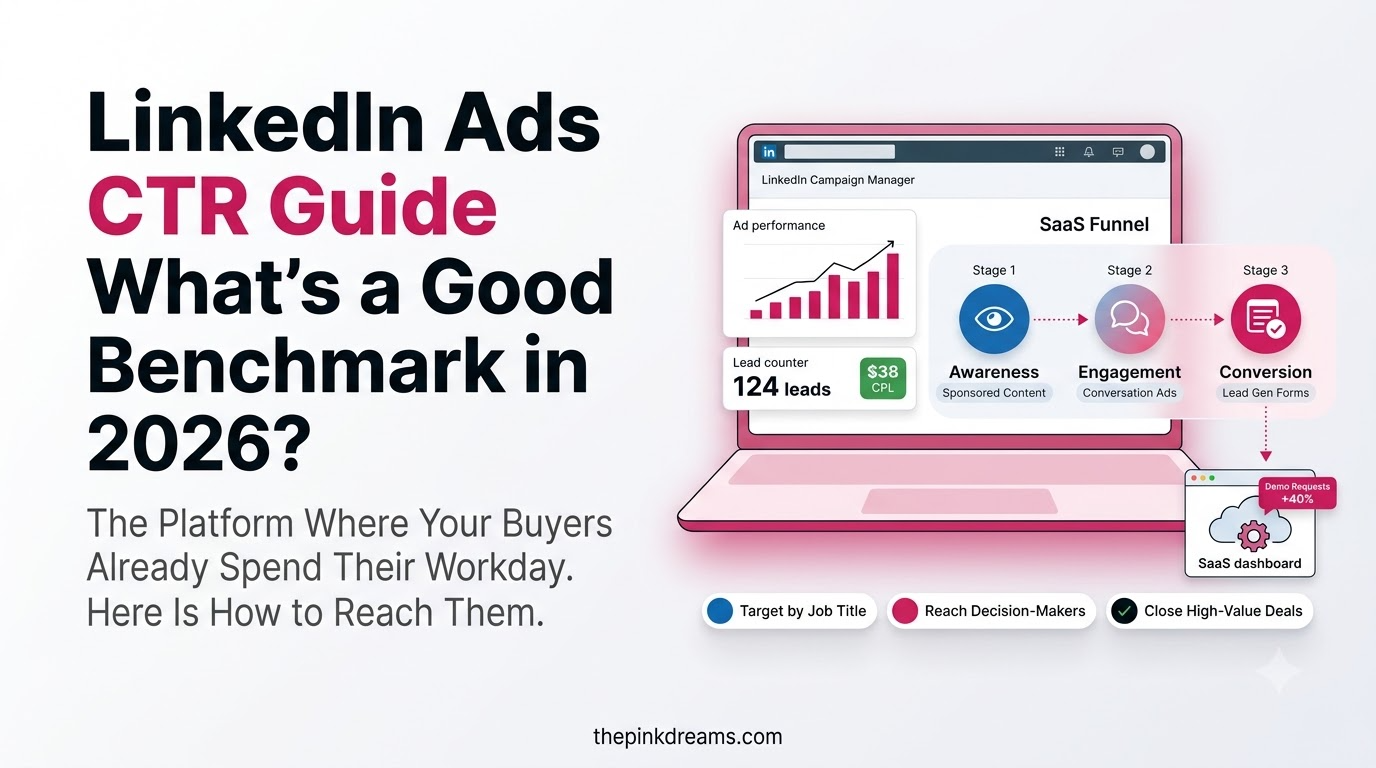
To analyze LinkedIn campaign performance properly, look past CTR alone. Pull CTR by format and by audience segment in Campaign Manager, then trace each click downstream to lead form completions, marketing-qualified leads, and pipeline. CTR tells you if the creative earns attention; the funnel tells you if it earns revenue.
1. Segment by Format
Compare Single Image, Carousel, Document, and Video separately. Averaging them hides your winners and buries your losers in the same blended number.
2. Segment by Audience
A tight, relevant audience almost always out-clicks a broad one. If CTR is low, your targeting may be too wide before your creativity is even the problem.
3. Follow the Funnel
Map CTR to landing-page or Lead Gen Form conversion, then to MQL and SQL rates. A high CTR with weak downstream conversion points at a message-to-landing-page mismatch.
4. Track Trends, Not Snapshots
A single week’s CTR is noisy. Watch the quarter-over-quarter direction against your own baseline instead of reacting to one report.
Do this: Benchmark each segment against itself over time. If your CTR climbed 20% while the vertical stayed flat, that’s a real, specific win worth scaling.
Key Takeaway: To analyze LinkedIn campaign health, read CTR by segment and always connect it to pipeline, not just clicks.
How to Boost LinkedIn CTR Without Raising Costs (Even on a Small Budget)
The fastest way to boost LinkedIn CTR is to tighten targeting and sharpen your creativity, not to spend more. Narrow your audience so every impression reaches someone who genuinely cares, then lead with a specific, benefit-driven hook and a clear call to action. Better relevance lifts CTR, lowers wasted spend, and can reduce your cost per click at the same time. Even on a limited budget, focusing on precision rather than reach helps every advertising dollar go further.
- Hyper-target beyond job titles. Layer in seniority, company size, or matched audiences so your ads reach real buyers, not just anyone with the right title.
- Write a scroll-stopping first line. Lead with the audience’s pain point or a measurable outcome instead of talking about your company.
- Test interactive formats. Compare a Single Image ad with a Document or Carousel ad to see which drives stronger engagement.
- Refresh creative before fatigue sets in. CTR naturally declines as frequency increases, so rotate new creative regularly.
- Match your landing page to the ad. If the landing page doesn’t deliver on the ad’s promise, conversions suffer even when CTR looks healthy.
- Start with a narrow audience. Tight targeting improves relevance and stretches a small budget further.
- Promote proven content. Turn high-performing organic posts into ads instead of guessing what might work.
- Test one variable at a time. Change either the audience, creative, or headline so you know exactly what improved performance.
Do this: Improve relevance, not just curiosity. A precise audience combined with a genuinely valuable offer raises CTR and relevance score together, improving cost efficiency. A professional LinkedIn ad agency typically manages this through continuous testing and optimisation rather than one-off campaign changes.
Key Takeaway: Whether your budget is large or small, the best way to improve LinkedIn CTR is to focus on precise targeting, relevant creative, and continuous testing before increasing ad spend.
Common Mistakes That Undermine LinkedIn CTR
Even a well-funded campaign can be undone by a few avoidable errors. Each quietly caps your click-through rate or wastes spend, and each has a simple fix.
Comparing the Wrong Platform: judging LinkedIn against Google or Facebook and concluding it “doesn’t work.” Benchmark LinkedIn against LinkedIn.
Optimising to a Blended CTR: averaging all formats hides a strong Document Ad behind a weak Text Ad. Segment first.
Chasing Clicks with Clickbait: you’ll lift CTR and destroy lead quality, the opposite of what LinkedIn is good for.
Targeting Too Broadly: a wide audience drags CTR down before your creative even gets a fair test.
Ignoring Creative Fatigue: running the same ad until frequency climbs and CTR quietly decays. Refresh on a schedule.
Key Takeaway: Most CTR problems come from the wrong benchmark, broad targeting, and stale creative, not from the platform. Fix those three and CTR rises.
How to Improve Your LinkedIn Ads CTR and Results
A good LinkedIn Ads CTR for Sponsored Content is generally above 0.60%, but that benchmark matters only if those clicks turn into qualified leads and revenue. LinkedIn has never been about generating the cheapest clicks. Its real value lies in helping you reach professional decision-makers who are most likely to influence buying decisions.
Treat CTR as a diagnostic rather than a success metric. If your CTR falls below the benchmark, improve your audience targeting, creative, or offer before increasing your budget. If your CTR is strong but conversions are weak, review your landing page and lead generation process instead. The goal is not simply to earn more clicks, but to build a pipeline of qualified opportunities.
If you’re ready to improve your LinkedIn campaign performance, start by benchmarking your current CTR, refining your targeting, and testing one change at a time. And if you’d rather leave it to the experts, Pinkdreams can help. As a LinkedIn Ads agency working with businesses across the US, the UK, Canada, Australia, and the UAE, we build and optimize LinkedIn advertising campaigns, connect every campaign to pipeline through B2B lead generation, and continuously test what converts. Request a free LinkedIn advertising audit to discover where your fastest CTR improvements are.
FAQ
What is a good click-through rate for LinkedIn ads in 2026?
A good CTR for LinkedIn ads in 2026 is generally above 0.60% for Sponsored Content, with the platform average sitting roughly between 0.44% and 0.65%. Reaching the 0.6% – 1.0% range usually means your creativity and targeting are landing. Message Ads and Document Ads often exceed this, since their formats naturally drive higher engagement.
Are LinkedIn ads worth it if the CTR is lower than other platforms?
Often yes. LinkedIn CTRs look low beside Google or Facebook, but the clicks come from professional decision-makers you can’t easily reach elsewhere. Whether LinkedIn ads are worth it comes down to lead quality and pipeline, not raw clicks. A modest CTR that produces qualified, sales-ready leads frequently beats a high CTR full of unqualified traffic.
How do I analyze my LinkedIn campaign the right way?
To analyze LinkedIn campaign performance, segment CTR by ad format and by audience in Campaign Manager, then follow each click through to lead form completions, MQLs, and pipeline. Track trends against your own baseline rather than one-week snapshots. Reading CTR in isolation hides your best performers and leads to poor budget decisions.
Which LinkedIn ad format has the best CTR?
Document Ads and Carousel ads typically earn the highest click-through rates because their interactive preview and swipe mechanics drive engagement. Single Image Sponsored Content sits in the middle. Message Ads report much higher click rates because engagement is measured inside the inbox. Text and Dynamic Ads have the lowest CTRs by design, offering cheap awareness-level reach.
How can I boost LinkedIn CTR without spending more?
To boost LinkedIn CTR without raising budget, narrow your targeting so every impression reaches a relevant buyer, sharpen your opening line and call to action, test interactive formats like Documents or Carousels, and refresh creative before fatigue sets in. Better relevance lifts CTR and can lower cost per click by improving your auction relevance score.

Digital Marketing Strategist & Business Coach
As a leading digital marketing strategist and business coach, he is responsible for helping entrepreneurs and brands grow faster in a smarter, more scalable way. With over 20 years of experience, Nagarajan specializes in practical coaching, automation-first marketing strategies, and technology-driven growth systems. His work focuses on enhancing brand visibility, improving performance, and building sustainable frameworks that enable long-term business success.