



Most B2B LinkedIn campaigns fail for one reason: they run a single ad at every stage of a journey that has three.
To run a B2B lead funnel with LinkedIn Ads, split your campaign into three stages: top-of-funnel awareness with cold audiences, middle-of-funnel engagement with lead gen forms and gated content, and bottom-of-funnel conversion retargeting warm prospects with demo and pricing offers. Match the ad format and message to each stage, track cost per qualified lead, and optimize continuously. If you need expert help building and scaling campaigns, partnering with a LinkedIn Ads Agency can help you generate higher-quality leads and improve your return on ad spend.
Key Takeaways
- A funnel beats a single campaign: awareness, engagement, and conversion each need their own ads.
- Cold audiences get value-first content, not a demo request. Save the hard ask for warm retargeting.
- LinkedIn Lead Gen Forms auto-fill from profiles, lifting completion rates for gated offers.
- Retarget engaged prospects at the bottom of the funnel, where intent is highest and cost per lead lowest.
- Judge the funnel on cost per qualified lead and pipeline, not clicks or impressions.
- Costs, language, and consent rules vary by region. Localise before scaling.
Why Most B2B LinkedIn Ads Campaigns Underperform
Most B2B LinkedIn campaigns underperform because they run one ad, usually a demo request, at every stage of the buying journey. But a cold audience that has never heard of you is not ready to book a demo, so the ad wastes budget on people who were never going to convert on first contact. The fix is a funnel, not a bigger bid.
LinkedIn is not a search platform. Nobody is typing your solution into a search bar with intent to buy. That means a cold audience is being served your ad without asking for it, and the click you get costs you more than a search click would. Cost per click on LinkedIn is high, so relevance is everything, which is why LinkedIn Ads for B2B lead generation works best when it respects the prospect’s readiness.
A funnel fixes this by matching the offer to the stage. Someone seeing your brand for the first time needs a different message from someone who has already downloaded a guide. Split the single campaign into three connected ones, each with the right task, and cost per qualified lead falls while lead quality rises.
Key Takeaway: The problem is rarely the platform or the budget. It is asking a cold audience to buy. A staged funnel asks for the right thing at the right time.
The Three Stages of a LinkedIn Ads Funnel
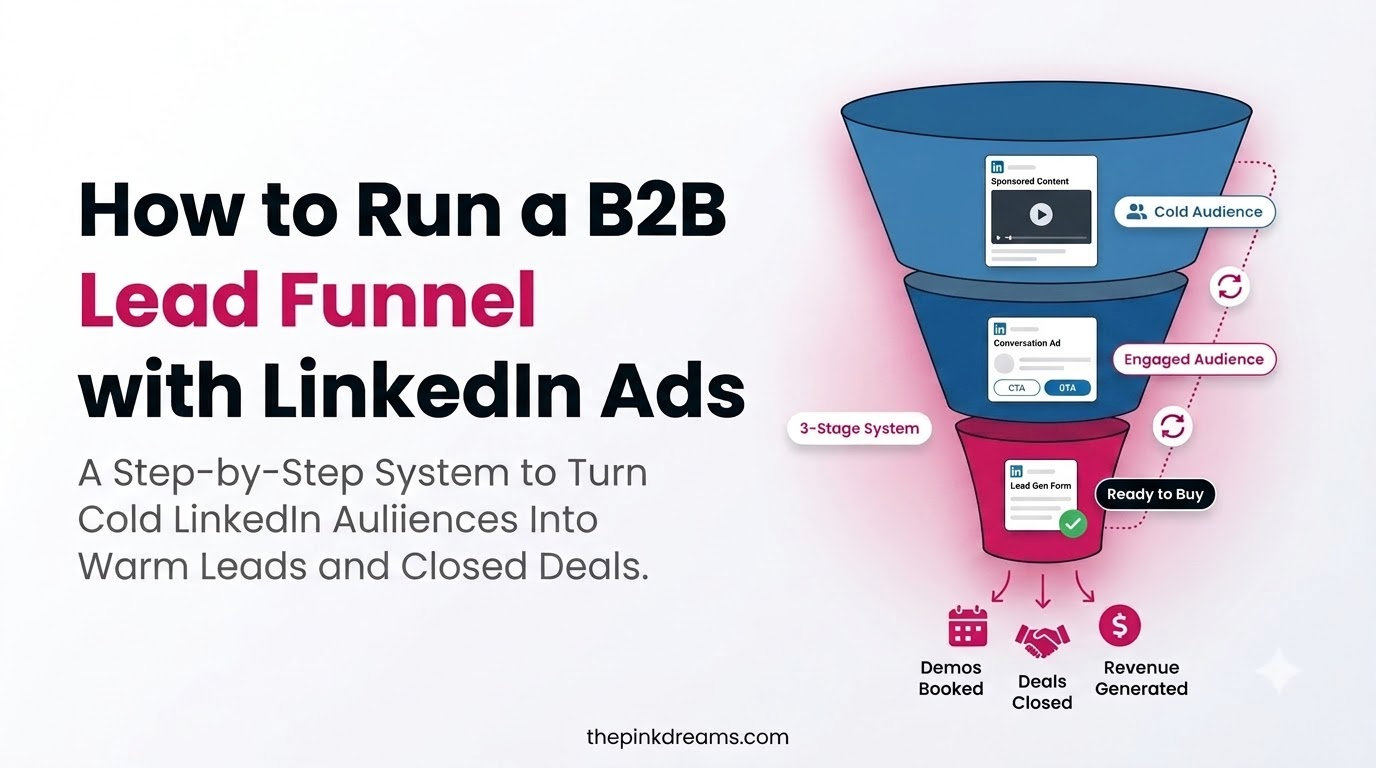
A B2B LinkedIn Ads funnel has three stages: top-of-funnel awareness, middle-of-funnel engagement, and bottom-of-funnel conversion. Each reaches a different level of readiness, uses a different offer, and is measured against a different metric. This is the backbone of any effective b2b linkedin ads strategy.
| Funnel stage | Primary goal | Best-suited formats | Core metric to track |
| Top (awareness) | Reach and warm the right cold audience | Single-image, video, document ads | Cost per 1,000 impressions, engagement rate |
| Middle (engagement) | Capture engaged leads | Lead gen forms, document ads | Cost per lead, form completion rate |
| Bottom (conversion) | Convert warm leads into pipeline | Conversation ads, retargeted single-image ads | Cost per qualified lead, pipeline |
Key Takeaway: Three stages, three offers, three metrics. The awareness ad warms, the engagement ad captures, and the conversion ad closes. Skipping a stage breaks the linkedin ads funnel.
Stage One: Build Awareness with the Right Cold Audience
The top of the funnel exists to do one job: reach and warm the right people, not to convert them. At this stage you are introducing your brand to a cold audience defined by job title, seniority, industry, and company size, and earning enough attention that they recognise you later. Conversion is not the goal yet.
Because this audience did not ask for your ad, the creative has to earn attention rather than demand action. Lead with a genuinely useful insight, a relevant trend, or a strong point of view, and keep any sell light. A link to an article or a short video works better here than a demo request.
What to do
• Target a broad but relevant cold audience: two to three facets such as job function, seniority, and industry.
• Use awareness formats: single-image, video, or document ads that deliver value without asking for anything.
• Measure engagement, not leads: track engagement rate and cost per thousand impressions, not conversions.
• Build the retargeting pool: every person who engages here becomes a warm audience for stage two.
Key Takeaway: Stage one buys attention and builds a warm audience. Judge it on reach and engagement, and resist the urge to ask for a sale.
Stage Two: Turn Attention Into Engaged Leads
The middle of the funnel converts attention into contact details. Once someone has engaged with your awareness content, they are warm enough to exchange information for something valuable. This is where LinkedIn Lead Gen Forms earn their place, because they auto-fill from the member’s profile and remove almost all friction.
The offer at this stage should be worth a few form fields: a substantial guide, a webinar, a template, or a benchmark report. Whatever it is, point the ad directly to a Lead Gen Form or a fast, relevant landing page, and keep the promise of the ad and the offer perfectly aligned.
What to do
• Retarget stage-one engagers: build the audience from people who watched, clicked, or engaged with your awareness ads.
• Offer real value: a guide, webinar, template, or report worth exchanging details for.
• Use Lead Gen Forms or a matched landing page: forms lift completion; a landing page allows richer qualification.
• Add one qualifying question: company size or role filters casual sign-ups without killing volume.
Key Takeaway: Stage two trades value for contact details among people already warmed. Lead Gen Forms remove friction; one qualifying question protects quality.
Stage Three: Convert Warm Leads Into Pipeline
The bottom of the funnel turns engaged leads into sales conversations. These people know you, have consumed your content, and are close to a decision. The message can finally be direct: a demo, a consultation, a trial, or pricing. This is classic account-based marketing territory, aimed at decision-makers and buying committees.
Conversation ads and retargeted single-image ads work best here, carrying an outcome-led message to a warm, high-intent audience. Learn more about LinkedIn Conversation Ads best practices to create stronger messages, CTAs, and conversion paths for these prospects. Because these people already recognise you, the same direct offer that would have fallen flat cold now converts, and at a far lower cost per qualified lead than a cold campaign.
What to do
• Retarget warm, engaged leads only: people who consumed stage-two content or visited key pages.
• Make a direct offer: demo, consultation, trial, or pricing, matched to buyer readiness.
• Use conversation or retargeted image ads: outcome-led creative for a high-intent audience.
• Route leads straight to sales: connect the form to your CRM so warm leads reach a rep fast.
Key Takeaway: Stage three asks for the sale, but only of people the funnel has warmed. That is why the same offer converts here and fails cold.
Which Ad Formats Fit Each Funnel Stage
LinkedIn offers several ad formats, and each suits a different stage. Matching the format to the stage is half of a working funnel with LinkedIn Ads; using the wrong one, like a demo-request conversation ad on a cold audience, is one of the most common ways campaigns waste budget.
• Single-image and video ads (top): carry awareness content to cold audiences at scale.
• Document ads (top and middle): deliver a guide or report in-feed, building authority without a form.
• Lead Gen Forms (middle): capture engaged leads with pre-filled, low-friction forms.
• Conversation ads (bottom): deliver a direct, branching offer to warm, high-intent prospects.
• Retargeted single-image ads (bottom): keep a conversion offer in front of people who are already engaged.
Key Takeaway: Format follows funnel stage. Awareness formats warm, Lead Gen Forms capture, and conversation ads close. Match them deliberately.
Measuring the Funnel: Cost Per Qualified Lead, Not Clicks
Measure a LinkedIn Ads funnel on business outcomes, stage by stage. Top-of-funnel is judged on reach and engagement, middle on cost per lead and form completion, and bottom on cost per qualified lead and pipeline. Clicks and impressions describe activity; qualified leads and revenue describe results.
Connecting LinkedIn Campaign Manager to your CRM is what makes this real. Without it, you see the setup time and the click, but not whether a lead turned into a qualified opportunity. With it, you can tell which stage, audience, and offer actually produced the pipeline, and reallocate budget toward what works.
What to track per stage
• Top: cost per thousand impressions, engagement rate, and audience growth for retargeting.
• Middle: cost per lead, form completion rate, and lead-to-qualified rate.
• Bottom: cost per qualified lead, cost per meeting, and closed-won revenue.
Key Takeaway: Judge the funnel on pipeline, not opens. Cost per qualified lead is the number that tells you whether the whole system is working.
Common Mistakes That Break a LinkedIn Ads Funnel
Even a well-planned funnel can be undone by a few avoidable errors. Each quietly wastes budget or breaks the flow between stages, and each has a straightforward fix.
• One offer for every stage: a demo request to a cold audience is the classic funnel-killer. Match the task to the stage.
• Over-narrow targeting: too many filters starve delivery and raise cost per click. Stick to two or three facets.
• No retargeting pool: without capturing stage-one engagers, the funnel has no warm audience to convert.
• Skipping the middle: jumping from awareness straight to a hard sell loses the leads in between.
• No CRM connection: without it you cannot tell which stage produced the pipeline. Connect it before scaling.
• Judging too early: B2B cycles are long. Give each stage a full window before deciding it failed.
Key Takeaway: Most funnels break on a single mismatched offer, a missing retargeting pool, or no CRM link. Fix those three and the stages connect.
Build Your Funnel One Stage at a Time
A full-funnel LinkedIn Ads strategy is not a single clever campaign. It is a connected system that works because each stage does one job well, and each feeds the next. The mistake that sinks most B2B campaigns, asking a cold audience to buy, disappears the moment you separate awareness, engagement, and conversion into their own campaigns with their own offers.
If you were to build only one stage this week, build the awareness layer, because it creates the warm audience every other stage depends on. Get people engaging with genuinely useful content, capture that engagement as a retargeting pool, and the middle and bottom of the funnel suddenly have someone to talk to. Add the engagement offer next, then the conversion retargeting, and connect the whole thing to your CRM so you can see what pipeline each stage produces.
Run it for a full sales cycle before you judge it, measure on cost per qualified lead rather than clicks, and let the data tell you which stage to scale. A funnel built and measured this way compounds: every month of awareness spend feeds a larger warm audience, and every warm audience makes the conversion stage cheaper.
Ready to Build Your Funnel?
If you would rather have specialists build and run it, Pink Dreams can help. As a LinkedIn Ad agency working with businesses across the US, the UK, Canada, Australia, and the UAE, we design full-funnel LinkedIn campaigns, connect every stage to pipeline, and continuously test what converts. Request a free LinkedIn Ads audit to see where your funnel is leaking and where the fastest gains are.
FAQ
What is a B2B lead funnel with LinkedIn Ads?
It is a staged campaign that reaches prospects with a different message at each step of their buying journey. Awareness ads warm a cold audience, engagement ads capture leads with valuable content, and conversion ads retarget warm prospects with a direct offer. Splitting the journey into stages lowers cost per qualified lead and raises lead quality.
How much should a business budget for a LinkedIn Ads funnel?
It varies widely by market, industry, and competition, so treat any figure as a starting point rather than a rule. Give the funnel enough budget to run all three stages and enough time to gather data across a full sales cycle. Fund it properly for at least a few months before judging performance.
Are LinkedIn Lead Gen Forms better than landing pages?
Each has a place. Lead Gen Forms auto-fill from the member’s profile, which removes friction and lifts completion, making them strong for the middle of the funnel. Landing pages allow richer qualification and custom content. The right choice depends on whether volume or deeper qualification matters more for that offer.
How long does it take to see results from a LinkedIn Ads funnel?
Awareness and engagement metrics often move within the first couple of weeks, but qualified leads and pipeline follow the length of your sales cycle, which in B2B can be weeks to months. Give each stage a full window, and allow time after any change for the platform to stabilise before judging it.
What is the difference between b2b linkedin ads strategy stages?
The stages differ by audience readiness and offer. Top-of-funnel reaches cold audiences with value-first content and asks for nothing. Middle-of-funnel captures engaged leads with a valuable, gated offer. Bottom-of-funnel retargets warm, high-intent prospects with a direct demo or pricing offer. Each uses different formats and metrics.

Digital Marketing Strategist & Business Coach
As a leading digital marketing strategist and business coach, he is responsible for helping entrepreneurs and brands grow faster in a smarter, more scalable way. With over 20 years of experience, Nagarajan specializes in practical coaching, automation-first marketing strategies, and technology-driven growth systems. His work focuses on enhancing brand visibility, improving performance, and building sustainable frameworks that enable long-term business success.