Introduction
The U.S. moving industry trends of 2025 reveal a market in transition. After years of pandemic-driven volatility, elevated mortgage rates, and shifting migration patterns, the industry is stabilizing but the rules of competition have changed. Moving companies that understand these shifts and adapt their strategies will capture market share. Those that rely on outdated playbooks risk falling behind.
This report provides a data-driven analysis of the U.S. moving services market, covering market size and growth trajectory, migration and relocation patterns, consumer behavior shifts, technology adoption, competitive dynamics, and the digital transformation reshaping how movers acquire customers. Each section includes actionable insights to help moving company owners make better strategic decisions for 2025 and beyond.
Overview of the U.S. Moving Industry
Market Size and Growth
The U.S. moving services industry reached an estimated $23.4 billion in revenue in 2025, growing at approximately 0.6% year-over-year. Over the past five years, the industry has grown at a compound annual growth rate (CAGR) of 2.8%. Including indirect and induced economic activity, the broader moving and storage sector contributes approximately $92.2 billion to the U.S. economy annually and employs over 480,000 people.
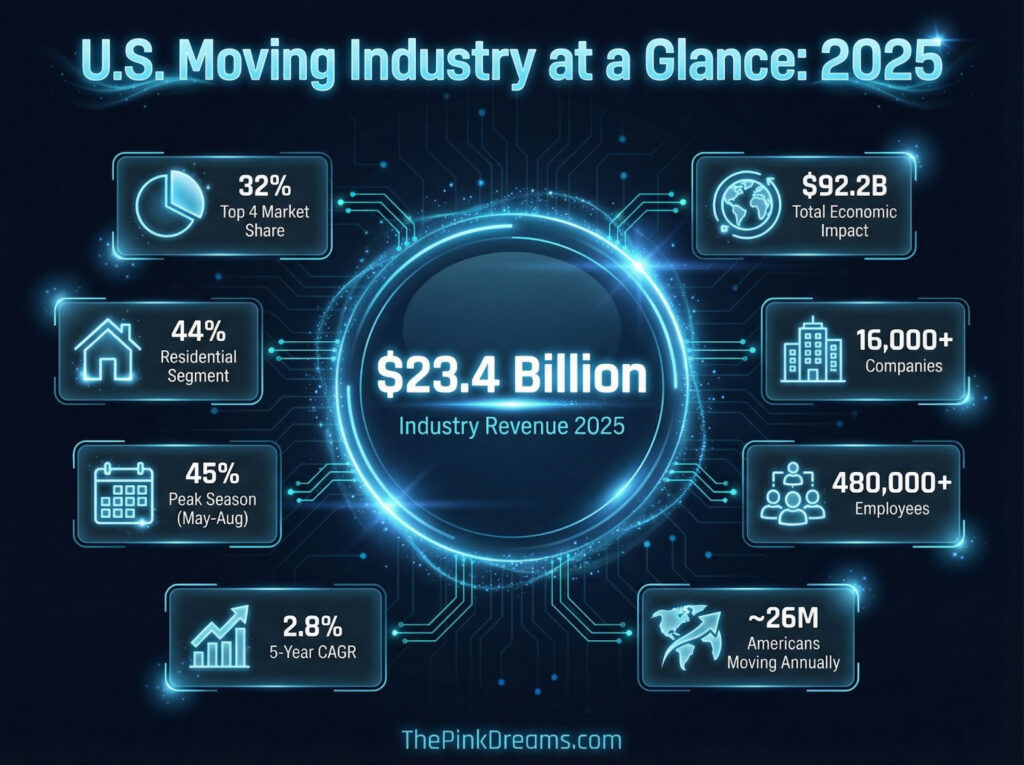
While revenue growth has been modest, the composition of that revenue is shifting. Residential moving, historically the largest segment, has slowed as elevated mortgage rates and housing affordability challenges keep many homeowners in place. Commercial moving and premium full-service relocations have become increasingly important revenue drivers as the market concentrates among higher-income consumers.
Industry Landscape
| Metric | Data Point |
| U.S. Moving Industry Revenue (2025) | $23.4 billion |
| Total Economic Impact (incl. indirect) | $92.2 billion |
| Number of Moving Companies | 16,000-17,000+ |
| Industry Employment | 108,000-110,000+ |
| Average Employees per Company | 6.2 |
| 5-Year Revenue CAGR (2020-2025) | 2.8% |
| Americans Moving Annually | ~26 million (8% of population) |
| Peak Moving Season Share | 45% (May-August) |
| Top Revenue Segment | Residential Moving (~44%) |
| Market Concentration (Top 4 Companies) | ~32% of revenue |
Business impact: The industry is highly fragmented with low barriers to entry, meaning competition is intense at every level. Market concentration is low, with the top four companies controlling only about 32% of revenue. This fragmentation creates both challenge and opportunity: small and mid-sized movers can compete effectively through local specialization and superior digital presence.
Key Trends Shaping the Moving Industry in 2025
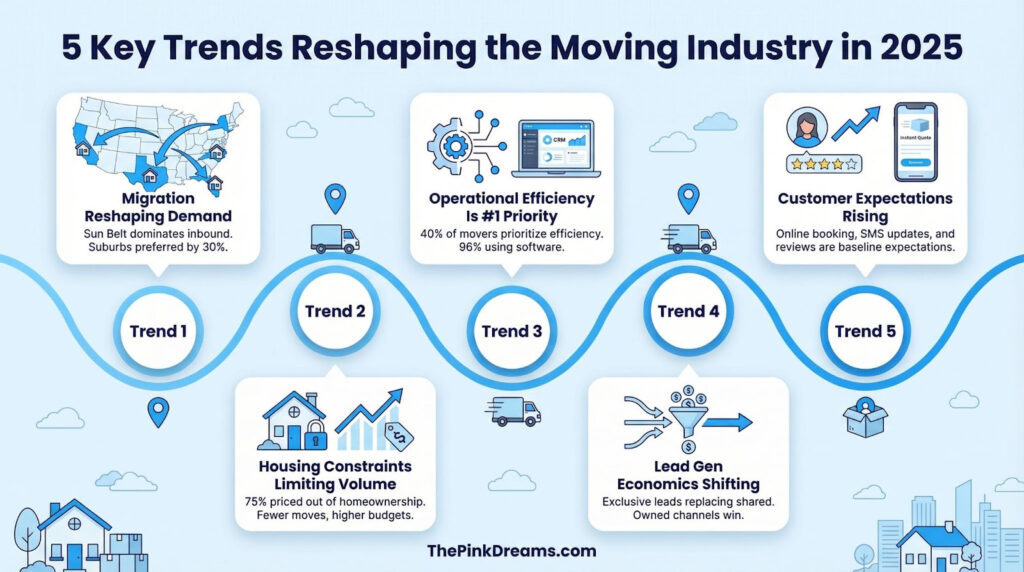
1. Migration Patterns Are Reshaping Regional Demand
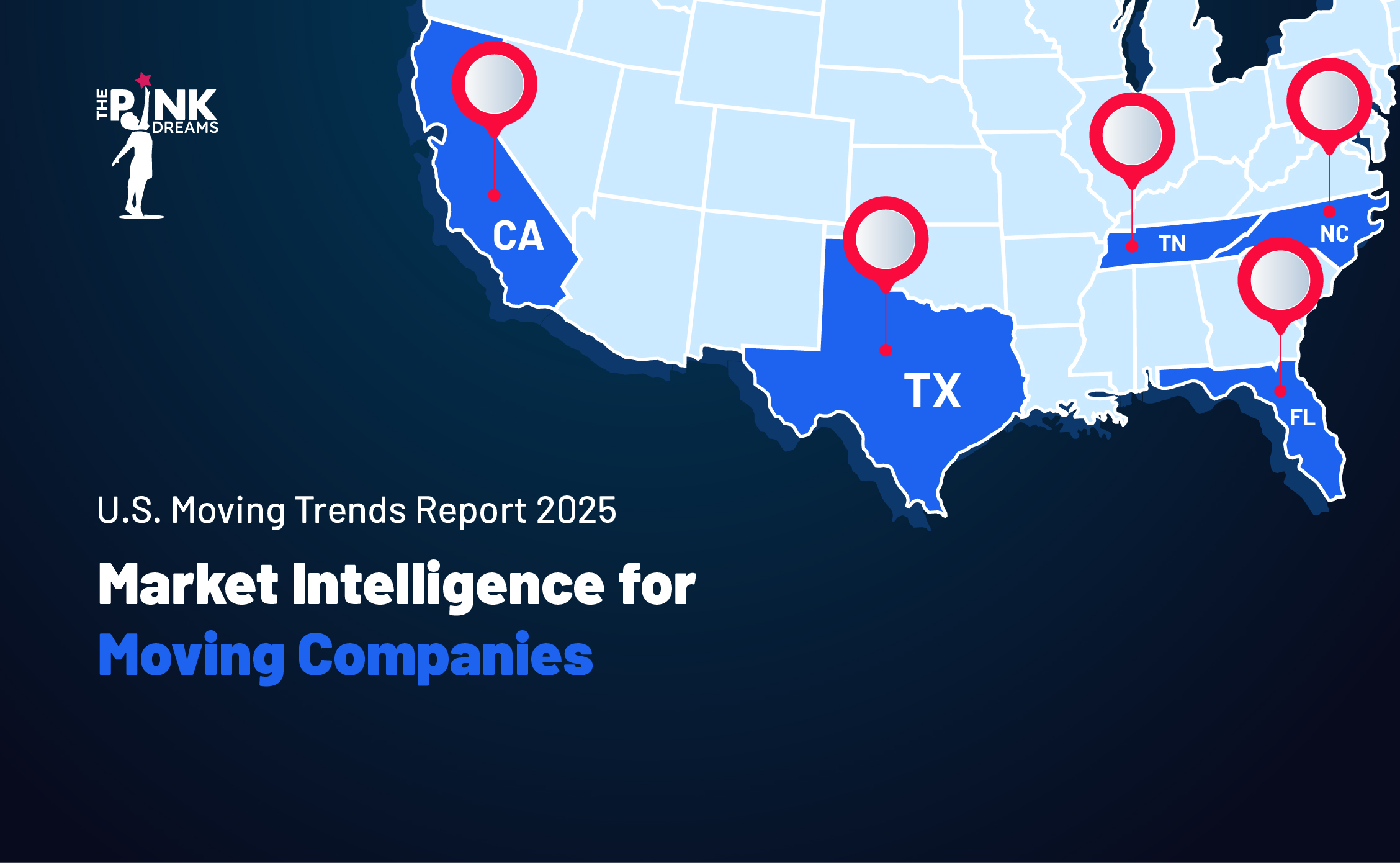
The Sun Belt continues to dominate inbound migration. Florida, Texas, North Carolina, and Tennessee remain top destinations, driven by lower costs of living, favorable tax environments, and remote work flexibility. Conversely, California, New York, and Illinois continue to lead outbound migration. However, the pace of migration has moderated from the post-COVID surge. People are still moving, but fewer are making impulsive cross-country relocations.
Suburbs remain the most desirable destination, with nearly 30% of prospective movers prioritizing suburban environments. Lower-income households lean toward rural areas, while middle and upper-income families continue choosing suburban communities with access to urban employment centers.
Business impact: Movers in Sun Belt growth markets should invest in capacity expansion and digital visibility. Companies in outbound-heavy markets should focus on long-distance partnerships and marketing to capture high-value interstate moves. All movers should create location-specific marketing content reflecting their region’s migration dynamics.
2. Housing Market Constraints Are Limiting Move Volume
Elevated mortgage rates continue to suppress housing turnover. According to the National Association of Home Builders, approximately 75% of Americans are priced out of homeownership in 2025. While 19% of homeowners indicate plans to sell within three years, only about 15% currently have homes listed. This gap creates a “lock-in” effect where existing homeowners are reluctant to sell and buy at higher rates, directly reducing the total volume of residential moves.
The result is a smaller but more affluent customer base. Movers are handling fewer total jobs but the customers who are moving tend to have higher budgets and higher expectations for service quality. Only 29% of movers plan to raise prices in 2025, down from 42% the previous year, recognizing that pricing sensitivity has increased even among wealthier clients.
Business impact: Moving companies should pivot from volume-based strategies toward value-based approaches. Focus on premium service offerings, upsells like packing and storage, and delivering an exceptional customer experience that justifies higher pricing and generates reviews and referrals.
3. Operational Efficiency Is the Top Priority
Nearly 40% of moving companies identify operational efficiency as their primary business goal for 2025. Rising costs for labor, fuel, truck maintenance, insurance, and equipment are squeezing margins. Companies are responding by investing in technology to automate scheduling, route optimization, lead follow-up, and customer communications.
Approximately 96% of moving companies now use at least one type of software, with over 80% using multiple platforms. Key technology areas include vehicle tracking (68%), accounting platforms (67%), and moving-specific CRM software (59%). However, customer-facing technology adoption, like virtual surveys and online booking systems, remains surprisingly low, representing a significant untapped opportunity.
Business impact: Companies that invest in automation and CRM systems will operate with lower costs and faster response times. The data suggests that virtual surveys and automated follow-up sequences are still underused competitive advantages. Movers who adopt these tools early gain a measurable edge in both efficiency and conversion rates.
4. Lead Generation Economics Are Shifting
The lead generation landscape for movers is undergoing a fundamental shift. Lead aggregator platforms have moved toward exclusive-only leads, eliminating the shared lead model where multiple movers received the same lead at low cost. This makes purchased leads significantly more expensive. Survey data shows that 69% of movers say word-of-mouth drives their highest-quality leads, followed by referrals. Most other channels, including social media, are underperforming expectations.
This shift is creating a clear divide between movers who generate their own leads through organic search, Google Ads, and direct website traffic, and those who remain dependent on third-party platforms. The companies building their own lead generation systems report six-figure monthly revenue without purchasing a single lead.
Business impact: The cost of purchased leads will continue rising. Moving companies must invest in owned lead generation channels: local SEO, Google Ads, a high-converting website, and Google Business Profile optimization. The transition from purchased to owned leads is one of the most important strategic shifts a mover can make in 2025.
5. Customer Expectations Continue Rising
Customers now expect faster service, clearer communication, more flexible options, and real-time visibility throughout the moving process. The ability to get an instant quote online, book through a website, track shipment status, and communicate via text or chat is transitioning from a differentiator to a baseline expectation.
Review volume and velocity remain critical. While 95% of moving companies maintain a 4-5 star Google rating, most have fewer than 500 reviews. Review count and the frequency of new reviews directly influence local search rankings, making review generation a competitive imperative rather than a nice-to-have.
Business impact: Movers should invest in customer-facing technology: online booking, automated quote systems, SMS communication, and real-time job tracking. A systematic review collection process should be embedded into standard operating procedures, not treated as an afterthought.
Digital Transformation in the Moving Industry
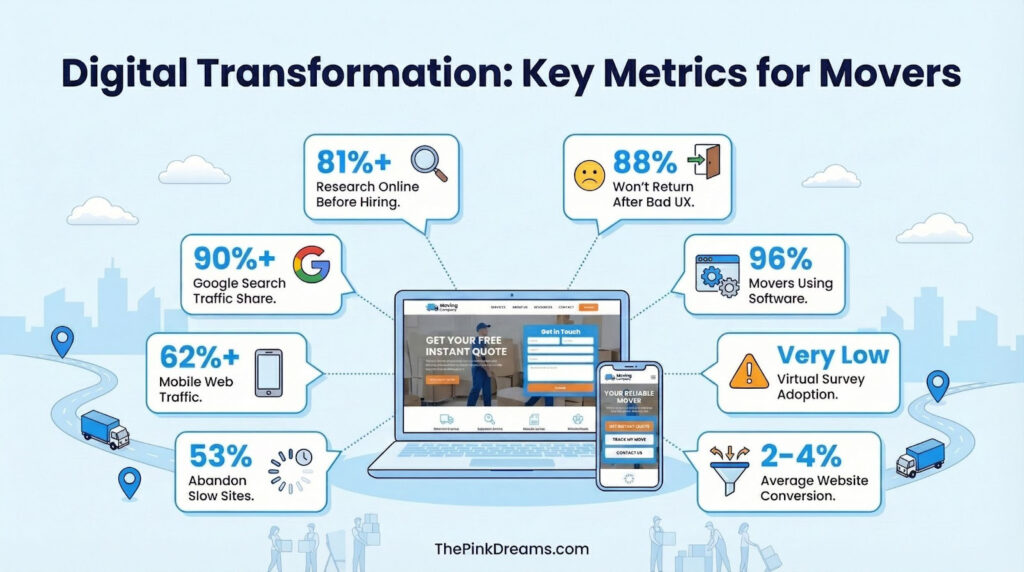
Digital presence has shifted from optional to essential for moving companies of every size. Over 81% of consumers research businesses online before hiring, and Google dominates with over 90% of search traffic. For local service businesses like movers, appearing in Google’s Local Pack (the map with three listings at the top of search results) is one of the highest-value positions in digital marketing.
Despite this, many movers remain underinvested in digital channels. Common gaps include websites that lack mobile optimization, Google Business Profiles that are incomplete, minimal or no SEO strategy, and ad campaigns running without proper conversion tracking. These gaps represent significant competitive advantages for companies willing to invest.
Key Digital Metrics for Movers
| Digital Factor | Current Reality |
| Consumers researching online before hiring | 81%+ |
| Google’s share of global search traffic | 90%+ |
| Mobile share of web traffic | 62%+ |
| Users abandoning slow sites (3+ seconds) | 53% |
| Users unlikely to return after bad experience | 88% |
| Moving companies using some software | 96% |
| Movers using virtual survey technology | Very low adoption |
| Average website conversion rate | 2-4% |
Consumer Behavior Insights
How Customers Find Movers: The customer journey typically begins with a Google search (“movers near me” or “moving company in [city]”). Customers compare 3-5 companies based on Google ratings, review volume, website quality, and pricing transparency before requesting quotes. Companies that appear in the Local Pack with strong reviews and a professional website capture the majority of initial consideration.
Trust Signals That Matter: Customers prioritize Google reviews (both rating and quantity), licensing and insurance verification, years in business, professional website appearance, and clear pricing. A company with 200 reviews and a 4.7 rating will consistently win over a competitor with 15 reviews and a 4.9 rating because volume signals reliability and consistency.
Pricing Sensitivity: Nearly 40% of movers report their customers experienced higher-than-expected costs. This creates a trust challenge for the entire industry. Companies that provide transparent pricing, detailed quotes, and clear explanations of potential additional charges build stronger customer relationships and generate more positive reviews.
Challenges Facing Moving Companies
Rising Operational Costs: Fuel, labor, insurance, and equipment costs continue climbing. Steel and aluminum tariffs in 2025 may increase truck and trailer prices further, pressuring margins for companies needing fleet expansion.
Intense Competition: Low barriers to entry mean new competitors constantly enter the market. Established movers face pressure from both new entrants and national brands with larger marketing budgets.
Seasonal Demand Volatility: With 45% of moves concentrated in May through August, managing cash flow and staffing during off-peak months remains a persistent challenge.
Lead Generation Costs: The shift to exclusive leads and rising ad costs mean customer acquisition is becoming more expensive across every channel.
Workforce Retention: Finding and retaining reliable crew members is consistently cited as a top operational challenge, with labor costs representing the largest expense for most movers.
Opportunities for Growth in 2025
1. Local SEO Dominance: Most moving companies have significant gaps in their local SEO strategy. Companies that fully optimize their Google Business Profile, build location-specific website pages, and generate consistent reviews can capture organic leads at zero marginal cost, outperforming competitors who rely on paid channels.
2. Service Differentiation: As the customer base shifts toward higher-income clients, there is growing demand for premium services: white-glove packing, temporary storage, furniture assembly, cleaning services, and concierge-level project management. Adding these services increases revenue per job and creates differentiation from price-focused competitors.
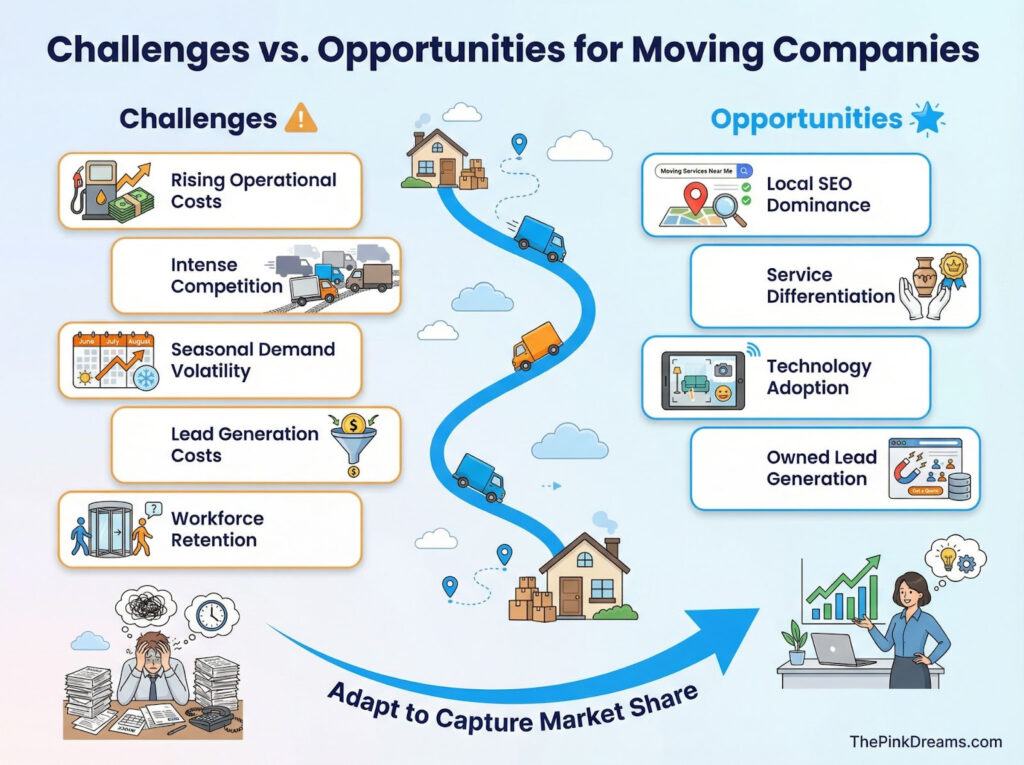
3. Technology Adoption: Virtual surveys, automated quoting, CRM-driven follow-up, and online booking systems remain under adoption. Early adopters gain measurable advantages in conversion rates and operational efficiency.
4. Owned Lead Generation: Building proprietary lead channels through SEO, content marketing, and optimized paid advertising reduces dependence on third-party platforms and creates a sustainable competitive moat that is difficult for competitors to replicate.
Actionable Insights for Moving Companies
Invest in your digital presence now. If you have not fully optimized your Google Business Profile, built location-specific web pages, and implemented conversion tracking, these should be your immediate priorities. The ROI on digital infrastructure far exceeds any other marketing investment.
Build your own lead generation system. The economics of purchased leads are deteriorating. Invest in local SEO, Google Ads with dedicated landing pages, and a systematic review collection process to generate exclusive leads you control.
Focus on premium service delivery. The market is shifting toward higher-value customers. Differentiate through service quality, transparent pricing, and professional communication rather than competing on price.
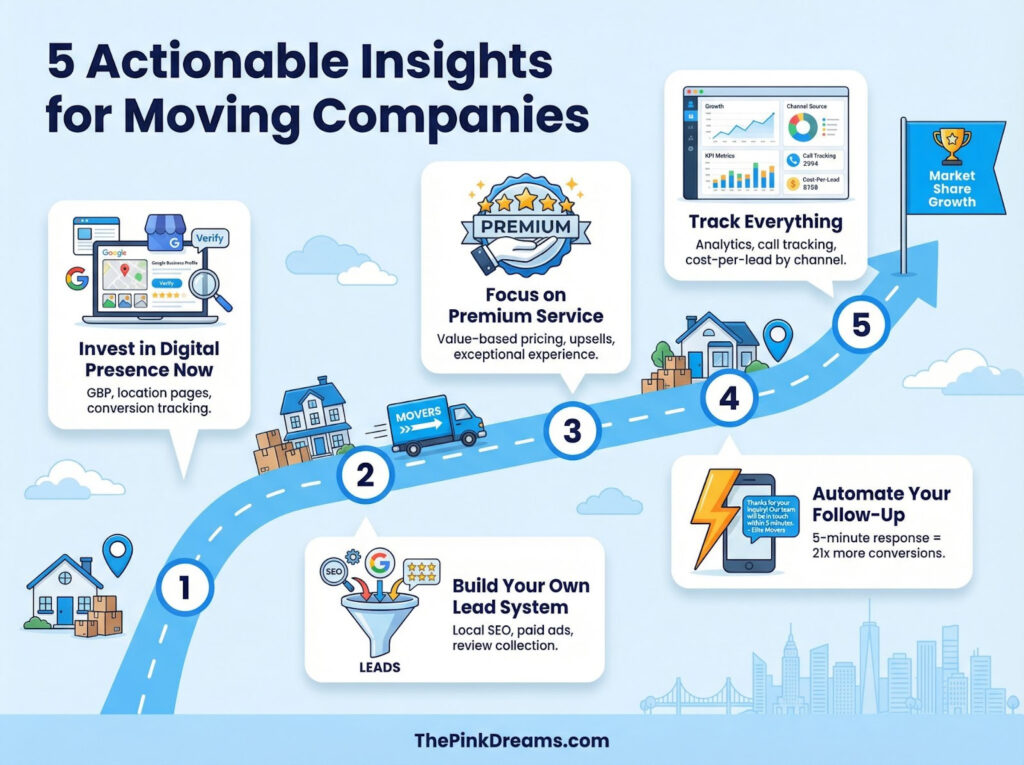
Automate your follow-up. Leads contacted within 5 minutes are 21 times more likely to convert. Implement CRM-driven automated email and SMS sequences to ensure no lead falls through the cracks.
Track everything. Fewer than half of moving companies track critical KPIs. Implement analytics, call tracking, and cost-per-lead measurement by channel to make data-driven decisions instead of guessing.
Why Choose Pink Dreams as Your Digital Growth Partner
At Pink Dreams, the team helps moving companies navigate these industry shifts by building digital marketing systems that generate consistent, exclusive leads. With deep expertise in SEO, paid advertising, website optimization, and lead generation strategy for local service businesses, Pink Dreams delivers the data-driven approach that the current market demands.
As a Google Partner and Microsoft Advertising Partner, Pink Dreams brings certified expertise and industry-leading tools to help movers compete in an increasingly digital marketplace. Visit thepinkdreams.com to get a free digital presence audit and discover the specific growth opportunities available in your market.
Conclusion
The U.S. moving industry in 2025 is defined by housing market constraints, shifting migration patterns, rising operational costs, and an accelerating digital transformation. The companies that will thrive are those that adapt investing in digital presence, building owned lead generation systems, focusing on premium service delivery, and using technology to improve efficiency and customer experience.
The opportunity is clear for moving companies willing to act. The majority of competitors are still underinvesting in digital marketing, local SEO, and customer-facing technology. This gap will not last forever. The movers who establish strong digital foundations now will capture market share as the industry continues its recovery and growth.
FAQ
What are the latest moving industry trends?
Key trends include shifting migration toward Sun Belt states, housing market constraints limiting move volume, rising importance of digital lead generation, increasing operational costs, growing customer expectations for technology-enabled service, and the transition from shared to exclusive lead platforms.
Is the moving industry growing?
The U.S. moving services industry reached $23.4 billion in 2025, growing at 0.6% year-over-year and 2.8% CAGR over five years. Growth has moderated from post-pandemic levels, but the market is projected to continue expanding as housing inventory gradually improves and migration patterns sustain demand in growth regions.
What challenges do moving companies face?
The primary challenges include rising operational costs (fuel, labor, insurance, equipment), intense competition from a fragmented market, seasonal demand volatility, increasing lead generation costs, and workforce retention difficulties.
How can movers get more customers?
The most effective approach combines local SEO for organic visibility, Google Ads for immediate leads, Google Business Profile optimization for local map presence, a high-converting website, and systematic review collection. Companies building owned lead generation systems outperform those relying on third-party lead platforms.
What role does digital marketing play?
Digital marketing is now the primary customer acquisition channel for competitive moving companies. Over 81% of consumers research online before hiring, and Google controls 90%+ of search traffic. Companies with strong SEO, optimized Google Business Profiles, and professional websites capture the majority of local leads.

Digital Marketing Strategist & Business Coach
As a leading digital marketing strategist and business coach, he is responsible for helping entrepreneurs and brands grow faster in a smarter, more scalable way. With over 20 years of experience, Nagarajan specializes in practical coaching, automation-first marketing strategies, and technology-driven growth systems. His work focuses on enhancing brand visibility, improving performance, and building sustainable frameworks that enable long-term business success.