Introduction
For most moving companies, the number one challenge is not doing the work. It is finding work. Lead generation for moving companies is the single biggest factor that determines whether a business grows, stagnates, or closes its doors. Yet the majority of movers still rely on unpredictable referral networks and expensive third-party lead platforms that share your leads with five or six competitors.
The moving services industry is worth over $86 billion in the United States alone, with more than 16,000 companies competing for customers. As lead aggregator platforms shift to exclusive-only leads and costs continue rising, movers who build their own lead generation systems will be the ones who thrive. Those who keep buying leads from shared sources will continue fighting over scraps.
This guide is a complete digital marketing blueprint for moving businesses. It covers every major lead generation channel, shows you how to build a conversion-ready website, explains how to create a lead funnel from scratch, and gives you a realistic plan for scaling your results in 2026 and beyond. This is not a list of generic tips. It is a system you can implement.
Why Lead Generation Is Critical for Moving Businesses
Without a consistent flow of new leads, a moving company cannot grow. Here is why lead generation deserves your full attention.
Revenue Growth
Every lead represents potential revenue. A local residential move might be worth $500 to $2,000. A long-distance or commercial move could be $5,000 to $20,000 or more. When you generate your own leads instead of buying shared leads, your close rate increases dramatically because you are the only mover the customer is talking to. Industry data shows that companies generating organic leads consistently outperform those dependent on third-party platforms.
Consistency in Bookings
The moving industry is seasonal. Peak season (May through August) accounts for roughly 45% of all moves, while winter months slow significantly. A structured lead generation system smooths out these fluctuations by building a pipeline that delivers leads year-round, not just during busy months. This consistency allows you to plan staffing, equipment, and growth with confidence.
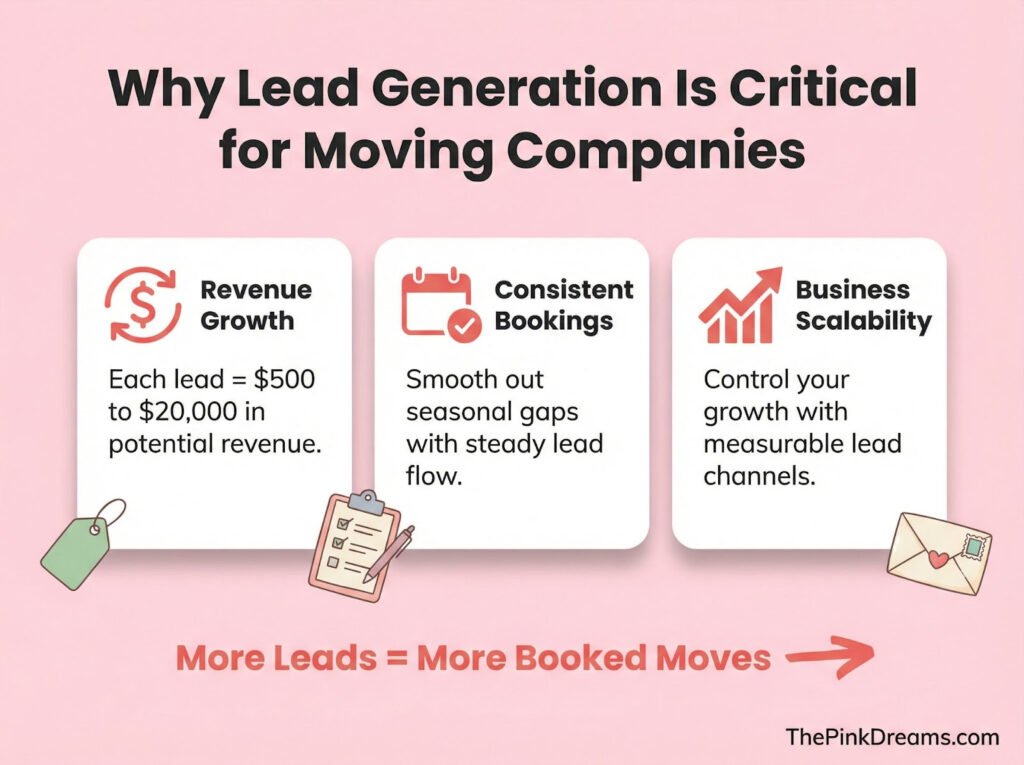
Business Scalability
A business that depends entirely on referrals and word-of-mouth cannot predictably scale. You cannot decide to “grow by 30%” if you have no control over your lead flow. A digital lead generation system gives you levers you can pull: increase ad spend, publish more content, expand to new service areas, or optimize conversion rates. Each lever produces measurable results.
The Digital Marketing Blueprint for Moving Companies
Effective lead generation is not about picking one tactic and hoping it works. It is about building a system where multiple channels work together to attract, nurture, and convert potential customers.
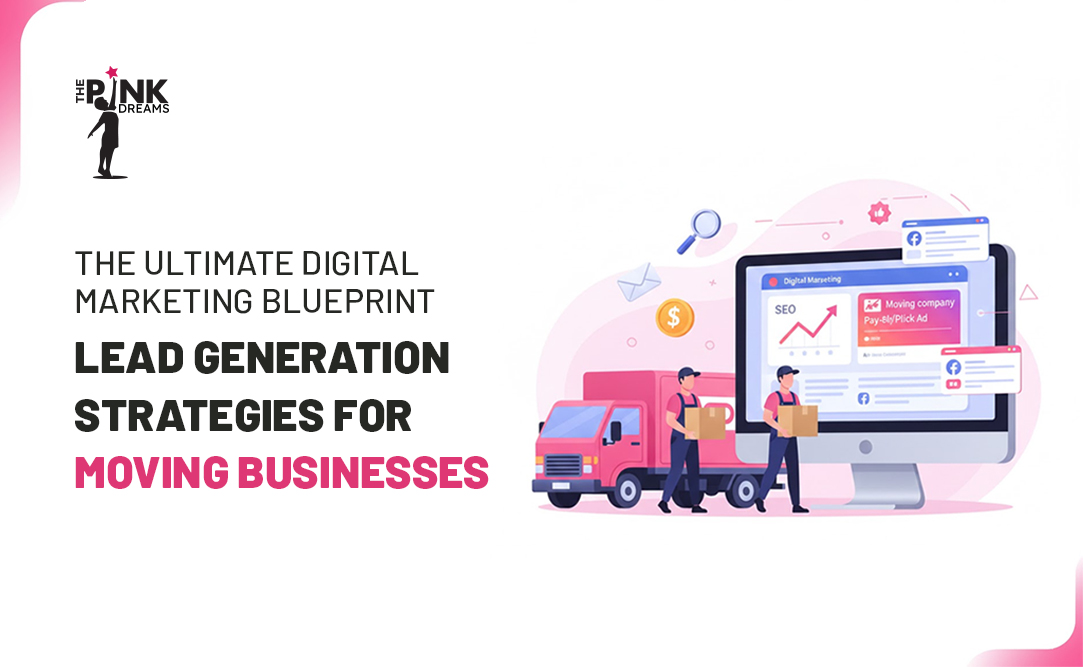
Think of it as an engine with four cylinders: SEO drives long-term organic traffic. Paid ads deliver immediate leads. Social media builds brand awareness and trust. And your website converts all that traffic into actual quote requests and phone calls. Remove any cylinder and the engine runs rough. Combine all four and you have a lead generation machine.
The sections below break down each channel with specific, actionable strategies you can implement.
Core Lead Generation Channels for Moving Businesses
Channel 1: SEO (Search Engine Optimization)
SEO is the foundation of sustainable lead generation. When your website ranks on Google’s first page for keywords like “movers in [your city],” you receive free, high-intent traffic from people actively searching for moving services. Unlike paid ads, this traffic does not stop when your budget runs out.
Local SEO Strategy
Local SEO is the most impactful SEO strategy for moving companies because virtually all your customers are searching locally. The key components include:
Google Business Profile Optimization: Complete every field, add 15+ photos, post weekly updates, and actively collect and respond to reviews. This is your single highest-impact local SEO action.
Location-Specific Website Pages: Create dedicated pages for each city and neighborhood you serve. A page titled “Movers in Burnaby, BC” targeting that specific keyword will rank far better than a generic “Service Areas” page.
Local Citations: Submit your business with consistent NAP (Name, Address, Phone) to directories like Yelp, Better Business Bureau, HomeAdvisor, and Thumbtack.
Keyword Targeting
Focus on high-intent keywords that signal someone is ready to hire a mover. These include patterns like “movers near me,” “best moving company [city],” “affordable movers [city],” and service-specific terms like “long distance movers [city]” or “office movers [city].” Use Google’s Keyword Planner or Ubersuggest to identify search volume and competition for your target areas.
Content Strategy
Publish blog content that answers questions your potential customers are asking: “How much does it cost to move a 2-bedroom apartment?” “What should I look for in a moving company?” “Moving day checklist.” Each blog post is a new page that can rank on Google and drive traffic to your site. Over time, a library of helpful content builds your authority and attracts hundreds of additional monthly visitors.
Channel 2: Google Ads (PPC)
Google Ads is the fastest way to start generating moving leads. When you run search ads targeting keywords like “movers in [city],” your business appears at the very top of Google results, above the organic listings.
Why It Works for Movers
Google Ads targets intent-based users. Someone searching “movers near me” is not casually browsing. They need a mover, often within the next few weeks. This high intent translates to strong conversion rates compared to other advertising channels.
How to Execute Effectively
Target Location-Specific Keywords: Bid on “movers in [city]” and “moving company [city]” for each area you serve. Avoid broad match keywords that waste budget on irrelevant searches.
Use Negative Keywords: Add terms like “free,” “DIY,” “jobs,” and “hiring” as negative keywords to prevent your ads from showing to people who are not looking to hire a mover.
Create Dedicated Landing Pages: Do not send ad traffic to your homepage. Create specific landing pages with a clear headline, service details, trust signals (reviews, insurance info), and a prominent quote request form.
Track Everything: Set up conversion tracking for phone calls, form submissions, and online bookings. Without tracking, you cannot know which keywords and ads are actually generating leads.
Budget Guidance
Most moving companies start with $1,500 to $3,000 per month in Google Ads spend. Cost per click for moving keywords typically ranges from $5 to $25 depending on your market. A well-optimized campaign should deliver a cost per lead of $30 to $80. Track your cost per booked job to determine true ROI.
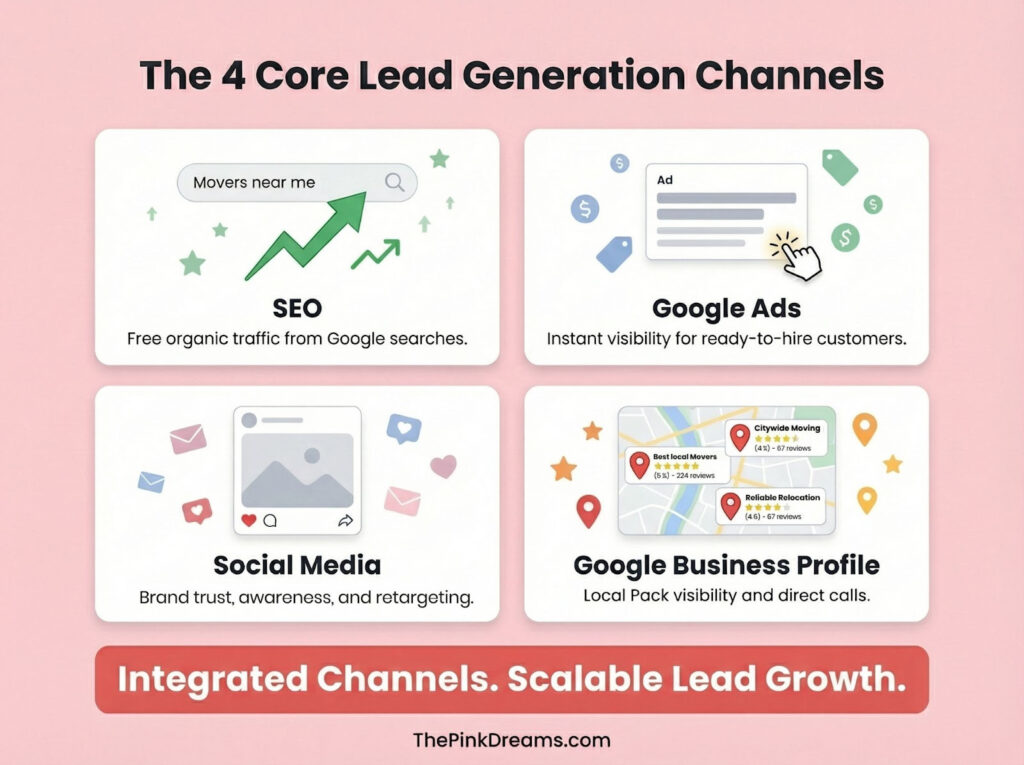
Channel 3: Social Media Marketing
Social media is not a primary lead generation channel for most moving companies, but it plays a critical supporting role in building brand awareness, trust, and retargeting opportunities.
Brand Awareness
Post regularly on Facebook and Instagram with content that showcases your team, completed moves, customer testimonials, and moving tips. This builds familiarity and trust so that when potential customers are ready to move, your brand is already in their awareness.
Retargeting
The most powerful social media strategy for movers is retargeting. When someone visits your website but does not request a quote, Facebook and Instagram retargeting ads follow them with your brand message. Since most people do not convert on their first website visit, retargeting keeps your company top of mind and brings them back to complete the conversion. Retargeting campaigns typically cost a fraction of cold acquisition campaigns and deliver significantly higher conversion rates.
Channel 4: Google Business Profile Optimization
Your Google Business Profile (GBP) is where many of your highest-quality leads will come from. When someone searches “movers near me,” the Local Pack (the map with three business listings) appears at the top of results. Appearing in this pack is one of the most valuable positions in all of local search.
Complete Every Field: Business name, address, phone, website, hours, categories, service areas, and business description. Leave nothing blank.
Add High-Quality Photos: Upload at least 15 photos of your team, trucks, completed moves, and office. Businesses with more photos receive more clicks and calls.
Collect Reviews Consistently: Develop a system to request reviews after every completed job. Aim for a steady stream of new reviews each month, not a one-time burst.
Post Weekly: Share updates, offers, moving tips, and photos directly on your GBP. Regular posting signals to Google that your business is active and engaged.
Website Optimization for Lead Conversion
Driving traffic to your website is only half the equation. If your site does not convert visitors into leads, all the SEO and advertising in the world will not help your bottom line.
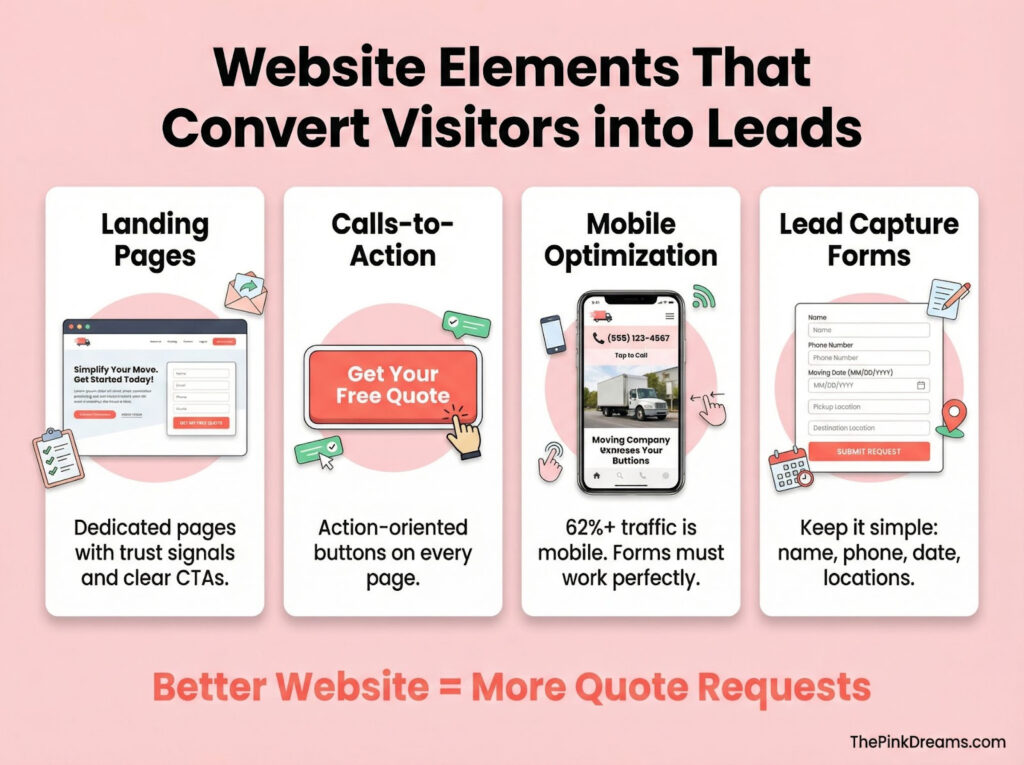
High-Converting Landing Pages
Every major service should have a dedicated landing page optimized for conversion. The page should include a clear headline that matches the visitor’s search intent, a concise value proposition, trust signals (reviews, insurance badges, years in business), and a prominent quote request form above the fold.
Calls-to-Action
Every page on your site should have a clear next step for the visitor. This means quote request buttons, click-to-call phone numbers, and contact forms visible without scrolling. The most effective CTAs use action-oriented language like “Get Your Free Moving Quote” rather than generic text like “Contact Us.”
Mobile Optimization
Over 62% of web traffic comes from mobile devices. Your website must load fast, display correctly, and have fully functional forms on smartphones. Test your site on multiple mobile devices to ensure the experience is seamless. A mobile visitor who cannot easily fill out a form will leave and call your competitor instead.
Lead Capture Forms
Keep forms simple. The more fields you require, the fewer people will complete them. For moving companies, the essential fields are: name, phone number, email, moving date, origin location, and destination. Optional fields like room count or special items can be gathered during a follow-up call. Make the form easy to find, easy to fill, and mobile-friendly.
Building a Lead Generation Funnel
A lead generation funnel maps the customer journey from first awareness to booked move. Understanding this funnel helps you allocate resources to the right channels at the right stage.
| Funnel Stage | What Happens | Best Channels |
| Awareness | Customer realizes they need to move and starts researching | SEO blog content, social media, Google Business Profile |
| Consideration | Customer compares movers, reads reviews, visits websites | Service pages, Google Ads, retargeting ads, review sites |
| Conversion | Customer requests a quote, calls, or books online | Landing pages, quote forms, click-to-call, live chat |
| Retention | Customer becomes a repeat client or referral source | Email follow-ups, review requests, referral programs |
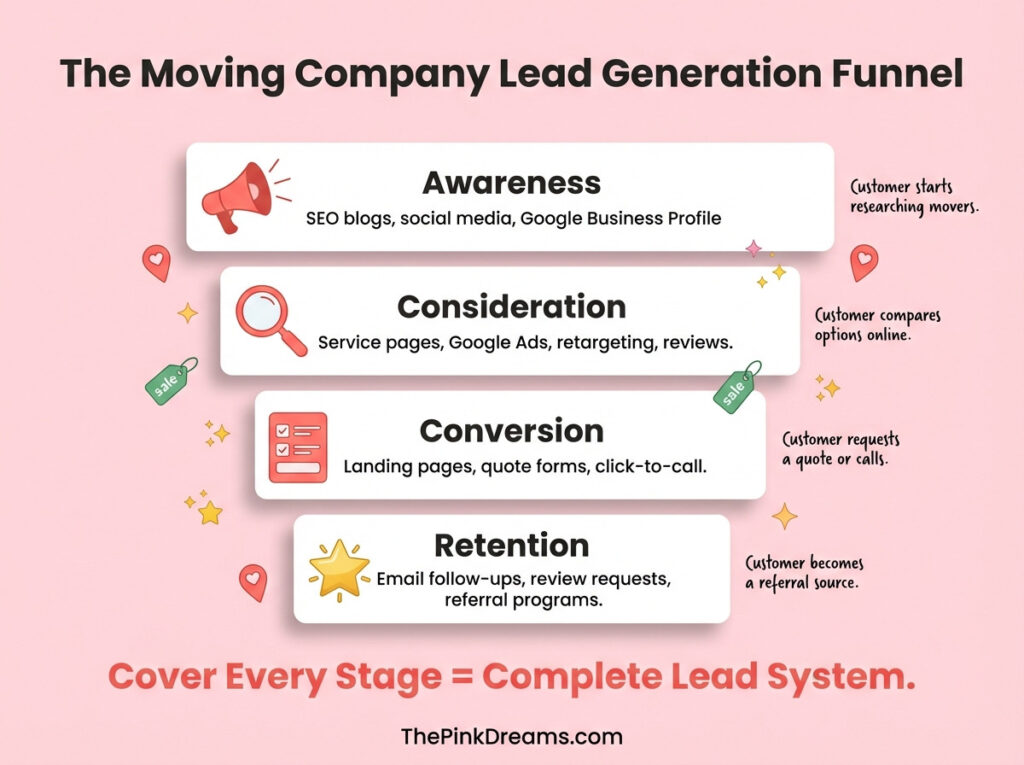
The key insight is that different channels serve different funnel stages. SEO and social media build awareness. Your website and ads drive consideration. Optimized landing pages and forms handle conversion. A follow-up system retains customers and generates referrals. When all stages are covered, you have a complete lead generation system.
Common Lead Generation Mistakes to Avoid
Relying Only on Referrals: Word-of-mouth is valuable but unpredictable and impossible to scale. Nearly 69% of movers say referrals drive their best leads, but the companies that grow fastest supplement referrals with digital channels.
Ignoring SEO: Organic search drives 53% of all web traffic. Every month without SEO is a month your competitors are capturing leads you could have earned for free.
Poor Website Design: A website that loads slowly, looks outdated, or makes it hard to request a quote is actively losing you leads. Your site is your digital storefront.
No Tracking or Analytics: If you do not know where your leads are coming from, you cannot optimize your spending. Set up Google Analytics, call tracking, and form submission tracking from day one.
Buying Shared Leads: Shared leads from aggregator platforms pit you against 5-6 other movers for the same job. The close rate is low and the competition drives prices down. Invest in generating your own exclusive leads instead.
How to Scale Lead Generation in 2026
Automation
Automate your follow-up process. When a lead submits a quote request, an automated email or SMS should go out within minutes. Leads that receive a response within 5 minutes are 21 times more likely to convert than those contacted after 30 minutes. Use CRM tools like Supermove, SmartMoving, or a simple email automation platform to ensure no lead falls through the cracks.
Data-Driven Marketing
Track every marketing dollar and measure cost per lead and cost per booked job for each channel. Double down on what works and cut what does not. Review your data monthly. The most successful moving companies treat marketing as a measurable investment, not a guessing game.
Multi-Channel Strategy
Do not put all your eggs in one basket. The strongest lead generation systems combine organic SEO for long-term sustainability, Google Ads for immediate results, social media for brand awareness and retargeting, and a high-converting website to capture it all. When one channel dips (as happens seasonally), others compensate.
Why Choose Pink Dreams for Lead Generation
At Pink Dreams, lead generation for moving companies is not a side service. It is a core speciality. The team has helped moving businesses across Canada and the United States build predictable lead generation systems that reduce dependence on third-party lead platforms and put growth back in the business owner’s control.
What makes Pink Dreams different is the integrated approach. Rather than offering isolated services, the team builds complete lead generation systems that combine SEO, paid advertising, website optimization, and conversion tracking into a unified strategy. As a Google Partner and Microsoft Advertising Partner, Pink Dreams brings certified expertise and data-driven decision-making to every campaign.
Services include SEO optimization, Google Ads and Meta Ads management, website design and optimization, lead generation strategy, and ongoing performance monitoring. Visit thepinkdreams.com to get a free digital presence audit and discover the specific lead generation opportunities available for your moving business.
How to Get Started
Here is a practical starting plan based on your current situation.
1. If you have no website: Start here. Get a professional, mobile-friendly website with clear service pages, a quote form, and your Google Business Profile connected. Budget: $2,000 to $10,000.
2. If you have a website but no leads: Optimize your Google Business Profile, fix on-page SEO issues, and launch a targeted Google Ads campaign for your primary service area. Budget: $1,500 to $3,000/month.
3. If you are getting some leads but want to scale: Add content marketing, expand to new service area pages, implement retargeting, and automate your follow-up process. Budget: $2,500 to $5,000/month.
4. If you want maximum growth: Build a full multi-channel system with SEO, paid ads, social media, email marketing, and conversion optimization working together. Budget: $5,000+/month.
Conclusion
Lead generation for moving companies is not about finding a single magic tactic. It is about building a system where multiple channels work together to attract, nurture, and convert potential customers into booked jobs. The businesses that grow fastest are not the ones with the biggest trucks. They are the ones with the most predictable lead flow.
Start by getting the fundamentals right: a professional website, an optimized Google Business Profile, and targeted local SEO. Then layer on paid advertising for immediate results and social media for brand building and retargeting. Track everything, automate your follow-ups, and continuously optimize based on data.If you are ready to stop relying on shared leads and start building a lead generation engine you own, Pink Dreams specializes in digital marketing for moving companies across Canada and the United States. Visit thepinkdreams.com to claim your free digital presence audit and get a personalized growth strategy.
FAQ
How do moving companies generate leads?
Moving companies generate leads through a combination of channels: SEO and content marketing drive organic traffic from Google, Google Ads deliver immediate visibility for high-intent searches, social media builds brand awareness and enables retargeting, and a conversion-optimized website captures leads through quote forms and click-to-call functionality. The most successful companies use a multi-channel approach rather than relying on any single source.
What is the best marketing strategy for movers?
The best strategy combines local SEO for long-term organic visibility, Google Ads for immediate lead generation, a Google Business Profile optimized for local search, and a high-converting website. This multi-channel approach ensures consistent lead flow across seasons and market conditions. The specific mix and budget allocation depend on your market, competition level, and growth goals.
Is SEO important for moving companies?
SEO is one of the most important marketing investments a moving company can make. It drives free, ongoing organic traffic from customers actively searching for moving services. Unlike paid ads which stop when you stop paying, SEO builds long-term visibility that compounds over time. Companies with strong organic traffic consistently report lower cost per lead and higher close rates than those relying on purchased leads.
How much does lead generation cost for moving companies?
Costs vary based on strategy and market. Google Ads typically costs $1,500 to $3,000 per month with a cost per lead of $30 to $80. SEO services range from $500 to $2,500 per month. A comprehensive multi-channel strategy might cost $3,000 to $7,000 per month total. The key metric is ROI: if your average job is worth $1,500 and your cost per booked job from marketing is $150, you are getting a 10x return on investment.
How long does it take to see results from digital marketing?
Google Ads can generate leads within the first week of launching a campaign. SEO typically takes 3 to 6 months to produce significant ranking improvements, with results compounding over time. Social media brand building is a longer-term play. Most moving companies see meaningful overall results within 3 to 6 months of implementing a comprehensive digital marketing strategy.

Digital Marketing Strategist & Business Coach
As a leading digital marketing strategist and business coach, he is responsible for helping entrepreneurs and brands grow faster in a smarter, more scalable way. With over 20 years of experience, Nagarajan specializes in practical coaching, automation-first marketing strategies, and technology-driven growth systems. His work focuses on enhancing brand visibility, improving performance, and building sustainable frameworks that enable long-term business success.