




A month-by-month look at the work, the reporting you should receive, and what a good agency will need from you.
You pay an agency every month. Rankings move a little. Nobody can quite explain what happened in week three.
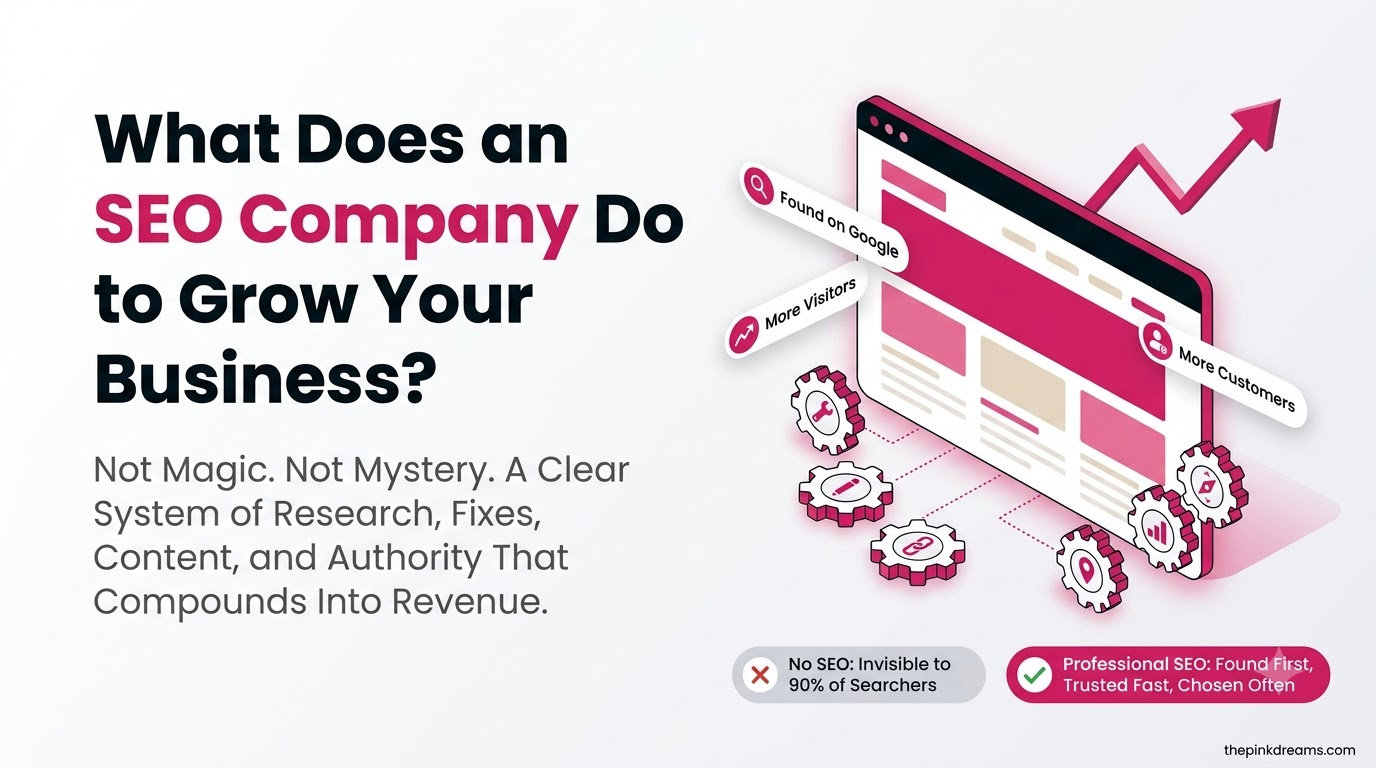
That confusion is why so many small business owners ask what does an SEO company do, usually after signing a contract rather than before. The honest answer is that an SEO company runs a structured, long-term programme: it audits your site, fixes what is broken, targets the searches your buyers actually use, publishes and improves content, earns authority, and reports on what it produced. If you are still weighing up whether to hire at all, our guide on when to hire a lead generation SEO company covers that decision first.
This article explains the six areas of work, what happens in the first 90 days, the monthly tasks that follow, what you should receive each month, and what a good agency will expect from you in return.
The short answer: an SEO company improves how search engines and buyers find and judge your website, through technical fixes, keyword and intent research, content, authority building and conversion tracking, then reports on the enquiries that work produced.
Key Takeaways
- An SEO company runs a structured programme across technical, content, authority, local and reporting work.
- The first month is mostly diagnosis. Visible results typically start later, which is normal rather than a warning sign.
- SEO agency responsibilities should be written down, because vague scope is the main cause of disappointment.
- Monthly SEO tasks are mostly unglamorous: fixing, publishing, improving, earning links and reviewing data.
- Reporting should cover enquiries and revenue, not only rankings and traffic.
- A good agency needs things from you too, including approvals, access and subject knowledge.
- No agency can guarantee rankings, because search engines decide results, not suppliers.
- Judge the relationship on qualified enquiries over quarters, not on position changes week to week.
What Does an SEO Company Do?
An SEO company improves a website’s visibility in search results so the business receives more relevant enquiries. The work combines technical website fixes, keyword and search intent research, content creation and optimization, authority building through links and mentions, local visibility, and measurement of the enquiries produced.
It helps to separate the agency from the activity. Search engine optimization is the practice. An SEO company is a team that performs it on your behalf, usually for a monthly fee, bringing specialists in areas no small business would hire individually: a technical specialist, a writer, someone who understands search data, and an account manager who keeps it moving.
The critical distinction is between an agency that reports on rankings and one that reports on business outcomes. Both can be competent. Only the second answers the question every owner actually cares about, which is whether the investment produced customers.
Key Takeaway: An SEO company is accountable for visibility. A good one makes itself accountable for enquiries.
SEO Agency Responsibilities: The Six Areas of Work
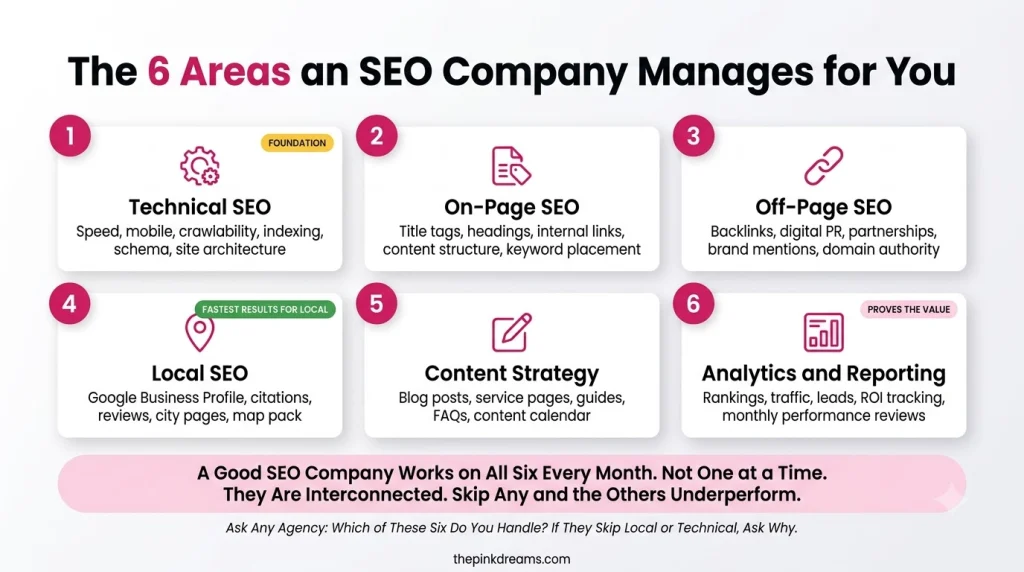
SEO agency responsibilities fall into six areas: technical SEO, on-page and content, off-page authority, local SEO, conversion alignment, and analytics and reporting. A complete SEO services engagement covers all six, though the balance shifts depending on what your site needs most.
1. Technical SEO
What it means: Making sure search engines can find, crawl, understand and load every page that matters.
The actual work:
• Fixing crawl errors, broken links and pages blocked from being indexed
• Improving page speed and performance on mobile devices
• Correcting site structure, URLs and internal navigation
• Adding structured data so search engines understand your services and reviews
• Resolving duplicate pages, redirects and indexing conflicts
Why it matters: A site search engines struggle to read will underperform however good the content is.
2. On-Page SEO and Content
What it means: Targeting the right searches on the right pages, then making those pages genuinely useful.
The actual work:
• Keyword and search intent research, mapped page by page
• Writing or rewriting service pages, location pages and articles
• Improving titles, headings, meta descriptions and internal links
• Filling content gaps competitors already cover
• Refreshing older pages that have slipped
Why it matters: This is where most organic traffic growth comes from, and where competitors are usually beaten.
3. Off-Page SEO and Authority
What it means: Building the credibility signals that help competitive pages rank at all.
The actual work:
• Earning links from relevant, credible websites
• Digital public relations, partnerships and industry listings
• Monitoring your backlink profile and disavowing harmful links
• Encouraging brand mentions and citations across the web
Why it matters: Authority is what decides close contests between two similarly good pages.
4. Local SEO
What it means: Making your business visible to nearby buyers searching for what you do.
The actual work:
• Optimizing and maintaining your Google Business Profile
• Keeping name, address and phone details consistent across directories
• Building service and location pages for each area you cover
• Generating and responding to customer reviews
Why it matters: For most service businesses, local visibility produces more enquiries than anything else on this list.
5. Conversion and User Experience Alignment
What it means: Making sure the traffic earned has somewhere useful to land and something clear to do.
The actual work:
• Reviewing calls to action, forms and enquiry routes on key pages
• Improving page layout, readability and mobile usability
• Adding trust signals such as reviews and case studies
• Testing changes and measuring the effect on enquiries
Why it matters: Traffic without conversion is a cost. Our guide on how to build a lead generation website covers this in depth.
6. Analytics, Tracking and Reporting
What it means: Measuring what the work produced and deciding what to do next.
The actual work:
• Setting up analytics, conversion tracking and call tracking
• Monitoring rankings, traffic, enquiries and cost per lead
• Reporting monthly in plain language
• Adjusting the plan based on what the data shows
Why it matters: Without this, nobody can tell whether the investment is working or merely busy.
What Happens in the First 90 Days of an SEO Campaign
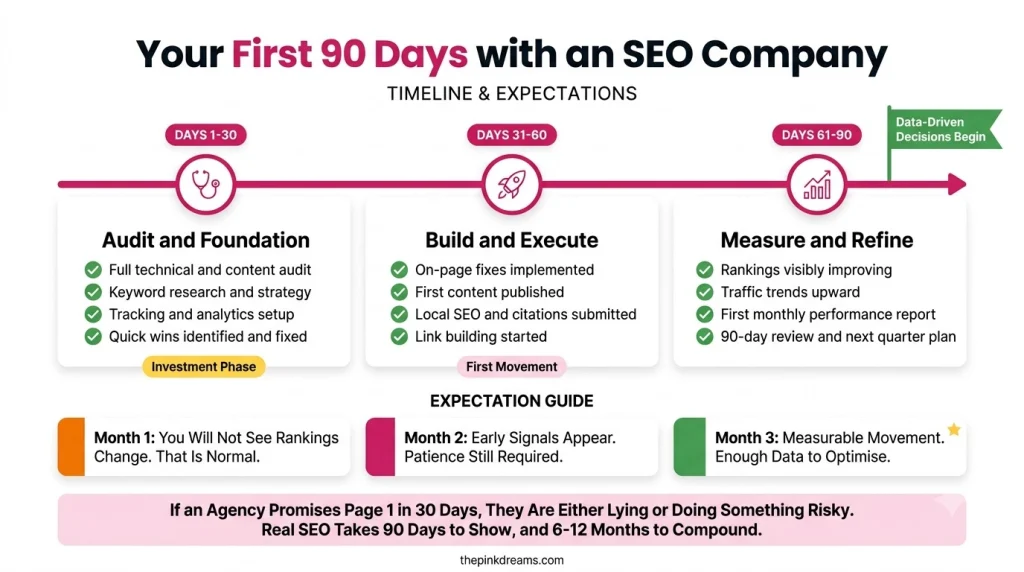
The first 90 days follow a predictable sequence: audit, strategy, fixes, then the first content and authority work. Very little visible movement happens in month one, because the agency is diagnosing and repairing rather than publishing. Understanding this sequence prevents the most common early misunderstanding.
Weeks 1 and 2: Audit and Discovery
The agency examines your website’s technical health, existing rankings, content, backlink profile and analytics setup, and looks at how competitors are performing. It should also interview you about your best customers, your margins and the services you actually want more of. An audit that never asks about your business is a template, not a diagnosis.
Weeks 3 and 4: Strategy and Keyword Mapping
Findings become an SEO strategy: which searches to target, which pages will target them, what needs fixing first, and what will be built. Good keyword research separates informational searches from commercial ones and prioritises the terms buyers use when they are close to spending. You should receive a clear plan with priorities and a realistic timeline before the work starts.
Month 2: Technical Fixes and On-Page Work
Execution begins with the foundations: speed, crawl issues, site structure and indexing, followed by optimizing your most important existing pages. This is the least visible and most valuable month, because everything published later performs better on a technically sound site.
Month 3: Content and Authority Work Begins
New pages and articles start appearing, internal links are strengthened, and authority building begins. Early ranking movement often shows for less competitive terms around now, though enquiries usually follow later. Local businesses may see faster movement if the Google Business Profile was previously neglected.
Key Takeaway: Month one looks like nothing is happening. That month decides whether months four to twelve work.
Monthly SEO Tasks: What SEO Campaign Management Looks Like
Ongoing SEO campaign management is a repeating cycle of publishing, improving, earning authority, monitoring and reporting. The monthly SEO tasks are rarely dramatic, which is precisely why they work: compounding small improvements is how search visibility is built.
• Content production: new service pages, location pages or articles targeting agreed searches.
• Content improvement: updating existing pages that have slipped or never ranked.
• Technical maintenance: checking for new crawl errors, speed regressions and broken links after site changes.
• Authority building: earning links, mentions and listings relevant to your industry and area.
• Local management: posts, photos, questions and review responses on your Google Business Profile.
• Monitoring: tracking rankings, traffic, enquiries and competitor movement.
• Analysis and adjustment: deciding what to do more of next month based on results.
• Reporting and a conversation: a written report plus a call to explain what it means.

Ask any prospective agency which of these are included and how much of each you receive monthly. “Content” without a number is where scope disputes begin.
Key Takeaway: Consistency beats intensity. The agencies that win are the ones still doing this in month eleven.
What You Should Receive From Your SEO Company Each Month
You should receive a written report, a conversation about it, and visible evidence of work completed. A report full of ranking charts with no mention of enquiries tells you the agency is measuring its own activity rather than your business outcomes.
• Work completed: what was published, fixed, built or earned, specifically.
• Enquiries and conversions from organic search, not just sessions.
• Ranking and visibility movement for the terms that matter commercially.
• Traffic by page, so you can see which content is working.
• Competitor context, because losing ground while growing is still losing ground.
• Next month’s priorities, agreed rather than announced.
• Plain-language commentary explaining what changed and why.
If you cannot connect the report to your own enquiry numbers, ask the agency to add that. Our guide on how to measure lead generation covers which figures belong in that conversation.

Key Takeaway: A good report answers one question: did this produce customers, and what happens next?
What a Good SEO Company Needs From You
SEO is a partnership rather than a service you switch on. Agencies that deliver results need access, approvals and your knowledge of the business. Most underperforming campaigns involve a client who stopped responding, not an agency that stopped working.
• Access: to your website, analytics, search console and business listings, in your own accounts.
• Timely approvals: content waiting three weeks for sign-off is content not ranking.
• Subject knowledge: nobody understands your customers’ objections better than you do.
• Honest commercial detail: which services are profitable and which you would rather not sell.
• Enquiry feedback: telling the agency which leads were good is how targeting improves.
• Patience with the timeline, paired with impatience about the work being done.
Key Takeaway: The best results come from clients who answer quickly and share what the agency cannot know.
How SEO Drives Organic Traffic Growth and More Enquiries
SEO grows a business by putting it in front of people at the moment they are looking for a solution. Unlike advertising, the visibility continues after the spending pauses, which is why organic traffic growth compounds while paid traffic resets each month.
The chain is straightforward. Better technical health and content mean more pages ranking. More pages ranking for commercial searches mean more of the right visitors. Clear conversion paths turn a share of those visitors into enquiries. And because the enquiries arrive from people actively searching, they tend to convert better than interrupted audiences.
There is a second benefit that rarely appears in reports. Ranking well is read as credibility by buyers, who assume the businesses at the top are established and trustworthy. That makes every later conversation easier, including the ones that started on another channel entirely.
Key Takeaway: Ads stop when the budget stops. Rankings keep working, which is why SEO compounds.
What an SEO Company Cannot Do, and the Red Flags to Watch
No SEO company can guarantee a specific ranking, because search engines decide results and change how they do so constantly. Any agency promising number one positions, immediate results or a secret method is selling certainty it does not possess.
• Guaranteed rankings: nobody controls search results, so the promise is either naive or dishonest.
• Instant results: meaningful movement takes months, longer in competitive markets.
• Secret techniques: credible agencies explain exactly what they do.
• Reports without enquiries: rankings alone can rise while your phone stays silent.
• Bought links in bulk: a short-term tactic with long-term consequences.
• Accounts in their name: your analytics, search console and listings should always belong to you.
• No questions about your business: an agency that never asks who your best customers are cannot target them.
Costs vary widely by country, competition and scope, so judge a proposal on what is actually included each month rather than on the headline fee. If you need enquiries sooner than SEO can deliver them, PPC and paid search management is the usual bridge while organic visibility builds.
Key Takeaway: Anyone guaranteeing rankings is guaranteeing something they cannot control.
Is an SEO Company Worth It for a Small Business?
An SEO company is worth it when buyers are already searching for what you sell, you are not appearing for those searches, and your website can convert the visitors it receives. If any of those three is missing, fix that first, because SEO amplifies an existing proposition rather than creating one.
The decision is usually one of capacity rather than capability. The individual tasks are learnable, but doing them consistently every month, alongside running a business, is what defeats most owners. An agency buys you consistency and specialist knowledge, which is what the work actually requires.
Give the relationship a fair run. Six months is the minimum sensible assessment period for most markets, and twelve is more realistic in competitive ones. Judging SEO at week six is like digging up a seed to check whether it is growing.
Key Takeaway: Hire for consistency and expertise. Judge over quarters, not weeks.
What Does an SEO Company Do for Your Business in the End?
What an SEO company does, when it is done properly, is turn your website from a brochure into a source of enquiries. It fixes the technical faults holding you back, targets the searches your buyers genuinely use, publishes content that answers their questions, earns the credibility that makes competitive pages rank, and measures the enquiries all of that produced.
If you are evaluating an agency this month, three questions separate the good from the plausible. Ask what they will do in the first 90 days and listen for diagnosis before activity. Ask what their monthly report contains and listen for enquiries rather than rankings alone. Ask what they need from you and be wary of anyone who says nothing, because that answer usually means the work will happen without your business in it.
Then commit properly or not at all. The businesses that get poor results from SEO are rarely the ones who chose the wrong agency. They are the ones who stopped at month four, just as the work was beginning to compound.
If you would like an outside view of where your visibility and pipeline stand today, Pinkdreams can help. Pinkdreams is a digital marketing agency that helps businesses attract more customers through search, paid media, content and conversion-focused strategy. Our team reviews your current visibility and pipeline, builds a customised roadmap, and handles the work needed to turn enquiries into clients. Request a free digital presence audit to see where you stand.
FAQ
What does an SEO company do exactly?
An SEO company improves your visibility in search results through six areas of work: technical website fixes, keyword and intent research with on-page content, authority building through links and mentions, local SEO, conversion alignment on key pages, and analytics with monthly reporting on the enquiries that work produced.
How long does it take to see results from an SEO company?
Most campaigns show early ranking movement within three to six months, with meaningful enquiry growth usually later. New websites and competitive industries take longer. The first month is mostly audit and technical work, so judge progress on work completed and leading indicators rather than enquiries alone.
What should an SEO company deliver every month?
Expect a written report covering work completed, enquiries and conversions from organic search, ranking and visibility movement, traffic by page, competitor context and next month’s priorities, plus a conversation explaining it in plain language. Reports showing only rankings and traffic are measuring activity rather than outcomes.
Can an SEO company guarantee first-page rankings?
No. Search engines decide rankings and change their systems constantly, so no agency controls the outcome. A guaranteed ranking promise is a warning sign rather than a selling point. Credible agencies commit to a defined scope of work and report on enquiries, not on positions they cannot control.
Is it better to hire an SEO company or do SEO yourself?
Do it yourself if you have the time, interest and a simple local market, since the individual tasks are learnable. Hire an agency when consistency is the problem, when competition is strong, or when your time is better spent running the business. Most owners fail on consistency rather than knowledge.

Digital Marketing Strategist & Business Coach
As a leading digital marketing strategist and business coach, he is responsible for helping entrepreneurs and brands grow faster in a smarter, more scalable way. With over 20 years of experience, Nagarajan specializes in practical coaching, automation-first marketing strategies, and technology-driven growth systems. His work focuses on enhancing brand visibility, improving performance, and building sustainable frameworks that enable long-term business success.