




When paid advertising brings in patients, when it burns budget, and how to tell the difference before you spend.
Every agency says healthcare ads work. Every practice that quietly switched them off after four months disagrees. The channel is not really the variable.
Do digital ads work in healthcare marketing? Yes, for demand capture and appointment volume, when the campaign matches how patients search and stays inside health advertising rules. Ads buy attention quickly. They do not buy the trust that turns an enquiry into a booked patient, which is why paid media works best alongside the wider digital marketing services around it.
Key Takeaways
- Ads work for demand capture. They are a poor substitute for reviews, reputation, and organic visibility.
- Intent beats audience size. A patient searching for a specific procedure converts better than any interest-based audience.
- Health is a restricted ad category everywhere, so condition-based targeting is limited or prohibited.
- Measure booked appointments and cost per acquired patient, not clicks.
- Ads stop the day you stop paying. SEO compounds. Most practices need both.
- Landing pages and call handling, not ad creative, are where most healthcare budgets leak.
Do Digital Ads Work in Healthcare Marketing? What Decides the Answer
Digital ads work when four conditions hold together. Remove one and the same campaign stops performing, which is why identical setups produce opposite results for similar clinics.
| Condition | Why it decides the outcome |
| Real search demand | Ads capture demand efficiently but rarely create it |
| Conversion capability | Unanswered calls and slow follow-up waste paid clicks |
| Tracking to appointments | Without it you optimise toward cheap clicks, not patients |
| Margin per patient | High-value procedures absorb acquisition cost. Low-value ones do not |
A dental implant campaign and a check-up campaign can run in the same city on the same budget. The first works because one patient covers months of spend. The second struggles because the margin cannot support a competitive click cost.
Key Takeaway: Diagnose demand, conversion, tracking, and margin before blaming the platform.
The Importance of Digital Marketing in Healthcare: How Patients Search for Care
Most patients research online and shortlist two or three providers before contacting anyone. If you are invisible during that window, you are not in the consideration set at all.
• Symptom Stage: searching conditions. Reached by content, organic search, video.
• Research Stage: comparing treatments. Reached by educational and native ads.
• Comparison Stage: reading reviews and credentials. Reached by your profile and website.
• Decision Stage: searching a provider or procedure by name. Reached by paid and local search.
Ads are strongest at the decision end and weakest at the awareness end, where patients want information rather than an offer.
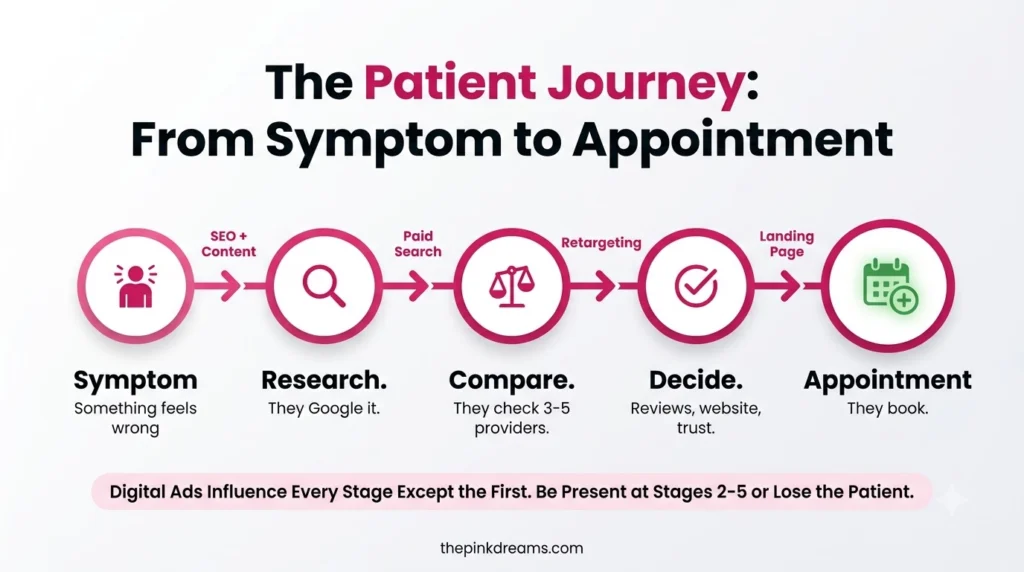
Key Takeaway: Match ad messaging to the stage, or decision-stage copy lands on awareness-stage audiences.
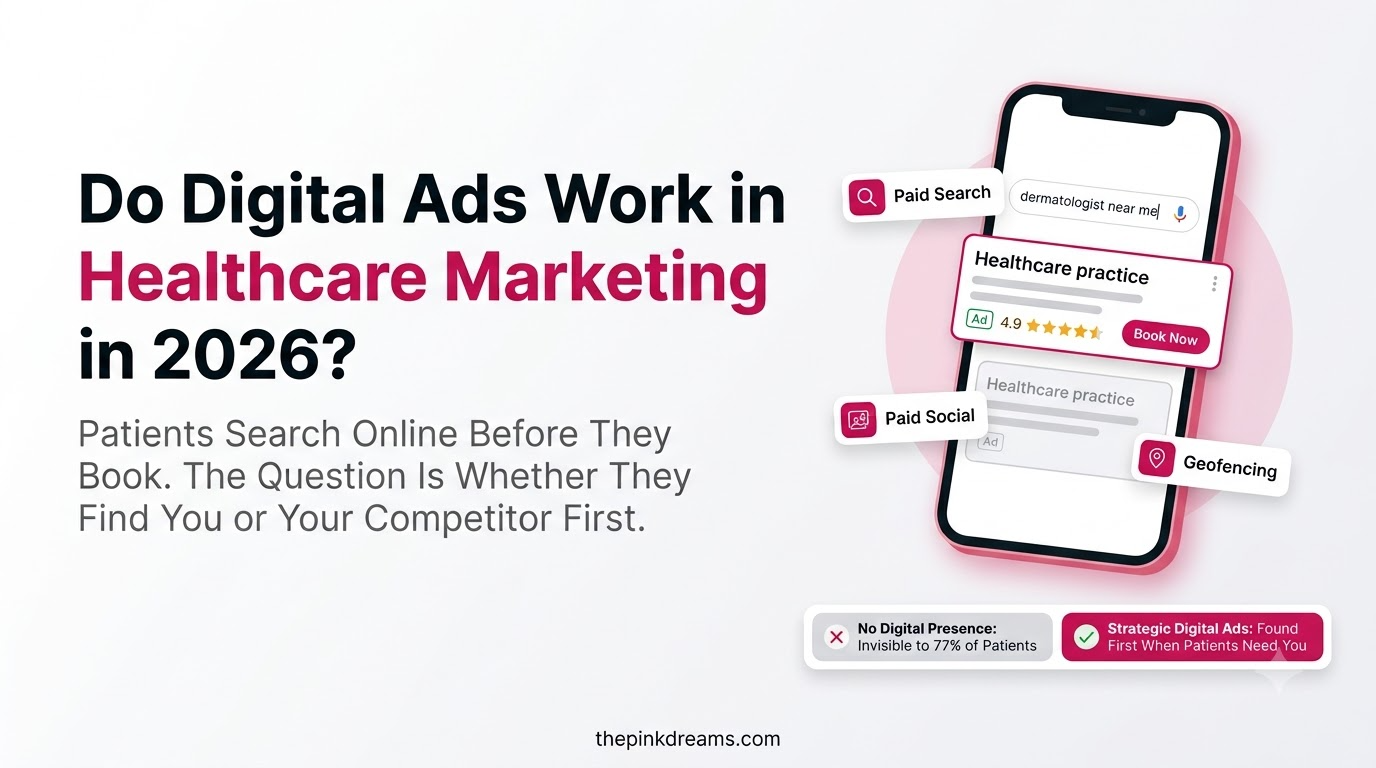
Healthcare Digital Advertising Strategies: 5 Channels That Work
The healthcare digital advertising strategies that perform are matched to a journey stage rather than chosen by popularity.
| Channel | Best for | Watch for |
| Paid search | Capturing active treatment demand | High click costs, heavy research traffic |
| Paid social | Elective services patients do not think to search | Restricted health targeting |
| Video and CTV | Familiarity with the clinician | Measure on lift, not last click |
| Geofencing | Patients within your catchment | Never target locations implying a condition |
| Retargeting | Recovering researchers who left | Brand-level messaging only, not condition-based |
Paid search deserves most of a first budget because intent is highest there, and disciplined PPC and paid search management usually beats a larger budget spent badly. On social, coordinate campaigns with your organic presence through social media marketing services, since patients check the profile before trusting the ad.
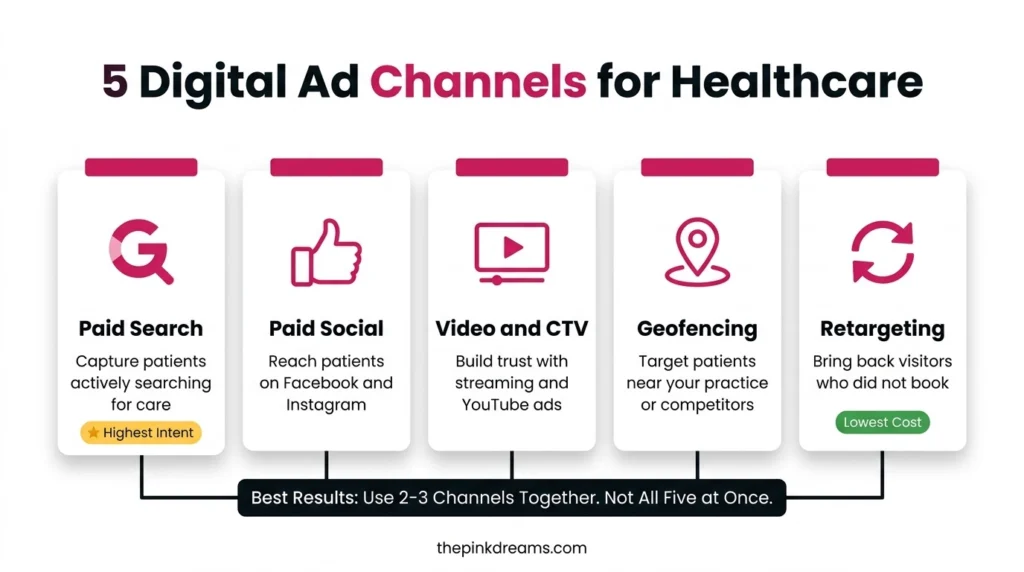
Key Takeaway: Paid search for demand capture, social and video for awareness, geofencing for proximity, retargeting for recovery.
Healthcare Digital Advertising Tips: 7 Rules That Protect the Budget
These healthcare digital advertising tips are operational rather than technical, because campaign settings are the easy part.
1. Build a dedicated landing page per service, fast on mobile, booking above the fold.
2. Track to the appointment with call tracking and booking data, not to the click.
3. Start with your highest-margin service and prove the model before broadening.
4. Separate brand and non-brand campaigns so brand searches do not flatter results.
5. Write to the patient’s problem, not to the practice’s credentials.
6. Update negative keywords weekly to filter research and job-seeking traffic.
7. Judge campaigns on 90 days and real conversion volume, not on the first fortnight.
Key Takeaway: Most healthcare budgets are lost after the click, not during it.
When Digital Ads Do Not Work
Ads fail predictably in five situations, and none are fixed by raising the budget.
• Calls go unanswered during clinic hours.
• Reviews are thin or poor, so patients drop out after you have paid for the click.
• The service has almost no search demand to capture.
• Patient value cannot cover a realistic acquisition cost.
• Tracking never reaches the appointment, so optimization runs on clicks.
Key Takeaway: In these cases ads amplify the problem rather than solving it.
What Ads Cost and How to Measure Return
Medical categories carry some of the highest click costs in digital advertising, and rates vary widely by specialty, city, and country. Budget for media, management, creative, landing pages, and tracking, then measure in layers.
| Metric | What it tells you |
| Cost per click | Competitive pressure in the category |
| Cost per lead | Landing page and offer efficiency |
| Cost per acquired patient | Real acquisition efficiency |
| Patient lifetime value | Whether the campaign actually makes money |
The gap between cost per lead and cost per acquired patient is where most campaigns are misjudged. Cheap enquiries that never book are worse than expensive ones that do.
Key Takeaway: Judge campaigns on cost per acquired patient against lifetime value.
Compliance: What Healthcare Advertisers Cannot Do
Rules come from two directions. Platforms restrict personalized advertising and remarketing based on sensitive health categories, so assume you cannot target by condition. Regulators control claims, testimonials, and in some markets whether you can advertise at all without approval.
| Market | Check locally |
| United States | HIPAA and tracking technologies, FDA drug promotion rules, FTC claim standards |
| Canada | Privacy law, provincial college advertising standards, national ad codes |
| United Kingdom | ASA and CAP codes, MHRA medicines rules, professional regulator guidance |
| Australia | AHPRA advertising guidelines, which restrict testimonials, and TGA rules |
| UAE and Dubai | Health advertising generally needs prior approval or a permit before publication |
Two rules travel everywhere: never imply guaranteed outcomes, and treat patient testimonials as restricted until confirmed otherwise.
Key Takeaway: Run a compliance check before launch, not after a complaint.
Digital Ads vs Healthcare SEO: Which First?
| Digital ads | Healthcare SEO | |
| Time to results | Days | Three to twelve months |
| When you stop | Traffic ends immediately | Visibility persists |
| Best for | Empty slots, new services, competitive markets | Long-term acquisition, research traffic |
| Trust contribution | Low, patients know it is an ad | High, organic and reviews carry credibility |
Run ads on your highest-value service for immediate appointments while investing in SEO services and reviews so acquisition cost falls over time. Fund only ads and you pay full price for every patient indefinitely.
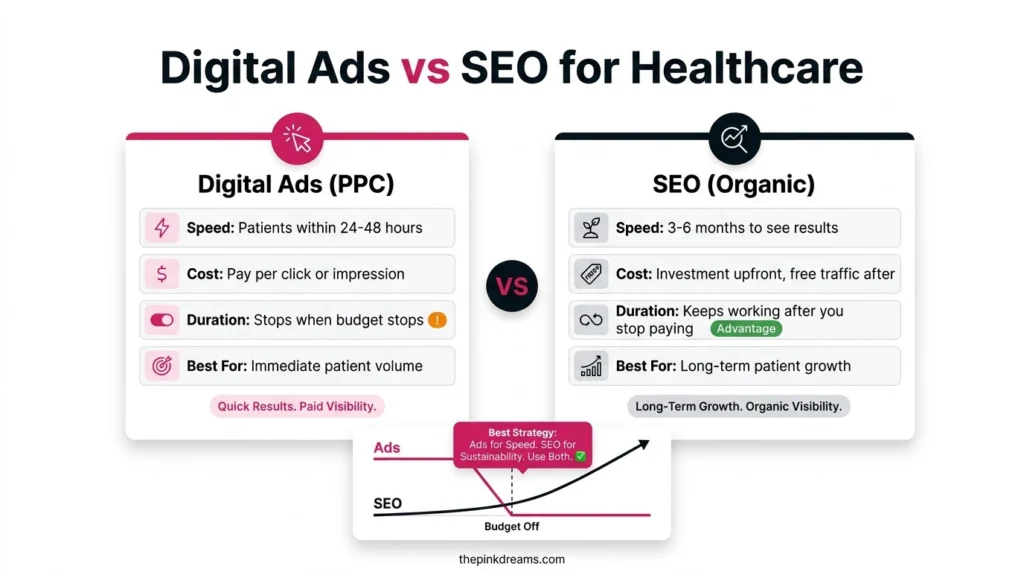
Key Takeaway: Ads rent visibility. SEO owns it.
Digital Marketing for the Healthcare Industry: Where Ads Fit
Digital marketing for the healthcare industry works as a system where each part lowers the cost of the others. Strong reviews raise ad conversion rates. Educational content gives retargeting somewhere useful to send people. A faster booking page improves every channel at once. Isolated campaigns underperform even when technically well built.
Key Takeaway: Ad efficiency depends almost entirely on the components around it.
Final Verdict: Do Digital Ads Work in Healthcare Marketing?
Yes, when there is real demand, the practice converts enquiries, tracking reaches the appointment, and margin supports the acquisition cost. Outside those conditions, ads are an efficient way to spend money.
| Fund ads when | Fix something else first when |
| Slots are unfilled now | Calls go unanswered |
| Margin per patient is high | Patient value cannot cover acquisition cost |
| Patients actively search the treatment | Nobody knows the service exists |
| Reviews and website are solid | Reviews are thin or the site is slow |
Audit the destination first, then start on one high-value service, measure the appointment, and scale what works.
If the harder problem is finding where the budget is leaking, Pink Dreams can help. Pink Dreams is a digital marketing agency that helps healthcare providers grow patient volume through paid media, search, content, and conversion-focused websites. Request a free digital presence audit to see where you stand.
FAQ
Do digital ads actually work for medical practices?
Yes, especially for demand capture. Paid search reaches patients at the moment they look for treatment, and results appear within days. Effectiveness depends on search demand, how reliably the practice converts enquiries, and whether margin per patient covers acquisition cost.
How much does healthcare digital advertising cost?
Costs vary widely by specialty, city, and country, and medical categories are among the most competitive. Budget for media, management, creative, landing pages, and tracking. The number that matters is cost per acquired patient measured against patient lifetime value.
Can healthcare advertisers target patients by medical condition?
Generally no. Major platforms restrict personalized advertising and remarketing based on sensitive health categories. Compliant campaigns target by location, age, and search intent, then let ad copy and landing pages qualify the audience.
Are digital ads better than SEO for healthcare?
They solve different problems. Ads deliver appointments in days and stop when the budget stops. SEO builds visibility over months and keeps working. Most providers run both, using ads for immediate volume and organic search to reduce acquisition cost.
How much should a healthcare practice spend on digital ads?
There is no single budget that works for every healthcare practice. Start with one high-value service, set a budget that can generate enough conversion data, and measure cost per acquired patient against patient lifetime value. Increase spending only after the campaign consistently generates profitable appointments.

Digital Marketing Strategist & Business Coach
As a leading digital marketing strategist and business coach, he is responsible for helping entrepreneurs and brands grow faster in a smarter, more scalable way. With over 20 years of experience, Nagarajan specializes in practical coaching, automation-first marketing strategies, and technology-driven growth systems. His work focuses on enhancing brand visibility, improving performance, and building sustainable frameworks that enable long-term business success.