




A straight answer on whether SEO pays off for a small business in 2026, what it costs, how long it takes, and how to work out the return before you spend anything.
Every small business owner eventually asks the same question after a sales call. Is this actually going to work, or am I about to pay a monthly retainer for a report nobody reads?
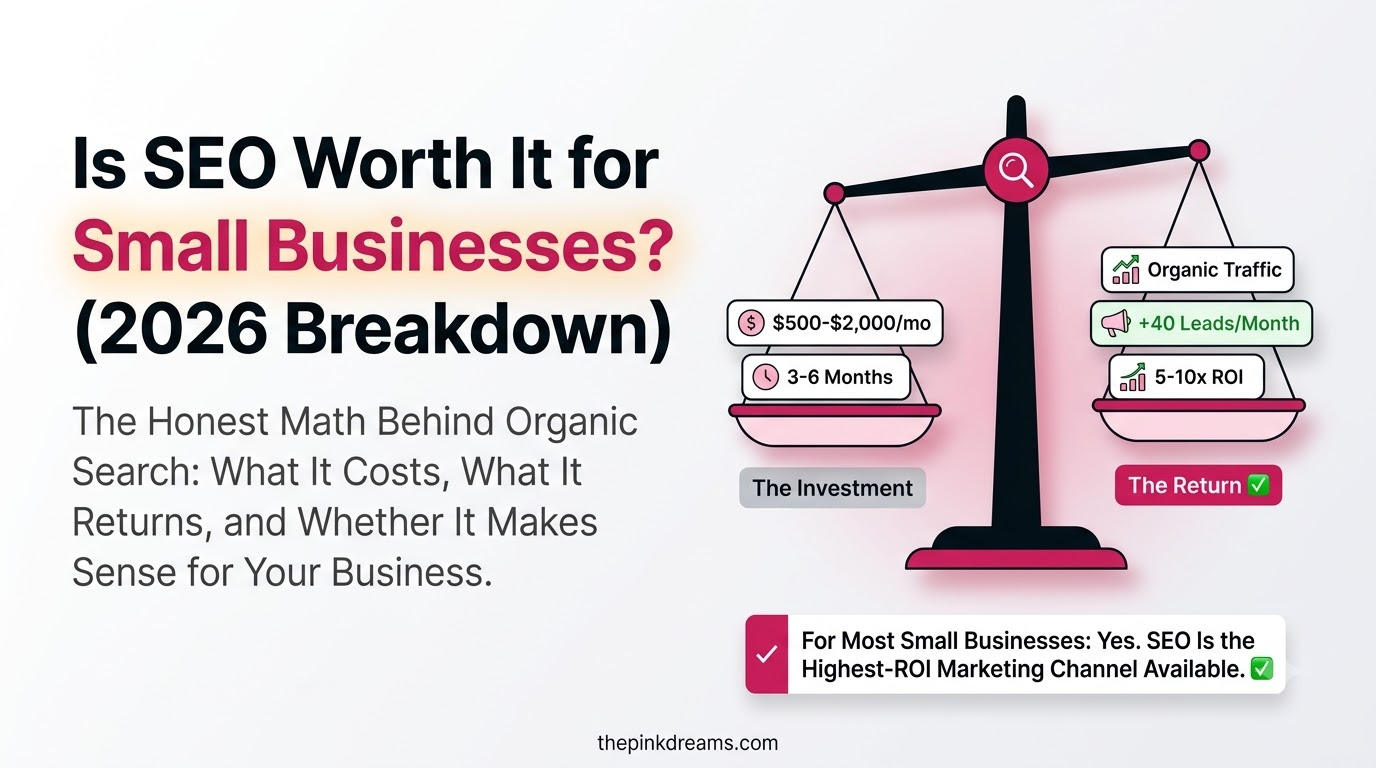
So, is SEO worth it for small business owners in 2026? For most, yes, but not for all of them, and not on the timeline agencies imply. SEO rewards businesses that can wait six to twelve months, already convert the traffic they get, and sell something people search for. It punishes businesses that need revenue this quarter. That distinction matters more than any argument about SEO services in general, because the channel is not the variable. Your situation is.
This guide covers what SEO actually does for a small business, the benefits worth counting, what it costs, how to calculate the return, how long it takes, whether it still works in the AI search era, and the situations where the honest answer is no.
Key Takeaways
- SEO is worth it for small businesses that can fund six to twelve months, convert existing traffic, and sell something people actively search for.
- SEO is not worth it if you need revenue this month, your website does not convert, or nobody searches for what you sell.
- The main benefits of SEO are compounding traffic, lower long-term cost per lead, local visibility, and trust that paid ads cannot buy.
- Google states that SEO changes typically take four months to a year to show benefit, and that nobody can guarantee a number one ranking.
- Calculate your break-even in extra sales per month before comparing any proposal. The number is specific to your business.
- SEO and paid search solve different problems. Paid buys speed, SEO buys durability, and most small businesses need both in sequence.
- AI search has changed how results appear, not whether search matters. Businesses structured for extraction are being cited; the rest are losing informational traffic.
What Is SEO for a Small Business?
SEO, or search engine optimization, is the practice of improving how often and how prominently your website appears in unpaid search results. For a small business, that usually means ranking for a modest number of commercially valuable searches rather than competing nationally, and being visible in local results where buying intent is highest.
Small business SEO differs from enterprise SEO in scope rather than method. You are not trying to own an entire category. You are trying to appear for the twenty or thirty searches your actual buyers type before they choose someone.
The work splits into four areas that depend on each other.
• Technical SEO: whether search engines can crawl, index, and render your site quickly on mobile.
• On-page and content SEO: service pages, location pages, and guides that match what buyers search for.
• Local SEO: Google Business Profile, consistent business details, reviews, and map pack visibility.
• Off-page SEO: the links, citations, and mentions that establish credibility.
Key Takeaway: Small business SEO means winning a focused set of high-intent searches, not competing with national brands across an entire market.
Is SEO Worth It for Small Businesses? The Short Answer
Yes for most, with conditions. SEO is worth it for a small business that can fund at least six to twelve months, has a website capable of converting visitors into enquiries, and sells something people actively search for. It is not worth it as an emergency revenue channel, and it will not rescue a business with no runway.
The reason the answer is conditional is that SEO is an investment with a delay. Google’s own guidance on hiring an SEO states plainly that SEO changes typically take four months to a year to show benefit, and that nobody can guarantee a number one ranking. Any pitch that ignores both facts is a warning sign rather than a bargain.
What makes SEO unusually good value for small businesses specifically is that local and niche search has a far lower barrier than national campaigns. A plumber, accountant, or boutique agency does not need to outrank a global brand. They need to outrank the four competitors in their city, which is achievable within a year on a modest budget.
Key Takeaway: SEO is worth it for small businesses that can wait for it. The channel is sound; the constraint is almost always runway and conversion.
Why SEO Is Important for Small Businesses: 8 Benefits of SEO
Why SEO is important comes down to economics. Paid channels rent attention, and the moment you stop paying, the traffic stops. SEO builds an asset that keeps working. Below are the benefits of SEO that hold up for small businesses specifically, ordered by how directly they affect revenue.
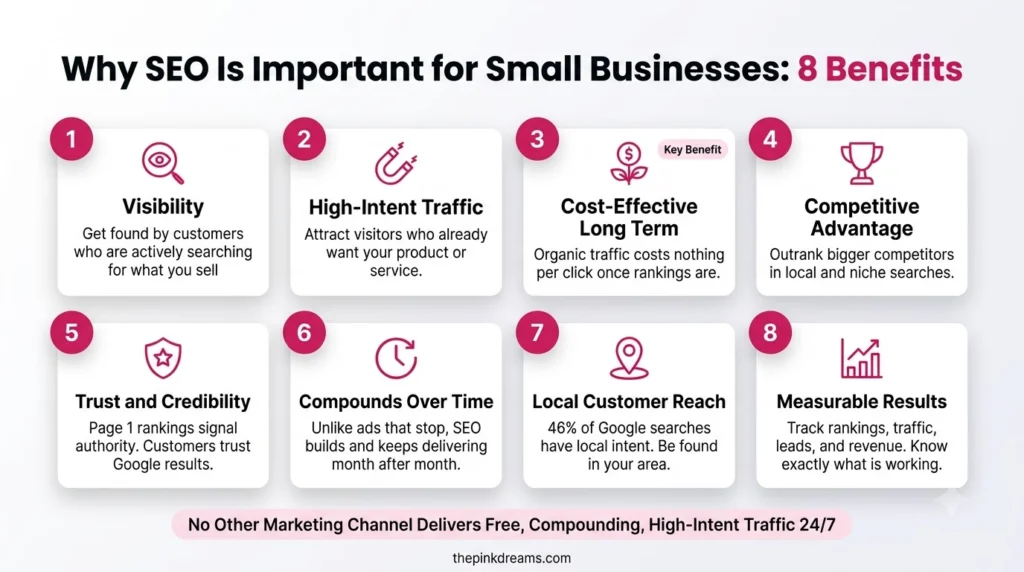
1. It captures people who are already looking. Search traffic is demand you did not have to create. Somebody typing “emergency electrician near me” has decided to buy. No other channel delivers that level of intent at that moment.
2. The cost per lead falls over time. Paid ads cost the same on day one and day nine hundred. A page that ranks keeps producing enquiries with no incremental spend, which is why mature SEO programmes carry a lower long-run cost per lead.
3. Local visibility is winnable. The map pack sits above organic results for local queries and is driven by relevance, distance, and prominence. A complete Google Business Profile, consistent business details, and a steady flow of reviews can put a small business above much larger competitors.
4. Ranking builds trust that ads cannot buy. Buyers know which results are paid. Appearing organically, with reviews and useful content behind you, carries credibility that a sponsored slot does not.
5. It compounds. A page published this year keeps earning enquiries next year, and the authority it builds makes future pages rank faster. This is the single strongest argument for starting early.
6. It improves the website for everyone. Faster load times, clearer structure, and better content help conversion rates, not just rankings. The work pays off twice.
7. It is measurable. Search Console and Analytics show exactly which queries you appear for, which pages earn clicks, and where enquiries came from. Few channels are this transparent.
8. It supports everything else you do. Content built for search feeds email, social, and sales conversations, which works far better when it runs from the same plan as your content marketing services rather than existing as a separate blog nobody owns.
Key Takeaway: The benefits of SEO for a small business are compounding traffic, falling cost per lead, and credibility. All three take time, which is exactly why competitors give up and leave the space open.
SEO vs Paid Search: Where Should a Small Budget Go?
SEO and paid search solve different problems. Paid buys immediate visibility at a fixed cost per click that never falls. SEO buys durable visibility that costs more upfront in time and less over the long run. Most small businesses need both, in sequence: paid to generate cash flow now, SEO to reduce dependency on it later.
| Factor | SEO | Paid search |
| Speed to results | Four to twelve months | Days |
| Cost behaviour | Front-loaded, then falls per lead | Constant, rises with competition |
| What happens if you stop | Rankings decay slowly over months | Traffic stops immediately |
| Trust | Higher, results are earned | Lower, buyers recognise ads |
| Best for | Durable demand capture and local visibility | Launches, deadlines, testing offers |
| Main risk | Slow start, budget abandoned too early | Cost per click rising past viability |
The common mistake is treating them as alternatives. A sensible sequence for a small business is to run paid search and paid social management to prove which offers and keywords convert, then build SEO around the terms already generating sales. You are no longer guessing what to rank for, because paid data already told you.
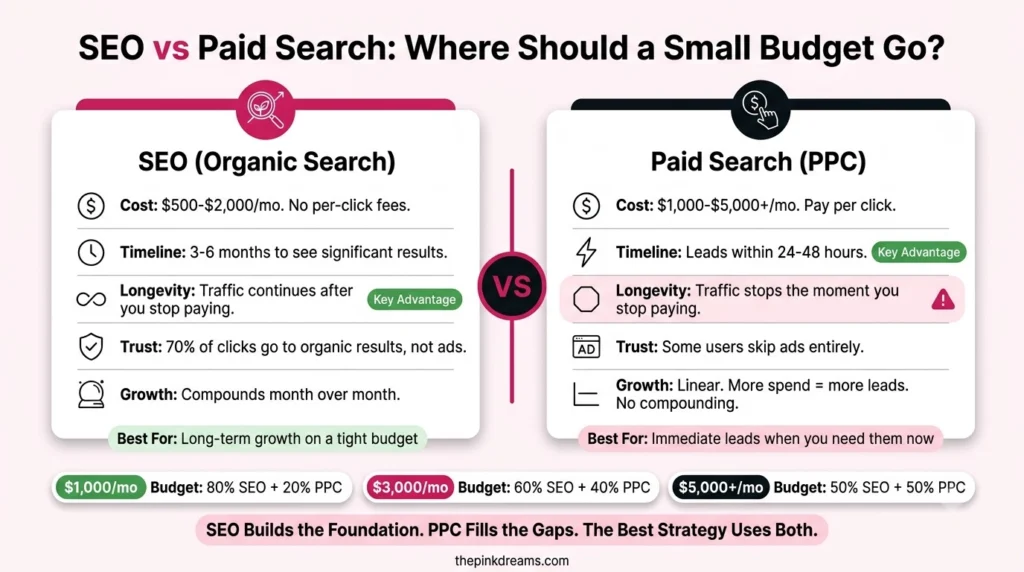
Key Takeaway: Paid buys speed, SEO buys durability. Use paid to find the message and SEO to stop paying for it forever.
Are SEO Services Worth It, or Should You Do It Yourself?
Are SEO services worth it depends on which part of the work you mean. The basics are genuinely doable in-house: claiming and completing your Google Business Profile, requesting reviews, keeping business details consistent, and writing clear service pages. Paying becomes worthwhile at technical fixes, competitive content, and link acquisition.
Doing it yourself has a hidden cost that rarely appears in the comparison. SEO is trial and error when you are learning, and errors are not free. A wrong redirect, a keyword-stuffed page, a poor-quality backlink, or a bad site migration can set you back further than the money you saved. Recovery takes longer than getting it right the first time.
The honest test is whether you have the hours. SEO done properly is a few hours a week, every week, indefinitely. Most owners can find that time for two months and not for twelve, which is why so many DIY efforts produce a burst of activity and then nothing.
Key Takeaway: Do the local and content basics yourself. Pay for technical work, competitive content, and links, or pay for the whole thing if you cannot protect the time every week.
How Much Does SEO Cost for a Small Business?
SEO pricing varies enormously by country, competitiveness, and scope, so treat any single quoted figure as unreliable. What is consistent is the structure: monthly retainers for ongoing work, one-off project fees for audits or migrations, and hourly rates for consulting. Compare quotes within your own market in USD, GBP, CAD, AUD, or AED rather than against figures published elsewhere.
Three things drive the price more than anything else.
• Competition: ranking in a dense city for a competitive service costs multiples of ranking in a small town for a niche one.
• Scope: one location and five services is a different job from twelve locations and thirty services.
• Starting condition: a site with technical debt or a penalty history needs remedial work before growth work begins.
Be sceptical of the cheapest tier. Packages priced below the cost of doing the work properly are usually thin content and automated links, which is how sites acquire problems that cost more to fix than the retainer ever saved.
Key Takeaway: Ignore market averages and judge price against your own break-even, which the next section shows you how to calculate.
The Small Business SEO ROI Guide: How to Work Out Whether It Pays
Use this ROI guide before you take a single sales call. Work backwards from your own numbers rather than forwards from an agency’s promises. Five steps tell you exactly how many extra sales per month SEO must produce to be worth the spend, in whichever currency you operate in.
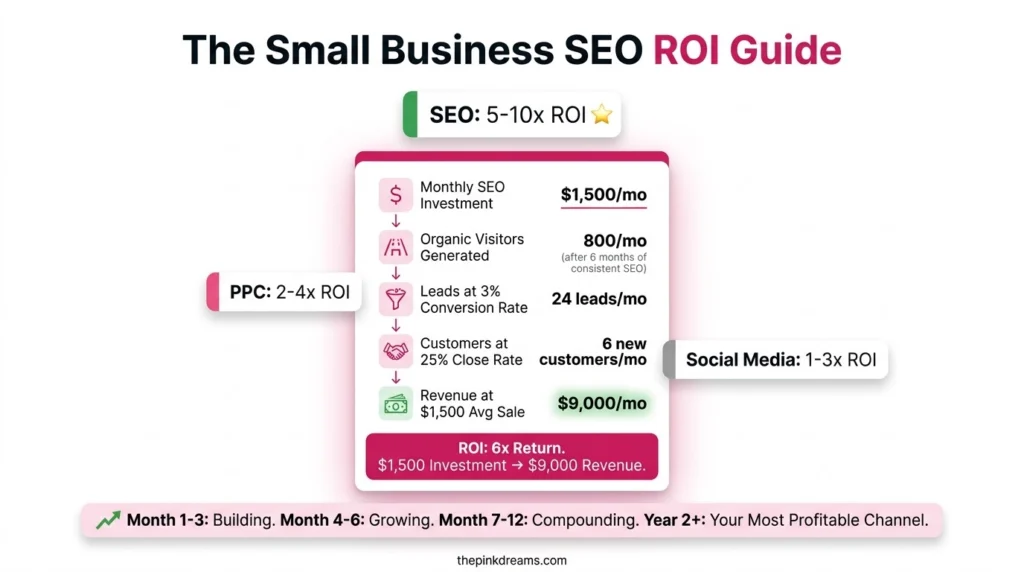
1. Average revenue per closed sale. Use the last quarter, split by service if values differ significantly.
2. Gross margin on that sale. Revenue is not profit. Use the margin, or the maths flatters the result.
3. Enquiry-to-sale close rate. If one in four enquiries converts, four qualified enquiries equals one sale.
4. Break-even sales per month. Divide the monthly retainer by the gross profit per sale.
5. Break-even enquiries per month. Multiply step four by the inverse of your close rate.
If your gross profit per sale is high and your close rate is decent, break-even often lands at one or two extra sales a month, which is a far more useful benchmark than any published average. If break-even lands at fifteen sales a month in a competitive market, the budget and the ambition do not match, and no agency can fix that arithmetic.
Should You Invest? A Six-Question Scorecard
Score one point for each yes. Four or more means SEO is likely worth it. Two or fewer means fix the constraint first.
| Question | Yes means |
| Do people actively search for what you sell? | There is existing demand to capture |
| Can you fund six to twelve months without returns? | You will not abandon it before it pays |
| Does your website already convert some traffic? | More traffic will produce more enquiries |
| Do you have capacity to serve more customers? | Growth will not damage delivery or reviews |
| Is your average sale worth enough to justify a retainer? | Break-even is realistic |
| Can somebody approve content and technical changes promptly? | The work will not stall in your inbox |
Key Takeaway: SEO is worth it when your break-even is a small number of extra sales and you can wait long enough to reach it. Both parts have to be true.
How Long Does SEO Take to Work?
Expect early movement in impressions and visibility within two to three months, and meaningful enquiry growth between six and twelve. Google’s guidance sets the expectation at four months to a year. New websites and competitive markets sit at the slower end; established sites with existing authority move faster.
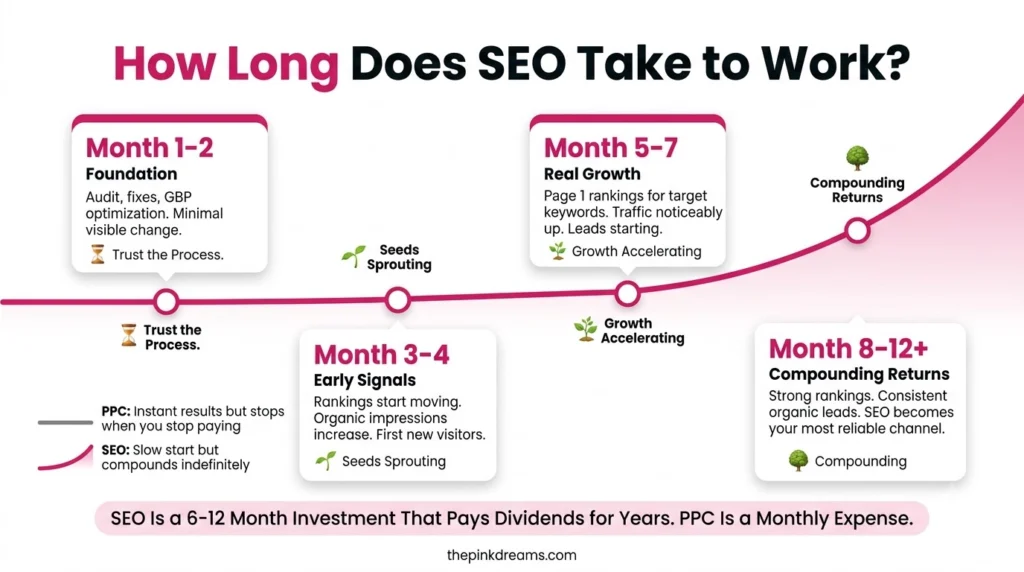
| Period | What should be happening | What to expect in the data |
| Months 1 to 2 | Audit, tracking, keyword research, Google Business Profile, technical fixes | Baseline only |
| Months 3 to 4 | Content publishing, on-page work, internal linking, citations | Impressions rising, first ranking movement |
| Months 5 to 8 | Consistent content, link acquisition, conversion improvements | Clicks and early enquiries |
| Months 9 to 12 | Compounding authority, expanding keyword coverage | Measurable pipeline contribution |
If nothing has been delivered by month three, the problem is the agency rather than the channel. Slow results are normal. No delivered work is not.
Key Takeaway: Budget twelve months to judge SEO properly, and judge the first quarter on work delivered rather than revenue.
Is SEO Still Worth It in the AI Search Era?
Yes, but the definition of success has changed. AI Overviews and answer engines such as ChatGPT, Perplexity, and Copilot now summarise answers directly, which reduces clicks on purely informational content. Search itself has not declined. What has changed is that being the cited source matters as much as holding a blue link.
For small businesses, the practical implications are narrower than the headlines suggest. Local and commercial searches, which is where most small business revenue comes from, still send people to websites, maps, and phone calls. Somebody choosing an emergency plumber does not stop at a summary.
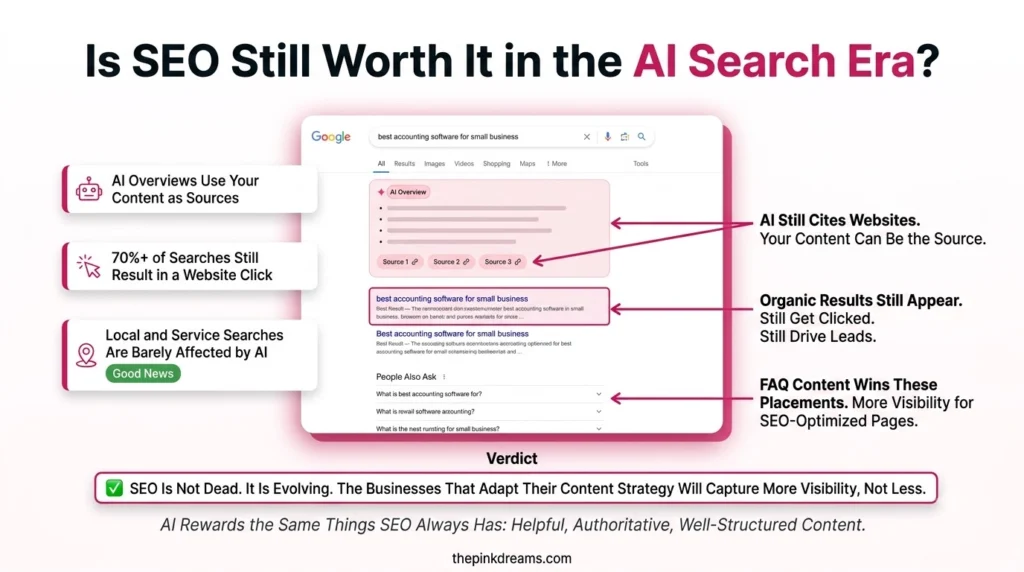
What does need to change is how content is written. Answer engines extract self-contained statements, so clear question-style headings, direct answers near the top of each section, consistent naming, and proper structured data now determine whether you get cited. Businesses that publish vague, padded content are the ones losing traffic.
Key Takeaway: AI search changed how visibility works, not whether it matters. Structure content to be extracted and cited, and prioritise commercial and local intent over generic informational posts.
When SEO Is Not Worth It for a Small Business?
SEO is not worth it if you need revenue within weeks, if nobody searches for what you sell, if your website cannot convert existing traffic, or if you have no capacity for more customers. In those cases the honest recommendation is to fix the constraint first and start SEO afterwards.
• Nobody searches for it. Genuinely new categories have no search volume yet. Demand has to be created through outbound, partnerships, or paid social first.
• You need cash this quarter. Paid search, outbound, and existing customers deliver faster. SEO cannot compress its own timeline.
• Your site does not convert. More traffic through a leaking funnel produces more wasted traffic. Fix the offer and the enquiry path first.
• You are already at capacity. Generating demand you cannot service damages reviews, and reviews feed local rankings.
• The runway is under six months. Starting and stopping wastes the entire spend, because the returns arrive after the point most businesses quit.
Key Takeaway: SEO amplifies a working business. It does not create demand that does not exist or rescue one that is out of time.
Small Business SEO Mistakes That Waste Money
• Quitting at month four: the most expensive mistake, because it discards the investment right before returns begin.
• Targeting vanity keywords: ranking for broad terms your buyers never type produces traffic and no enquiries.
• Buying cheap link packages: low-quality links create problems that cost more to remove than the package cost.
• Redesigning the site without redirects: the fastest way to lose years of accumulated authority overnight.
• Publishing content with no commercial destination: guides that link to nothing convert nobody.
• Ignoring the Google Business Profile: for local businesses, this is often the highest-return asset and the most neglected.
• Measuring rankings only: position one for a term nobody searches produces exactly zero revenue.
• Not tracking where enquiries come from: without attribution you cannot tell whether any of it worked.
Key Takeaway: Most small business SEO failure comes from impatience, wrong targets, or no measurement, rather than from the channel itself.
So, Is SEO Worth It for Your Small Business?
Is SEO worth it for small business owners in 2026 depends on three answers you already have. Can you fund twelve months? Does your website convert the traffic it already gets? Do people search for what you sell? If all three are yes, SEO is one of the most defensible marketing investments available to a small business, because the asset you build keeps producing after the spending stops.
If any of the three is no, the useful move is to fix that first. There is no version of SEO that outran a broken conversion path or an empty runway, and starting anyway is how businesses conclude the channel does not work when the real problem is timing.
The businesses that win at small business SEO are rarely the ones with the biggest budgets. They are the ones that started earlier and kept going while competitors stopped.
And if you would rather have SEO specialists evaluate and manage it for you, Pink Dreams can help. Pink Dreams helps small businesses strengthen their online visibility through SEO strategies designed to attract qualified traffic, improve search rankings, and generate sustainable growth. Our SEO and digital marketing services audit your current visibility, calculate the realistic return before you commit, and build the technical, content, and lead generation work that turns search visibility into booked revenue. Request a free digital presence audit to see where you stand.
FAQ
Is SEO worth it for small businesses in 2026?
Yes for most small businesses, provided you can fund six to twelve months and your website converts the traffic it already receives. SEO remains one of the lowest long-run cost-per-lead channels because the results compound. It is not worth it if you need revenue this quarter or nobody searches for what you sell.
How much should a small business spend on SEO?
SEO costs vary widely by country, competitiveness, and scope, so compare quotes within your own market. Rather than chasing an average, calculate how many extra sales per month would cover the retainer using your gross profit per sale and close rate. If break-even is one or two sales, the investment is usually defensible.
Are SEO services worth paying for, or can I do it myself?
You can handle the basics yourself: your Google Business Profile, reviews, consistent business details, and clear service pages. Paying becomes worthwhile at technical fixes, competitive content, and link building, which need continuous specialist attention. Most owners can protect the time for two months but not twelve, which is usually the deciding factor.
How long before SEO produces results for a small business?
Expect visibility movement within two to three months and meaningful enquiries between six and twelve. Google’s guidance states that SEO changes typically take four months to a year to show benefit. New sites and competitive markets take longer. Any agency promising rankings in weeks is either misrepresenting the timeline or planning something risky.
Is SEO still worth it now that AI answers appear in search?
Yes. AI Overviews have reduced clicks on generic informational content, but local and commercial searches still send people to websites and phone calls. The change is that content now has to be structured for extraction, with clear question-style headings and direct answers, so answer engines can cite it rather than skip it.

Digital Marketing Strategist & Business Coach
As a leading digital marketing strategist and business coach, he is responsible for helping entrepreneurs and brands grow faster in a smarter, more scalable way. With over 20 years of experience, Nagarajan specializes in practical coaching, automation-first marketing strategies, and technology-driven growth systems. His work focuses on enhancing brand visibility, improving performance, and building sustainable frameworks that enable long-term business success.