




Why hire an SEO company, what doing it yourself actually costs you, and how to choose an agency that produces enquiries rather than reports.
Most businesses discover SEO the same way. A competitor they do not particularly rate appears above them on Google, stays there, and quietly takes the enquiries that used to arrive by default. Nothing about the business changed. The visibility did.
Here is the honest answer to why hire an SEO company: search visibility is won by continuous specialist work that almost nobody can sustain internally while also running the business. An SEO company supplies the consistency, the technical depth, the tools, and the measurement discipline that turn search traffic into booked revenue. It also connects to everything else you are doing, which is why SEO belongs inside your wider digital marketing services rather than sitting in a corner on its own.
This guide covers twelve reasons hiring pays off, what it should cost, the questions to ask before you sign, when hiring is the wrong call, and how to tell whether any of it is working.
Key Takeaways
- Hiring an SEO company is a decision about consistency and expertise, not about buying rankings.
- The clearest benefits of hiring an SEO agency are time recovered, specialist judgement, professional tools, and measurement tied to revenue.
- Google states plainly that nobody can guarantee a number one ranking, and that SEO changes typically take four months to a year to show benefit.
- Agencies, freelancers, and in-house hires solve different problems. Choose the one that removes your actual bottleneck.
- Calculate your break-even in extra sales per month before comparing proposals, because prices vary widely by market.
- Do not start SEO if your website cannot convert the traffic it already gets or you cannot fund six to twelve months.
- Judge an agency on audits, ownership, reporting, and link-building methods. Treat ranking guarantees as a disqualifier.
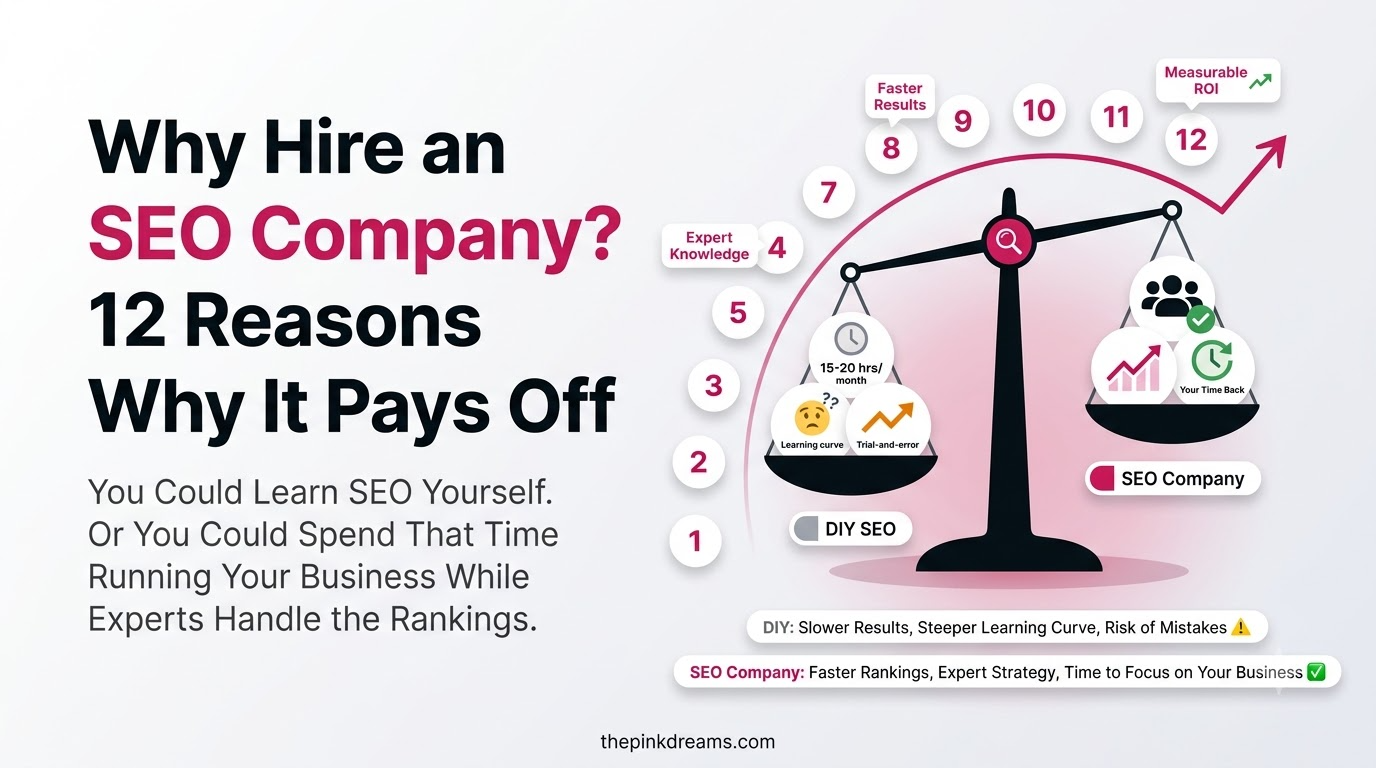
Why Hire an SEO Company Instead of Doing It Yourself?
Hiring an SEO company makes sense once the cost of your own time, the tools you would need to buy, and the slower learning curve add up to more than a retainer. DIY handles the basics competently. It usually stalls at the point where technical fixes, competitive content, and link acquisition all need to happen at the same time.
Most owners start with good intentions. They claim the Google Business Profile, add some keywords, publish two blog posts, then a busy quarter arrives and nothing gets touched for five months. Search does not reward that rhythm, and rankings drift backwards while competitors keep publishing.
There is also a knowledge gap that is easy to underestimate. Google’s own guidance on hiring an SEO is blunt about two things: nobody can guarantee a number one ranking in search results, and SEO changes typically take four months to a year to show benefit. Both facts should change how you judge results and how you judge anyone selling to you.
Key Takeaway: DIY SEO covers the basics. Hiring an SEO expert becomes worthwhile the moment consistency, technical debt, aThese twelve reasons hold up across industries and markets. They are ordered roughly by how quickly you feel them, starting with the one every owner notices first.
1. It buys back time you do not have
SEO is not one task. It is keyword research, page building, technical fixes, content, review management, reporting, and monitoring, repeated every month. Handing that to an agency returns those hours to the work that actually earns money.
A single service page done properly involves research, competitor review, copywriting, internal linking, schema markup, and a post-publish check that it indexed. Multiply that across a full site and it becomes a job, not a task. An agency also runs work in parallel, so technical fixes, content, and link building happen simultaneously rather than one at a time.
2. You get specialist expertise instead of guesswork
An SEO agency brings people who already made the expensive mistakes on someone else’s website. Hiring an SEO expert gives you pattern recognition built across dozens of campaigns, so decisions come from evidence rather than forum advice or whatever a competitor appears to be doing.
The depth is real. Working out why a page is indexed but not ranking, why traffic rose while enquiries fell, or why a smaller competitor outranks you takes diagnostic skill. One common example: traffic doubles after publishing how-to content, but enquiries stay flat, because the content attracts researchers rather than buyers. A specialist spots that in a week.
3. You get tools and data you would not buy alone
Professional SEO runs on paid platforms for keyword research, rank tracking, backlink analysis, site crawling, and competitor intelligence. Agencies spread those subscriptions across clients, so you get enterprise-level data inside a retainer instead of paying for licences you would use a few hours a month.
The free tools matter just as much, and most businesses own them without using them. Google Search Console shows exactly which queries you appear for and where clicks are being lost. A page ranking in position eight with a poor click-through rate can often be fixed by rewriting the title alone. That insight costs nothing, but only if somebody reads the data every month.
4. Technical problems get found before they cost you rankings
Technical SEO failures are invisible from the front end. Pages blocked from indexing, slow mobile load times, broken redirects after a redesign, duplicate content, and missing structured data all suppress rankings while the site looks perfectly fine to you.
Website redesigns are the classic disaster. A business relaunches with a better-looking site, nobody maps the old URLs to the new ones, and years of accumulated authority vanish into 404 errors. Traffic drops within weeks and the cause is rarely obvious to a non-specialist. Agencies run scheduled crawls and monitor Search Console, so problems surface in days rather than quarters.
5. Content and link building run consistently, not in bursts
Search rewards consistency. An SEO company keeps content and off-page work moving every month: new guides, refreshed service pages, internal linking, digital PR, and citations. Steady output builds topical authority, while sporadic internal effort produces spikes that fade.
Content should map to the questions buyers actually ask, from early research through to comparison and decision, with each piece linking to the pages that generate enquiries. This works far better when it feeds from the same plan as your content marketing services rather than existing as a separate blog nobody owns.
6. Local and multi-market visibility gets handled properly
For any business with a location or a service area, local search is the highest-intent channel available. The map pack sits above organic results for “near me” and “[service] in [city]” queries, and it is driven by relevance, distance, and prominence rather than your homepage alone.
Doing it well means a genuinely complete Google Business Profile, accurate categories and service areas, consistent name, address, and phone details across directories, and a steady flow of reviews rather than a burst of ten. Businesses operating across the US, the UK, Canada, Australia, and the UAE have the added problem of different search behaviour, currencies, and competitors in each market, which is exactly the sort of thing that gets neglected in-house.
7. You stay current with algorithm updates and AI search
Google updates its ranking systems continuously and ships several core updates a year. On top of that, AI-generated answers now sit above traditional results for a growing share of queries. An SEO agency tracks those shifts and adjusts, so your visibility survives changes that catch unmanaged sites by surprise.
The AI shift is the urgent one. Answer engines such as Google’s AI Overviews, ChatGPT, Perplexity, and Copilot summarise answers directly, which means content has to be structured so it can be extracted and cited: clear question-style headings, direct answers near the top of each section, self-contained factual statements, and proper schema. Businesses that ignore this will watch their informational traffic quietly disappear.
8. Results get measured against leads and revenue
A good SEO company reports on the numbers that matter: enquiries, calls, form submissions, cost per lead, and revenue by service line. Rankings and sessions are diagnostics, not outcomes. Proper measurement also tells you which services and which locations deserve more investment.
This is where hiring an SEO agency changes how you run the business rather than just the website. Once you know which service converts at the highest value, or which city produces three times the enquiries of another, decisions about budget, hiring, and expansion get easier. Reports showing only keyword positions cannot tell you any of that.
9. The growth compounds, which is the real reason to invest
SEO is an asset rather than an expense. Paid ads stop delivering the day you stop paying, while a well-optimized site keeps earning enquiries from work done months earlier. That compounding is the strongest of all the reasons to invest, provided you can fund the early months before returns appear.
A page published in March can still generate enquiries three years later. Authority earned this year makes next year’s pages rank faster. The honest trade-off is timing, which is why SEO should sit alongside faster channels rather than replacing them overnight.
10. DIY SEO often becomes expensive trial and error
DIY SEO can look cheaper at first, but trial and error has a cost. A wrong redirect, a poor-quality backlink, a keyword-stuffed page, or an indexing mistake can set a site back far more than the money saved by doing the work yourself.
A professional starts with a proven process, tests changes carefully, and knows which risks are not worth taking. That is the real saving: not the hours, but the mistakes that never happen. Every avoidable error costs twice, once in the effort spent making it and again in the months of visibility lost before anyone notices.
11. Recovering from SEO damage is harder than building it right
SEO problems are far easier to prevent than to repair. Once a site loses rankings through poor links, technical errors, a bad migration, or low-quality content, recovery can take months of diagnosis and corrective work before growth resumes.
The asymmetry is what makes this expensive. While you are undoing the damage, competitors occupy the positions you vacated, and search engines have to re-evaluate a site they have already downgraded. Getting the foundations right from the start is consistently faster and cheaper than recovering from avoidable mistakes, and the enquiries lost during the recovery period are difficult to recover.
12. Stay Ahead of Changes in SEO and Search Technology
SEO is constantly evolving. Search algorithms, AI-powered search, content standards, and optimization methods change regularly, so what works today may not work the same way tomorrow. An experienced agency monitors these changes and adjusts its strategy instead of relying on the same tactics year after year.
The real advantage is knowing which changes matter and how to respond to them. Agencies work across multiple campaigns, giving them broader exposure to algorithm updates, emerging search behaviour, and new optimization approaches. That experience helps them adapt your strategy without chasing every new trend.
Key Takeaway: Time, expertise, consistency, and avoided mistakes are what you are actually buying. The rankings are a by-product of those four things being handled properly every month.
Agency, Freelancer or In-House: Which Should You Choose?
There is no universally correct answer. Agencies suit businesses needing several disciplines at once, freelancers suit narrow and well-defined work, and in-house hires suit companies with enough volume to keep a specialist busy and enough senior oversight to direct them. Match the model to your constraint rather than to the headline price.
| Factor | SEO agency | Freelancer | In-house hire |
| Skill coverage | Technical, content, local, and links in one team | Usually one or two strengths | Depends entirely on the individual |
| Capacity | Several people working in parallel | Capped by one person’s hours | One person’s full attention |
| Tool access | Included in the retainer | Often limited or shared | You buy every licence |
| Ramp-up time | Fast, processes already exist | Fast | Slow, recruit then train |
| Best suited to | Competitive markets, multi-location or multi-service businesses | Defined projects and smaller sites | High-volume businesses with senior oversight |
| Main risk | Junior staff doing the actual work | Single point of failure | A wrong hire is expensive and slow to fix |
The most common in-house mistake is hiring a junior specialist with nobody senior enough to direct or evaluate them. They produce activity without strategy, and it takes a year to notice.
Key Takeaway: Choose the model that removes your real bottleneck, whether that is expertise, capacity, or accountability.
How Much Should You Spend on SEO?
SEO pricing varies enormously by country, competitiveness, and scope, so treat any single quoted figure with suspicion. The reliable approach is to work backwards from your own numbers: average sale value, close rate, and target volume. That calculation tells you what SEO has to produce to be worth it, in USD, GBP, CAD, AUD, or AED.
Run this before you take a single sales call.
1. Average revenue per closed sale. Use the last quarter, split by service line if values differ.
2. Enquiry-to-sale close rate. If one in four enquiries converts, you need four qualified enquiries per sale.
3. Target additional sales per month. Pick a number you can actually deliver.
4. Required extra enquiries. Multiply step three by the inverse of your close rate.
5. Break-even. Compare the gross profit from those extra sales against the monthly retainer.
For most businesses the break-even lands at a surprisingly small number of extra sales per month, which is a far more useful benchmark than any market average. If a proposal cannot show a credible route to that number, either the scope is wrong or the market is too competitive for the budget on offer.
Key Takeaway: Judge SEO against the sales it needs to produce. That number is specific to your business and cannot be faked in a pitch deck.
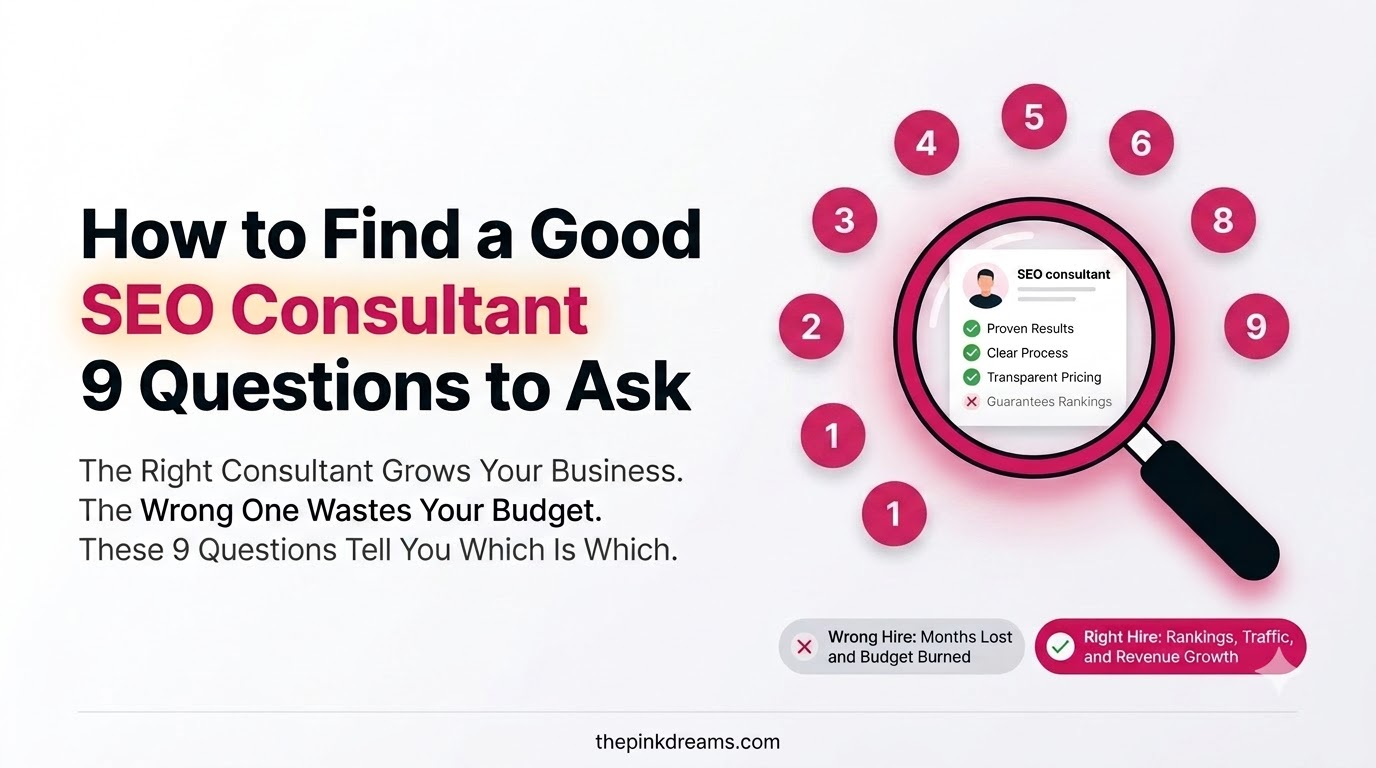
8 Questions to Ask Before Hiring an SEO Agency
The vetting call decides most of the outcome. Ask for an audit before you commit, request references, insist on transparent reporting, and treat any guarantee of a number one ranking as disqualifying. Google’s own guidance recommends exactly this kind of due diligence before signing anything.
1. Can you show me an audit of my site before we start? A credible agency will identify real problems, not compliment your logo.
2. Who will actually do the work? Sales polish and delivery quality are frequently different people.
3. What results have you produced for businesses like mine? Ask for case studies with enquiry data, not screenshots of traffic charts.
4. How will you measure success? The answer should include enquiries, calls, and cost per lead, not rankings alone.
5. What is your link-building approach? Bought links, private blog networks, and vague answers are risks to your domain.
6. What happens if we part ways? Content, accounts, and profile access should remain yours.
7. What is the contract length and notice period? Long lock-ins with no performance review favour the agency, not you.
8. How do you handle AI search visibility? An agency without an answer here is working from an outdated playbook.
| Red flag | Why it matters |
| Guaranteed number one rankings | Google states plainly that nobody can guarantee this |
| No audit or discovery before the proposal | The strategy is generic rather than built for your site |
| Reporting on rankings only | Hides whether enquiries actually increased |
| They own your accounts or content | Leaves you unable to leave without losing assets |
| Vague descriptions of link building | Often means purchased or low-quality links |
| Pressure to sign immediately | Good agencies have a pipeline and do not need to rush you |
Key Takeaway: Vet on process, ownership, and measurement. Price is the last question, not the first.
When You Should Not Hire an SEO Company
Do not hire an SEO company if you cannot fund at least six to twelve months, if your website cannot convert the traffic it already receives, if you have no capacity to service more customers, or if you need revenue this month. In those cases, fix the constraint first and start SEO afterwards.
• Your site converts poorly. If visitors already arrive and do not enquire, more traffic simply multiplies a leaking funnel. Fix the offer, the page speed, and the calls to action first.
• You need immediate volume. Paid search delivers faster. Use paid search and paid social management to bridge the gap while SEO builds, rather than expecting organic results in weeks.
• You are already at capacity. Generating demand you cannot service damages reviews, and reviews feed local rankings.
Being honest about this protects everyone. An agency that takes a client with no runway and no conversion path is arranging a cancellation in month four.
Key Takeaway: SEO amplifies a working business. It does not compensate for a broken website, an empty budget, or a delivery bottleneck.
How Long Does SEO Take, and What Should Happen First?
Expect early movement in impressions and visibility within two to three months, and meaningful enquiry growth between six and twelve. The first ninety days should be about foundations rather than results, and you can hold an agency to a clear delivery schedule even while the numbers are still flat.
| Period | What should be delivered | What to expect in the data |
| Days 1 to 30 | Technical audit, tracking setup, keyword and competitor research, Google Business Profile optimization | Baseline only |
| Days 31 to 60 | Priority technical fixes, service page rewrites, internal linking, schema, review process | Impressions beginning to move |
| Days 61 to 90 | Consistent publishing, citation cleanup, first link acquisition, reporting established | Early ranking movement, some clicks |
| Months 4 to 6 | Content depth, ongoing links, conversion improvements | Enquiries starting to arrive |
| Months 6 to 12 | Compounding content and authority | Measurable pipeline contribution |
If none of the first ninety days has happened by day ninety, that is a legitimate reason to review the relationship. Slow results are normal. No delivered work is not.
Key Takeaway: Judge the first ninety days on work delivered, then judge months six to twelve on enquiries and revenue.
How to Measure Whether Your SEO Company Is Working
Measure SEO on whether it produced enquiries, not impressions. Rankings and traffic are diagnostic figures that explain what is happening, but they are not the goal. Modest traffic from exactly the right people is worth more than a spike of visitors who will never buy.
| Stage | Metric to watch | What it actually tells you |
| Indexing | Pages indexed and crawl errors | Whether search engines can access your site at all |
| Visibility | Impressions and average position | Whether you are appearing for the right queries |
| Relevance | Click-through rate by page | Whether your titles and descriptions earn the click |
| Quality | Rankings for commercial keywords | Whether you rank for terms buyers use, not just informational ones |
| Conversion | Form fills, calls, and enquiries | Whether traffic is turning into contact |
| Pipeline | Revenue attributed to organic search | Whether the investment is actually paying back |
Ask every new enquiry how they found you, because attribution is unreliable. Somebody may read three of your guides over four months and then arrive through a branded Google search, and analytics will credit that to direct traffic. Pairing SEO reporting with your lead generation tracking is the only way to see the full picture.
Key Takeaway: Judge SEO on enquiries and commercial rankings. Impressions explain performance; they do not measure success.
SEO Mistakes That Waste Your Money
• Buying rankings rather than a strategy: cheap packages with fixed keyword lists ignore what your buyers actually search.
• Changing agency every six months: each switch resets momentum, which is the most expensive habit in the industry.
• Approving no content: agencies stall waiting for sign-off, and the delay is billed as the retainer regardless.
• Redesigning the website without telling the SEO team: the fastest way to lose years of accumulated authority.
• Ignoring the technical recommendations: advice that never reaches the developer produces no result and no accountability.
• Judging results in week three: Google’s own guidance sets the expectation at four months to a year.
• Not owning your own accounts: if the agency holds your Google Business Profile or analytics, you are renting your own data.
• Measuring rankings and nothing else: position one for a term nobody searches produces exactly zero enquiries.
Key Takeaway: Most SEO failure comes from impatience, poor briefing, or the wrong measurement, not from the channel itself.
Making the Decision to Hire an SEO Company Work for Your Business
The decision to hire an SEO company comes down to a straightforward test rather than a leap of faith. Ask how many extra sales per month would justify the investment. Ask whether your website can convert the traffic it already gets. Ask whether you can fund six to twelve months before the returns arrive. If those three answers line up, hiring is one of the more defensible marketing investments available.
The payoff is structural rather than instant. Organic search compounds, so the pages and authority built this quarter keep producing enquiries long after the work is done, while paid channels stop the moment the budget does. That is why businesses with mature SEO programmes carry a lower long-run cost per lead than competitors relying on ads alone.
Start with the numbers rather than the sales calls. Work out your break-even, confirm your site converts, then shortlist agencies willing to audit before they pitch.
And if you would rather have specialists build and run it, Pink Dreams can help. Pink Dreams is a digital marketing agency that helps business owners and startups grow online across the US, the UK, Canada, Australia, and Dubai. Our SEO services and wider growth work audit your current visibility, build a customized roadmap, and execute the technical, content, and link work that turns search visibility into booked revenue. Request a free digital presence audit to see where you stand.
FAQ
Why should I hire an SEO company instead of learning SEO myself?
You can learn the basics, and you should. The gap appears at technical fixes, competitive content production, and link acquisition, which all need to run simultaneously and continuously. Hiring an SEO company buys expertise, tools, and capacity at once, which is usually cheaper than the revenue lost while you learn on your own site.
How much does hiring an SEO company cost?
SEO costs vary widely by country, competitiveness, and scope, so compare quotes within your own market rather than against figures published elsewhere. The useful approach is to calculate how many extra sales per month would cover the retainer using your own average sale value and close rate, then judge each proposal against that number.
How long before an SEO agency produces results?
Expect early visibility movement within two to three months and meaningful enquiry growth between six and twelve. Google’s guidance states that SEO changes typically take four months to a year to show benefit. Competitive markets take longer. Any agency promising results in weeks is either misrepresenting the timeline or planning something risky.
Is hiring an SEO agency worth it for a small business?
Yes, often more so than for large ones, because local and niche search has a far lower barrier than national campaigns. A focused strategy covering your Google Business Profile, reviews, service pages, and a handful of commercial keywords can outrank much larger competitors within a defined area or specialism.
What is the difference between hiring an SEO expert and an SEO agency?
An SEO expert is one specialist, usually strongest in a single area such as technical SEO or content. An agency provides a team covering technical, content, local, and link building simultaneously, plus tools and capacity. Freelancers suit defined projects. Agencies suit ongoing, multi-discipline work across several services or locations.

Digital Marketing Strategist & Business Coach
As a leading digital marketing strategist and business coach, he is responsible for helping entrepreneurs and brands grow faster in a smarter, more scalable way. With over 20 years of experience, Nagarajan specializes in practical coaching, automation-first marketing strategies, and technology-driven growth systems. His work focuses on enhancing brand visibility, improving performance, and building sustainable frameworks that enable long-term business success.