Introduction
Most moving companies do not have a marketing problem. They have a planning problem. They try random tactics, spend money on ads without tracking results, and wonder why leads are inconsistent. If you want to build a predictable lead generation system, you need a structured moving company marketing plan with clear phases, specific actions, and measurable outcomes.
The moving industry is more competitive than ever. With over 16,000 companies operating in the United States alone and customer expectations shifting toward digital-first interactions, the movers who win are the ones who execute a focused marketing strategy, not the ones who throw money at random channels and hope for the best.
This 90-day digital marketing plan gives you exactly that: a phase-by-phase execution roadmap designed specifically for moving companies. Each phase builds on the previous one, creating momentum that compounds over time. By the end of 90 days, you will have a foundation that generates consistent leads, a traffic engine driving visitors to your site, and an optimization system that converts that traffic into booked moves.
Why Moving Companies Need a 90-Day Marketing Plan
Clarity and Direction: Without a plan, marketing becomes reactive. You spend money when things are slow and stop when things are busy. A 90-day plan gives you a clear sequence of actions, so you always know what to do next, regardless of how busy your schedule is.
Faster Results: Random tactics produce random results. A structured plan ensures every action builds on the previous one. Your Google Business Profile optimization in Phase 1 makes your Google Ads in Phase 2 more effective. Your content strategy in Phase 2 makes your SEO in Phase 3 more powerful. This compounding effect accelerates results.
Better ROI: When you track what you do and measure the results, you stop wasting money on what does not work and double down on what does. A 90-day plan with built-in tracking ensures every marketing dollar is accountable.
Overview of the 90-Day Strategy
| Phase | Timeline | Focus | Expected Outcome |
| Phase 1 | Days 1-30 | Foundation and Setup | Website ready, tracking live, GBP optimized |
| Phase 2 | Days 31-60 | Traffic and Visibility | Ads running, content published, leads starting |
| Phase 3 | Days 61-90 | Optimization and Scaling | Leads increasing, costs decreasing, system running |
Phase 1 (Days 1-30): Foundation and Setup
The first 30 days are about building the infrastructure that everything else depends on. Skip this phase and every dollar you spend on ads and SEO later will underperform. Get this right and you set yourself up for compounding returns.
Week 1: Website Audit and Quick Fixes
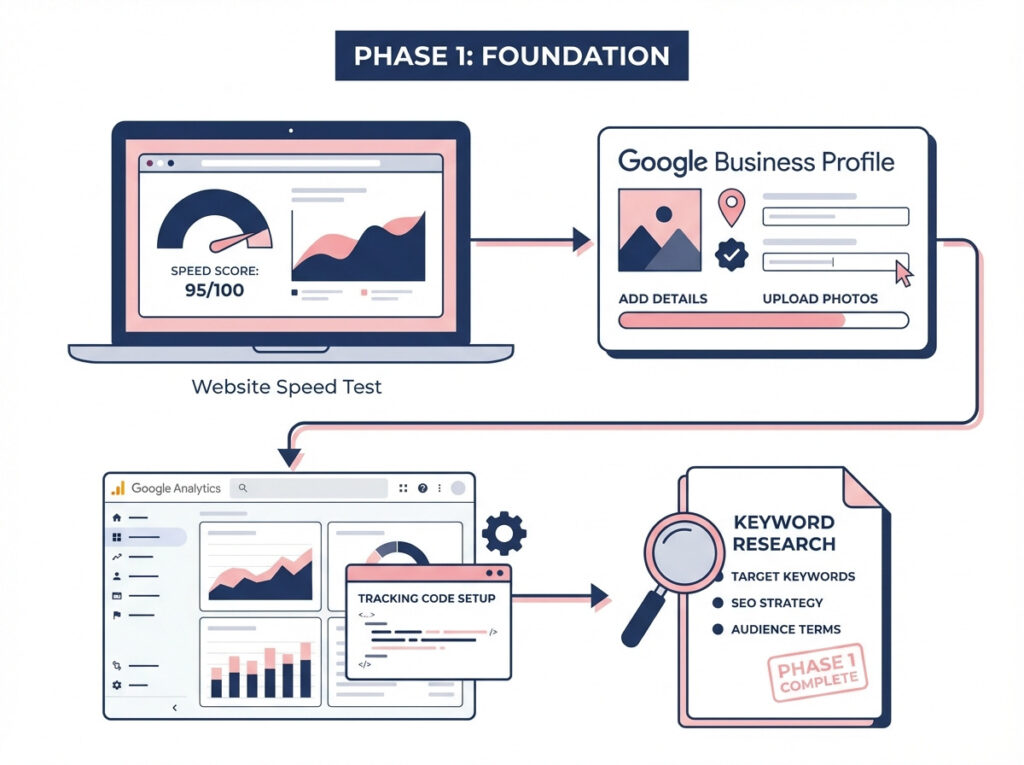
Run a website speed test: Use Google PageSpeed Insights. If your score is below 70, fix critical issues: compress images, enable caching, and minimize render-blocking scripts. Target: load time under 3 seconds.
Check mobile responsiveness: Test on at least 3 different phones. Every form, button, and page must work flawlessly on mobile. Over 62% of your traffic will come from mobile devices.
Review your quote request form: Is it easy to find? Does it work on mobile? Does it have too many fields? Simplify to name, phone, email, moving date, origin, destination. That is it.
Add trust signals: Ensure your license number, insurance info, years in business, and customer reviews are visible on every page.
Week 2: Keyword Research and Content Planning
Identify your top 20 keywords: Use Google Keyword Planner or Ubersuggest. Focus on: “movers in [city],” “moving company [city],” “affordable movers [city],” plus service-specific terms like “long distance movers [city]” and “office movers [city].”
Map keywords to pages: Assign each keyword group to a specific page on your site. Your homepage targets your primary city. Service pages target service + city combinations. Blog posts target question-based keywords.
Plan 4-8 blog topics: Choose topics your customers actually search for: “How much does it cost to move in [city]?” “Moving day checklist.” “How to choose a moving company.” These will be published in Phase 2.
Week 3: Google Business Profile Setup
Claim and verify your profile: If you have not done this, do it immediately. Verification can take up to two weeks via postcard, so start early.
Complete every field: Business name, address, phone, website, hours, primary category (Moving Company), secondary categories, service areas, and a keyword-rich business description.
Upload 15+ photos: Team photos, trucks, completed moves, your office, and your logo. Businesses with more photos receive significantly more clicks.
Set up messaging and Q&A: Enable messaging so customers can contact you directly through Google. Add common questions and answers to your Q&A section.
Week 4: Tracking and Analytics Setup
Install Google Analytics 4: Set up your GA4 property and verify it is tracking page views, traffic sources, and user behavior correctly.
Set up conversion tracking: Track form submissions, phone calls (use a call tracking number), and any online booking completions as conversion events.
Connect Google Search Console: This shows you which keywords your site appears for, your average position, and click-through rates. Essential for measuring SEO progress.
Create a tracking spreadsheet: Record baseline metrics: current monthly website visitors, current monthly leads, current Google ranking positions for your top 10 keywords. You will compare these at Day 60 and Day 90.
Phase 1 Checklist
| Action Item | Deadline |
| Website speed test completed, critical fixes applied | Day 7 |
| Mobile responsiveness verified on 3+ devices | Day 7 |
| Quote form simplified and tested | Day 7 |
| Top 20 keywords identified and mapped to pages | Day 14 |
| 4-8 blog topics planned with outlines | Day 14 |
| Google Business Profile claimed, verified, fully completed | Day 21 |
| 15+ photos uploaded to GBP | Day 21 |
| Google Analytics 4 installed and verified | Day 28 |
| Conversion tracking live (forms + calls) | Day 28 |
| Baseline metrics recorded in tracking spreadsheet | Day 30 |
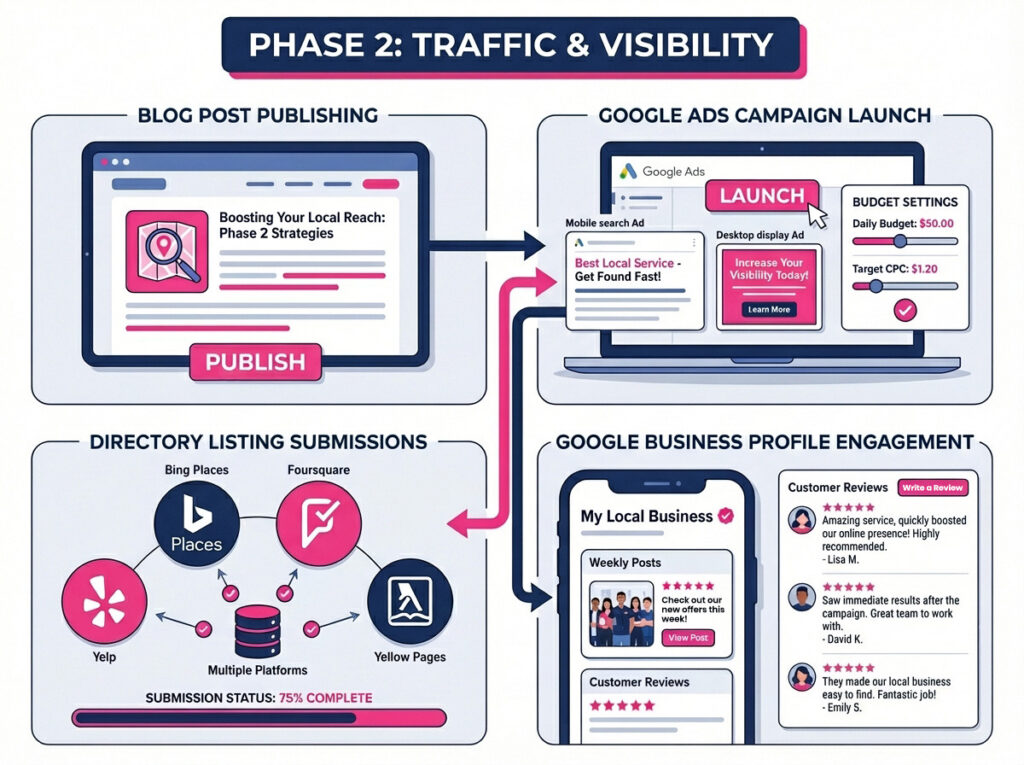
Phase 2 (Days 31-60): Traffic and Visibility
With your foundation in place, Phase 2 is about turning on the traffic engines. This is where you start publishing content, launching ads, and building the local signals that tell Google your business is relevant and trustworthy.
Launch SEO Content (Days 31-45)
Publish 2-4 blog posts: Write and publish the blog topics you planned in Phase 1. Each post should be 800-1,500 words, target a specific keyword, include internal links to your service pages, and end with a call-to-action to request a quote.
Create or improve service pages: Ensure you have a dedicated page for each service (residential, commercial, long-distance, packing, storage). Each page needs a unique title tag, meta description, H1 heading, and 500+ words of original content.
Build location pages: Create individual pages for your top 3-5 service cities. Each should describe your services in that specific area, include local landmarks and neighbourhoods, and have a quote form.
Start Google Ads (Days 35-45)
Set up your campaign structure: Create separate ad groups for each service type and location. For example: “Residential Movers Dallas,” “Commercial Movers Dallas,” “Long Distance Movers Texas.”
Write compelling ad copy: Include your city name, a clear value proposition (“Licensed & Insured,” “Free Quotes,” “5-Star Rated”), and a strong call-to-action (“Get Your Free Quote Today”).
Create dedicated landing pages: Do not send ad traffic to your homepage. Build specific landing pages for each ad group with a matching headline, relevant content, trust signals, and a prominent quote form.
Set your budget: Start with $50-100 per day ($1,500-3,000/month). Monitor cost per click and cost per lead daily for the first two weeks, then adjust based on performance.
Add negative keywords: Exclude terms like “free,” “DIY,” “jobs,” “hiring,” “salary” to prevent wasting budget on irrelevant clicks.
Optimize Local SEO (Days 40-55)
Submit to 15-20 directories: Yelp, Better Business Bureau, HomeAdvisor, Thumbtack, Angi, Yellow Pages, and your local Chamber of Commerce. Ensure NAP (Name, Address, Phone) is identical everywhere.
Start weekly GBP posts: Share updates, moving tips, special offers, and team photos directly on your Google Business Profile. Post at least once per week from this point forward.
Request reviews from recent customers: Send a text or email with a direct link to your Google review page. Aim to collect 5-10 new reviews during this phase. Respond to every review within 24 hours.
Improve Website Conversion (Days 50-60)
Add click-to-call buttons: Make your phone number a tappable link on every page, especially on mobile. Place it in the header and at the end of every service page.
Test your forms: Submit a test quote request yourself. How long does it take? Is the confirmation clear? Does it trigger a follow-up email? Fix any friction points.
Add live chat or chatbot: Even a simple chatbot that collects name, phone, and moving date can capture leads from visitors who are not ready to fill out a full form.
Review your first 30 days of ad data: Which keywords are generating leads? Which have high cost and no conversions? Pause underperformers and increase budget on winners.
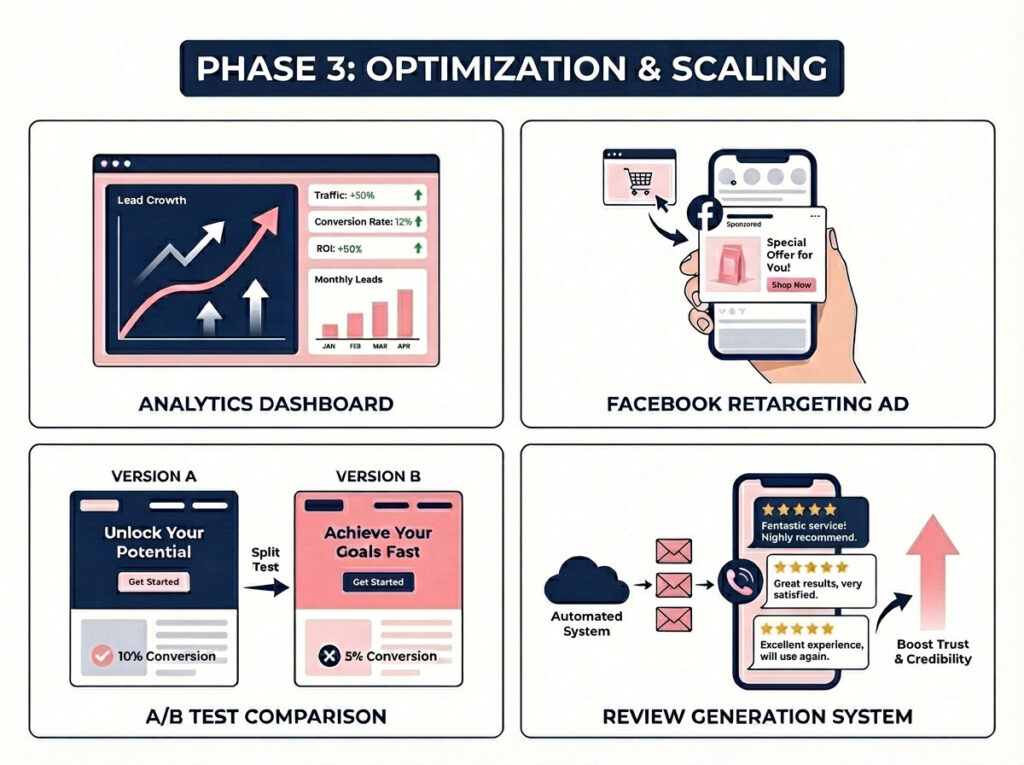
Phase 3 (Days 61-90): Optimization and Scaling
By Day 61, you should have a functioning system: a website that converts, ads that are running, content that is being indexed, and local SEO signals building. Phase 3 is about optimizing what is working and scaling the results.
Optimize Ad Campaigns (Days 61-70)
Analyze cost per lead by keyword: Identify your top 5 performing keywords (lowest cost per lead, highest conversion rate). Increase bids on these. Pause or reduce spend on keywords with high cost and no leads.
Test new ad copy: Create 2-3 variations of your best-performing ads. Test different headlines, value propositions, and calls-to-action. Let each variation run for at least 7-10 days before judging performance.
Optimize landing pages: If your landing page conversion rate is below 5%, test changes: simplify the form, add more reviews, change the headline, or make the CTA button more prominent.
Launch Retargeting Ads (Days 65-75)
Install Facebook/Meta Pixel: Add the tracking pixel to your website so you can retarget visitors who did not convert.
Create a retargeting audience: Target people who visited your website in the last 30 days but did not submit a quote request.
Run retargeting ads: Show these visitors ads on Facebook and Instagram with a compelling message: “Still planning your move? Get a free quote from [Your Company].” Budget: $10-20 per day. These campaigns typically have 3-5x higher conversion rates than cold traffic campaigns.
Conversion Optimization (Days 70-80)
Implement automated follow-up: When a lead submits a form, send an automated email or SMS within 5 minutes. Leads contacted within 5 minutes are 21 times more likely to convert.
Review website analytics: Check which pages have the highest bounce rates. These pages need improvement: faster loading, better content, or clearer CTAs.
A/B test your quote form: Try a shorter form vs. your current one. Or test different button colors, placement, or wording. Even small changes can increase conversion rates by 10-20%.
Review Generation Strategy (Days 75-85)
Systemize review requests: Build review collection into your standard operating procedure. After every completed move, send an automated text with your Google review link within 24 hours.
Set a target: Aim for 10-15 new reviews during Phase 3. If you completed 30 moves, a 33-50% review rate is realistic with a simple follow-up system.
Respond to all reviews: Thank positive reviewers by name and address concerns in negative reviews professionally. This signals engagement to both Google and potential customers reading your reviews.
Scale Winning Channels (Days 80-90)
Review your 60-day data: Compare current metrics to your Day 1 baseline. How much has traffic increased? How many leads are you generating? What is your cost per lead by channel?
Double down on winners: If Google Ads is delivering leads at $50 each and your average job is $1,500, increase your budget. If a specific blog post is driving traffic, write more content on related topics.
Cut or fix losers: If a channel has consumed a budget for 30+ days with no leads, either fix the strategy or reallocate that budget to a performing channel.
Plan the next 90 days: Your first 90 days built the system. The next 90 days will refine it. Set new targets for traffic, leads, and revenue based on what you have learned.
Common Mistakes to Avoid
No written plan: Marketing without a plan is just random spending. Write your plan down, set deadlines, and track progress weekly.
No tracking: If you cannot measure it, you cannot improve it. Analytics and conversion tracking are non-negotiable from Day 1.
Ignoring local SEO: For moving companies, local search is where your customers are. Skipping GBP optimization and local citations is leaving money on the table.
Weak website: A slow, outdated, or hard-to-use website undermines every other marketing effort. Fix your website before spending on ads.
Giving up too early: SEO takes 3-6 months. Ads need 2-4 weeks of data before you can optimize. A 90-day plan requires patience and consistent execution.
Why Choose Pink Dreams for Your 90-Day Growth Plan
At Pink Dreams, the team has built and executed 90-day marketing plans for moving companies and local service businesses across Canada and the United States. The approach is strategy-first: every action is tied to a specific business outcome, and every dollar is tracked against measurable results.
Pink Dreams brings a combination of SEO expertise, paid advertising management, website optimization, and lead generation strategy under one roof. As a Google Partner and Microsoft Advertising Partner, the team has certified expertise and access to industry-leading tools that deliver faster, more reliable results. Visit thepinkdreams.com to get a free digital presence audit and see exactly where your marketing stands today.
How to Get Started Today
Do not wait until you finish reading to take action. Here are the five things you can do right now to start your 90-day plan.
1. Run a website speed test at Google PageSpeed Insights and note your score.
2. Claim or verify your Google Business Profile if you have not already.
3. Write down your top 10 target keywords (cities + services you offer).
4. Set up Google Analytics 4 on your website today.
5. Ask your last 3 completed customers for a Google review right now.
Conclusion
A 90-day digital marketing plan is not about doing everything at once. It is about doing the right things in the right order so that each action builds on the last. Phase 1 builds your foundation. Phase 2 drives traffic and visibility. Phase 3 optimizes and scales what is working.
The moving companies that grow fastest are not the ones with the biggest budgets. They are the ones with the clearest plans and the most consistent execution. This 90-day roadmap gives you the structure to stop guessing and start growing.
If you want expert help executing your 90-day plan, Pink Dreams specializes in digital marketing for moving companies. Visit thepinkdreams.com to claim your free digital presence audit and get a personalized growth roadmap.
FAQ
How can moving companies get leads fast?
The fastest way to generate moving leads is through Google Ads targeting high-intent local keywords. A well-structured campaign can produce leads within the first week. Simultaneously, optimizing your Google Business Profile for local search and actively requesting customer reviews builds organic visibility that delivers free leads over time.
What is a 90-day marketing plan?
A 90-day marketing plan is a structured, phase-based roadmap that outlines specific marketing actions across three 30-day phases. Phase 1 focuses on foundation (website, tracking, GBP). Phase 2 focuses on driving traffic (content, ads, local SEO). Phase 3 focuses on optimization and scaling (improving conversions, retargeting, expanding winning channels).
Is SEO important for moving companies?
SEO is critical. It drives free, ongoing organic traffic from people actively searching for movers. While it takes 3-6 months for significant results, the traffic it generates does not stop when you stop paying, unlike ads. Companies with strong SEO consistently report lower cost per lead and higher close rates.
How much should a moving company invest in marketing?
A reasonable starting budget for digital marketing is $2,000 to $5,000 per month, covering Google Ads spend, SEO services, and website maintenance. The key metric is ROI: if your average job is $1,500 and your cost per booked job from marketing is $150, you are getting a 10x return. Scale your budget based on what the data shows is working.
When will I see results from digital marketing?
Google Ads can generate leads within the first week. Google Business Profile improvements often show impact within 2-4 weeks. SEO content typically takes 3-6 months for meaningful ranking improvements. A comprehensive 90-day plan should produce measurable increases in traffic, leads, and booked jobs by Day 90, with results continuing to compound beyond that.

Digital Marketing Strategist & Business Coach
As a leading digital marketing strategist and business coach, he is responsible for helping entrepreneurs and brands grow faster in a smarter, more scalable way. With over 20 years of experience, Nagarajan specializes in practical coaching, automation-first marketing strategies, and technology-driven growth systems. His work focuses on enhancing brand visibility, improving performance, and building sustainable frameworks that enable long-term business success.