




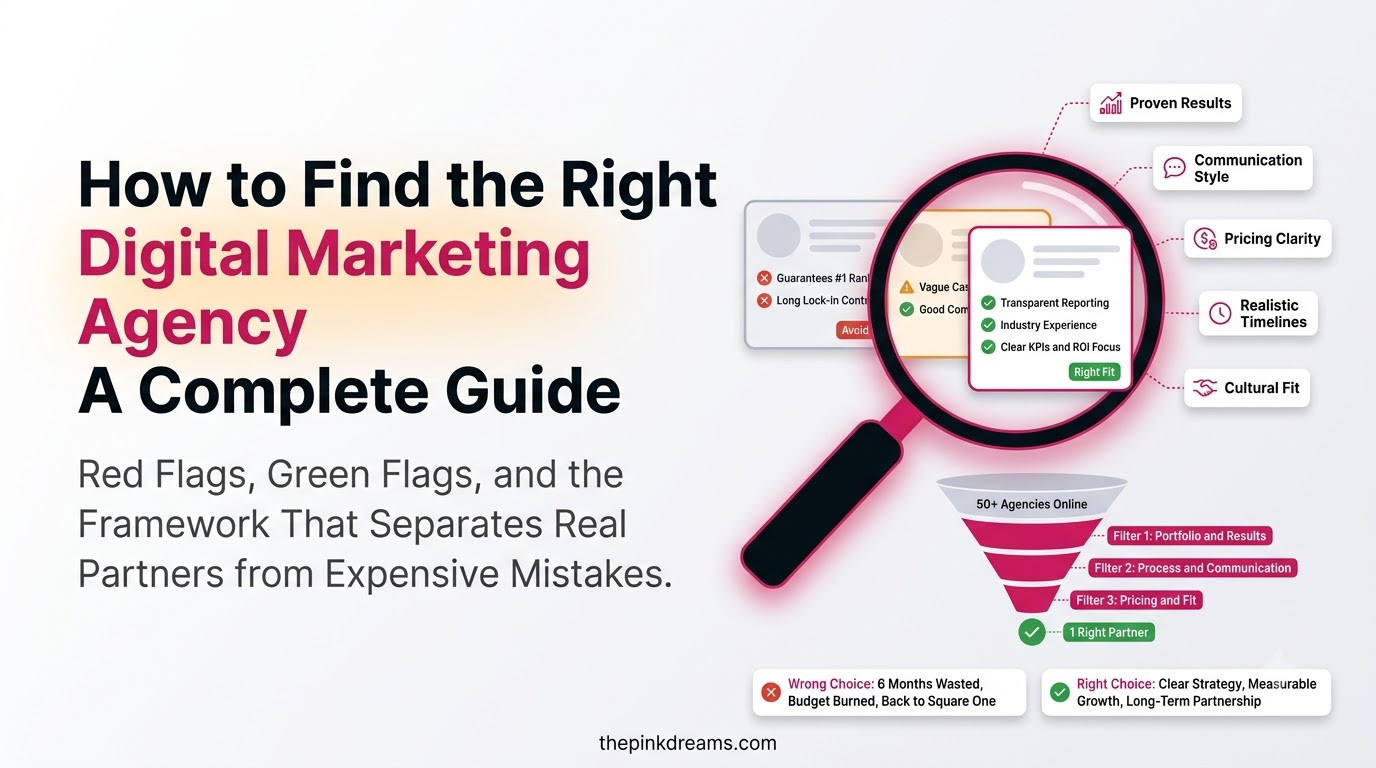
How to find the right digital marketing agency for your business: where to look, how to compare a shortlist objectively, what to ask, and the warning signs worth walking away from.
Most businesses choose an agency the way they choose a restaurant on holiday. They look at a few websites, pick the one that looks most impressive, sign a twelve-month contract, and hope. Six months later they cannot say what the agency did, what it cost per lead, or whether anything actually improved.
Knowing how to find the right digital marketing agency for your business is mostly a process problem rather than a judgement problem. Define what you need before you look, source candidates from places where quality is verifiable, compare them against the same criteria, and test how they think before you test how they sell. Do that and the decision becomes obvious. Skip it and you are choosing chemistry and a nice deck. The same discipline applies whether you need one channel or a full stack of digital marketing services.
This guide covers where to find agencies, a ten-step selection process, a scorecard for comparing a shortlist, what it should cost, the questions to ask, and what should happen in your first ninety days.
Key Takeaways
- Define your goals, scope, and budget before you contact anyone. Agencies cannot fix an unclear brief.
- Where you source candidates matters. Referrals and verified case studies beat search ads and cold outreach.
- Score your shortlist against identical criteria instead of comparing chemistry and slide design.
- Industry experience is useful, but relevant channel expertise and a clear strategy matter more.
- Cheapest is rarely cheapest. Low retainers usually mean junior execution and no strategic time.
- Treat guaranteed rankings, vague reporting, and account ownership issues as disqualifiers.
- Judge the first ninety days on work delivered and tracking installed, not on revenue.
Why Finding the Right Digital Marketing Agency Matters
The wrong agency does not just waste the retainer. It costs you the twelve months you spent with them, the momentum a competitor gained in the meantime, and often the tracking data and content you never actually owned. That combined cost is usually several times the fees paid.
The right agency does something harder to quantify. It brings pattern recognition from campaigns you will never run, catches problems before they cost you revenue, and holds a strategy steady while you get on with running the business.
The gap between good and bad is unusually wide in this industry because the barrier to entry is low. Anyone can build a website, use the language, and show a chart trending upward. Very few can explain why a number moved, what they would do differently next quarter, and how it connects to revenue.
Key Takeaway: The real cost of the wrong agency is the lost year, not the invoices. Slow down the selection to avoid it.
Before You Start Searching: Define Goals, Scope and Budget
Agencies cannot fix a vague brief, and a vague brief guarantees you will compare proposals that are not comparable. Write down what you want to achieve, which channels you think you need, what you can spend monthly, and how you will judge success. One page is enough, and it will save weeks.
Answer these four questions honestly before you contact anybody.
1. What is the actual business goal? More qualified enquiries, higher average order value, entering a new market, or reducing cost per acquisition. “More traffic” is not a business goal.
2. What is the constraint? No visibility, poor conversion, weak brand, or no capacity to execute. Different constraints need different agencies.
3. What can you commit monthly, for how long? Digital marketing compounds. A budget that runs out in month four buys nothing.
4. Who owns this internally? Agencies stall without a decision-maker who can approve content and answer questions within days.
The most common mistake here is asking agencies to tell you what you need before you have thought about it yourself. You will get a proposal shaped around whatever that agency sells rather than what your business requires.
Key Takeaway: A one-page brief covering goal, constraint, budget, and internal owner turns a confusing search into a straightforward comparison.
Agency, Freelancer, Specialist or In-House: Which Model Fits Your Business?
Full-service agencies, specialist agencies, freelancers, and in-house hires solve genuinely different problems. Choose based on the number of channels you need, how much internal direction you can provide, and whether your requirement is ongoing or project-based.
| Model | Best for | Main strength | Main risk |
| Full-service agency | Businesses needing several channels coordinated | One team, one strategy, shared data across channels | Depth can be uneven across services |
| Specialist agency | A single channel that needs to be excellent | Deep expertise and better benchmarks in that channel | You coordinate multiple suppliers yourself |
| Freelancer | Defined projects and smaller budgets | Direct access to the person doing the work | Single point of failure, limited capacity |
| In-house hire | High-volume marketing with senior oversight | Full attention, deep product knowledge | Slow to hire, expensive to get wrong, narrow skill set |
| Hybrid | In-house lead plus agency execution | Strategic control with external capacity | Requires a capable internal marketer to work |
The hybrid model is the one most growing businesses land on eventually. An internal marketing lead who understands the business briefs and holds the agency accountable, while the agency supplies specialist execution across channels.
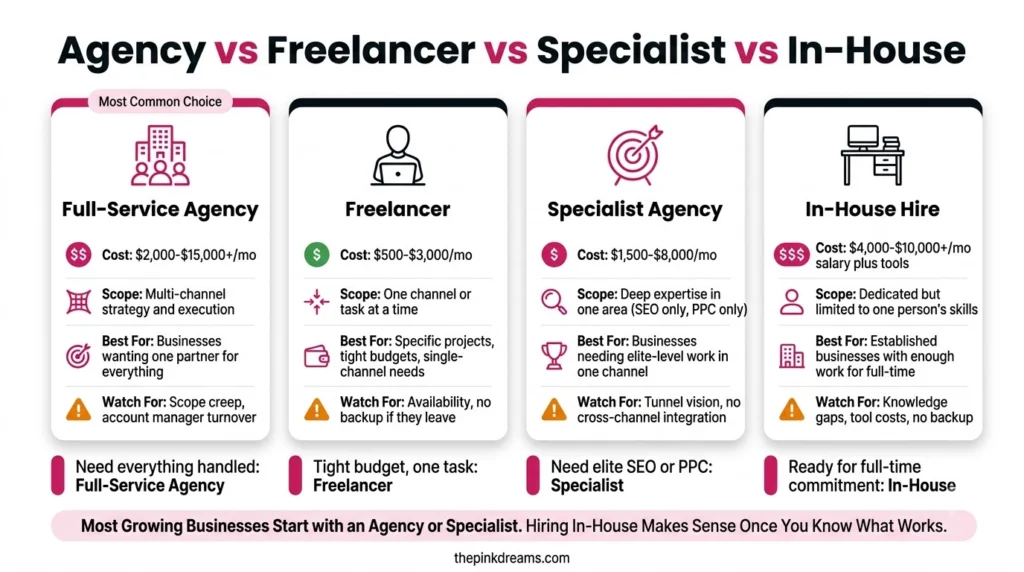
Key Takeaway: Match the model to the number of channels you need and the amount of internal direction you can realistically provide.
Where to Find Digital Marketing Agencies
The best sources are referrals from businesses like yours, verified review platforms such as Clutch and G2, LinkedIn activity that shows how an agency thinks, and industry-specific communities. The worst source is whoever ranks first on an ad, because that only proves they can afford the click.
Where to find digital marketing agencies worth shortlisting, roughly in order of reliability:
• Referrals from peers in your industry. Ask specifically what results they got and what frustrated them, not just whether they liked the team.
• Verified review platforms. Clutch, G2, and Google reviews carry weight because reviews are tied to identifiable clients and projects.
• Case studies with real numbers. An agency willing to publish cost per lead and revenue figures is confident in its work.
• LinkedIn and industry content. Agencies that publish genuinely useful thinking are demonstrating expertise rather than claiming it.
• Awards and certifications. Google Partner and Meta Business Partner status confirm platform competence, though not strategic ability.
• Organic search results. An agency ranking well for competitive terms is at least proving it can do SEO for itself.
• Industry associations and events. Useful for specialist sectors where relevant experience is scarce.
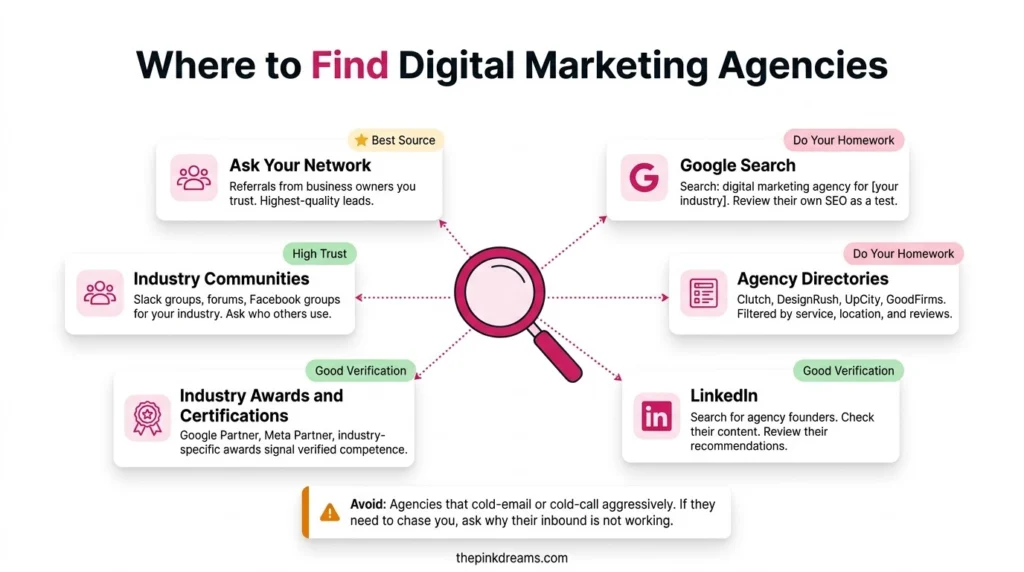
Be careful with directories that charge agencies for placement, because the ranking reflects spend rather than quality. Cold outreach is not automatically bad, but an agency prospecting hard usually has capacity to fill, which is worth asking about directly.
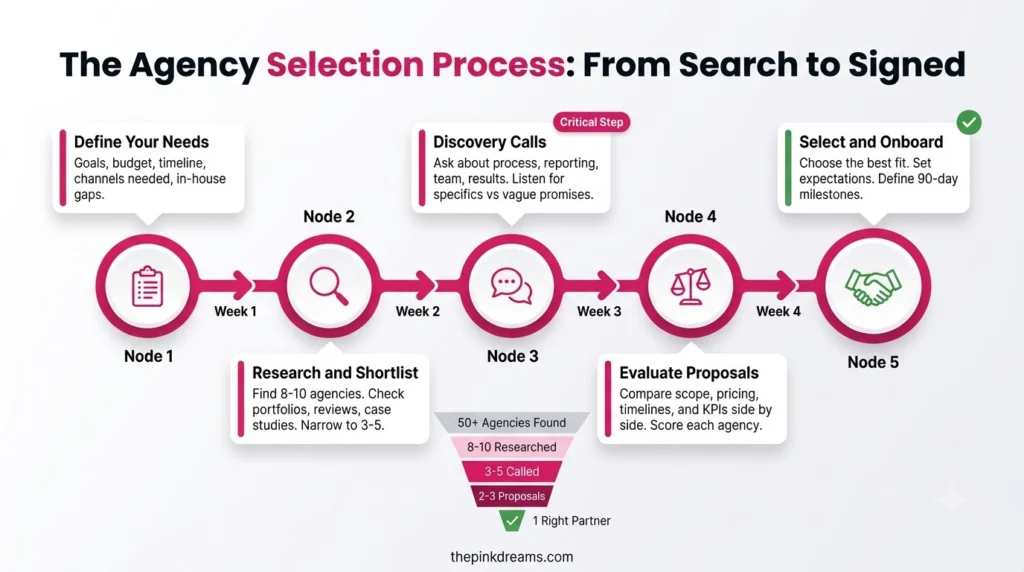
Key Takeaway: Source candidates from places where quality is verifiable, then shortlist three to five. Any more and the comparison collapses.
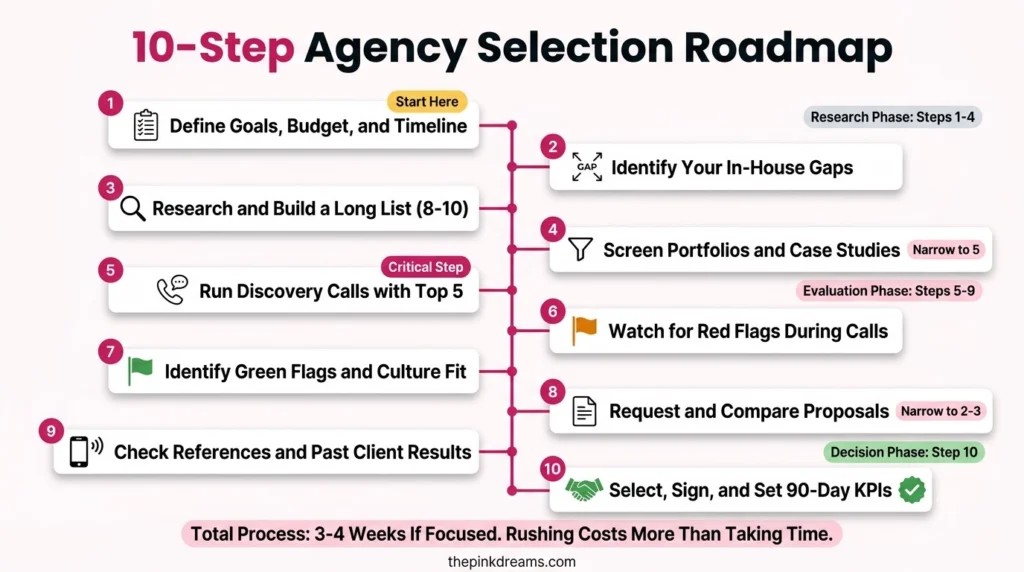
How to Choose a Digital Marketing Agency: 10 Steps to Follow
These are the steps to choose the right digital marketing agency in the order they actually work. Each step narrows the field, so running them out of sequence means evaluating agencies on the wrong criteria at the wrong time.
1. Confirm the services you genuinely need
Match your constraint to the service. Poor visibility points to SEO services, poor conversion points to web and creative work, and no immediate pipeline points to paid media. Buying a bundle because it is offered is how businesses end up paying for channels they never needed.
2. Shortlist on relevant experience, not just industry
Industry experience helps, but it is overrated compared with relevant channel and business-model experience. An agency that has scaled ecommerce brands understands your problem better than one that happens to have worked in your sector on a brochure website.
3. Examine their case studies properly
Look for the metric that matters, the timeframe, and the starting point. A case study showing a percentage increase with no baseline is decorative. Ask what did not work in that campaign, because the answer tells you whether the case study is honest.
4. Check their own marketing
An agency’s own website, search visibility, and content are a live demonstration of its capability. An SEO agency that does not rank, or a content agency with a neglected blog, is telling you something about either its skill or its priorities.
5. Interrogate the strategy, not the deliverables
Ask what they would do in the first ninety days and why. A strong agency will describe a diagnosis before a prescription. A weak one will list deliverables, because the deliverables are the same for every client they have.
6. Understand how they measure success
Agree the metrics before the contract. Enquiries, qualified leads, cost per acquisition, and revenue are outcomes. Impressions, rankings, and followers are diagnostics. Any agency reporting only diagnostics is protecting itself from accountability.
7. Meet the people who will do the work
Pitches are frequently delivered by senior staff and executed by juniors. Ask who your day-to-day contact will be, what their experience is, and how many other accounts they handle. Then ask to meet them before signing.
8. Assess communication and reporting
Ask for a sample report and a sample month of communication. You want a monthly report you can understand without translation, a named contact, agreed response times, and a regular call. Reporting quality predicts relationship quality more reliably than anything said in a pitch.
9. Compare pricing on scope, not headline cost
Two proposals at different prices are almost never buying the same thing. Break both down into hours, seniority, deliverables, and strategic time. The cheaper one usually has less senior involvement, which is exactly where the value sits.
10. Check contract terms before you fall in love
Notice period, minimum term, ownership of accounts and content, and what happens to your ad account and analytics if you leave. This is the least exciting step and the one businesses most regret skipping.
Key Takeaway: Narrow on evidence, then test thinking, then check terms. Most bad decisions come from doing those in reverse.
The Agency Scorecard: How to Compare a Shortlist Objectively
Score every shortlisted agency against identical criteria immediately after each call, before impressions blur. Weight the criteria according to your own constraint rather than treating them equally. This one habit removes most of the emotion from the decision and makes it defensible to whoever signs the invoice.
| Criterion | What a strong answer looks like | Weight |
| Understanding of your business | They asked about margins, sales cycle, and capacity, not just channels | High |
| Relevant proof | Case studies with baselines, timeframes, and revenue outcomes | High |
| Strategic thinking | A diagnosis and a first-ninety-days plan specific to you | High |
| Team and seniority | You met the people doing the work and know their experience | High |
| Measurement approach | Outcome metrics agreed upfront, tracking checked before launch | High |
| Communication | Named contact, agreed cadence, sample report you can read | Medium |
| Pricing transparency | Scope broken into hours, deliverables, and strategic time | Medium |
| Cultural fit | Direct answers, comfortable disagreement, no pressure to sign | Medium |
| Contract terms | Reasonable notice, you own accounts and content | Medium |
| Capacity | Clear on how many accounts your team handles | Low |
Score each from one to five, multiply by weight, and compare totals. If two agencies finish close, choose the one whose strategic thinking was clearest, because that is the part you cannot replace or supervise yourself.
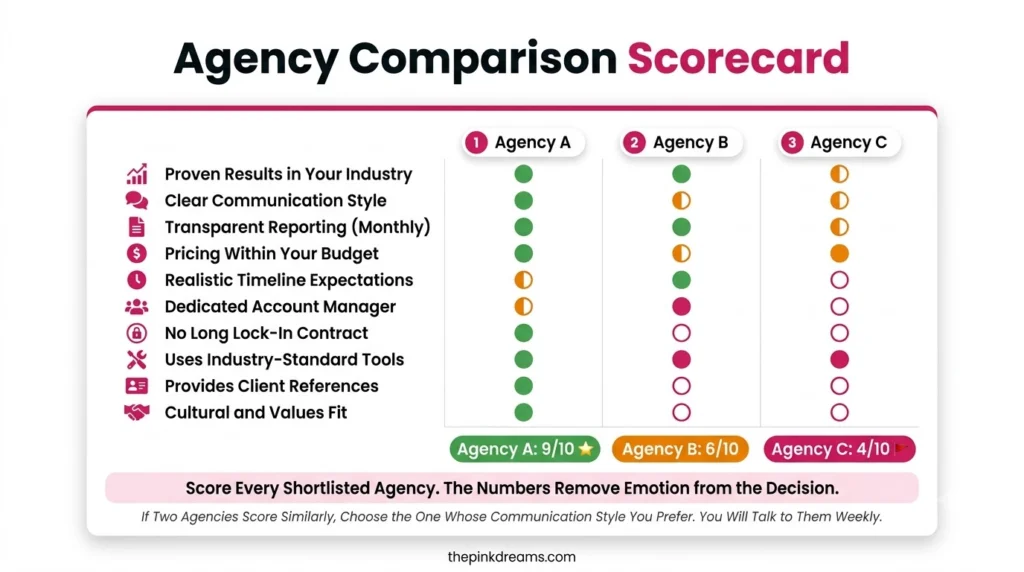
Key Takeaway: Score immediately after every call using the same criteria. Memory flatters whoever presented last.
What Should a Digital Marketing Agency Cost?
Pricing varies widely by market, channel, and seniority, so compare quotes within your own region rather than against figures published elsewhere. What matters is not the headline number but what the number buys: how many hours, at what seniority, on which deliverables, with how much strategic time included.
| Pricing model | How it works | Best for | Watch out for |
| Monthly retainer | Fixed fee for an agreed scope | Ongoing work across one or more channels | Scope creep in both directions |
| Project fee | Fixed price for a defined deliverable | Website builds, audits, campaign launches | Nothing budgeted for what happens next |
| Hourly or day rate | Billed for time used | Consultancy and ad hoc support | Unpredictable costs, no accountability for outcomes |
| Percentage of ad spend | Fee scales with media budget | Paid media at meaningful scale | Incentive to increase spend rather than efficiency |
| Performance-based | Fee tied to leads or revenue | Mature funnels with clean attribution | Attribution disputes, and rarely offered without a base fee |
Work out what an agency has to produce to be worth it. Take your average sale value and close rate, calculate how many additional sales per month would cover the fee, and judge every proposal against that number. If the math does not work at the proposed budget, the honest answer is that the scope is wrong rather than that the agency is expensive.
Key Takeaway: Compare what the fee buys in hours, seniority, and strategic time. Two proposals at the same price are frequently buying very different things.
Questions to Ask Before You Sign the Contract
Ask questions that require specific answers rather than reassurance. Anything answerable with “yes, absolutely” tells you nothing. The strongest signal in a selection process is an agency willing to say what it would not do, what it cannot promise, and where your expectations are unrealistic.
• Who will work on my account day to day, and how many other clients do they handle?
• What would you do in the first ninety days, and why that order?
• Which metrics will you report on, and which do you consider vanity metrics?
• Can you show a case study where results were disappointing, and what you learned?
• How do you handle the situation where our internal team is slow to approve work?
• What do you need from us for this to succeed?
• Who owns the ad accounts, analytics, and content if we part ways?
• What is the notice period, and what happens in the final month?
• How do you approach AI search visibility and answer engines?
• At what point would you tell us this is not working?
The last question is the most revealing. An agency that has a clear answer has had that conversation before and handled it professionally.
Key Takeaway: Ask for specifics, timelines, and failures. Confident agencies answer directly; weak ones redirect to case studies.
Red Flags and Mistakes That Cost Businesses Money
• Guaranteed rankings or guaranteed results: search platforms do not sell placement in unpaid results, so nobody can guarantee it.
• No questions about your business: an agency that pitches before diagnosing is selling a package, not a strategy.
• Reporting only on impressions and rankings: it hides whether enquiries actually increased.
• They own your accounts: if the ad account, analytics, or content sits under their ownership, leaving costs you everything.
• Pressure to sign quickly: discounts that expire on Friday are a sales tactic, not a business case.
• Choosing on price alone: low retainers usually mean junior execution and no strategic time, which is the part you were buying.
• No named contact: shared inboxes and rotating account managers predict exactly the experience you would expect.
• Signing a twelve-month term with no review points: agree quarterly reviews with clear criteria instead.
• Briefing badly and blaming the agency: unclear goals and slow approvals sink good agencies regularly.
Key Takeaway: Most agency relationships fail for predictable reasons. Nearly all of them are visible during the selection process if you know what to look for.
Local or Remote: Does Agency Location Still Matter?
Location matters less than it used to, but it has not stopped mattering entirely. Choose local when you need frequent in-person collaboration, on-site content production, or genuine knowledge of a specific local market. Choose remote when specialist expertise matters more than proximity, which is most of the time.
• Local is genuinely useful when: you need photography and video shot on site, your market has strong regional or cultural specifics, or your team works better face to face.
• Remote works better when: you need niche channel expertise, you want a wider pool of candidates, or your buyers are spread across several countries.
• Time zones matter more than distance. An agency four hours ahead is easier to work with than one twelve hours behind, regardless of which is closer.
Key Takeaway: Prioritise expertise and communication over postcode, unless your work genuinely requires someone physically present.
What Good Looks Like in the First 90 Days
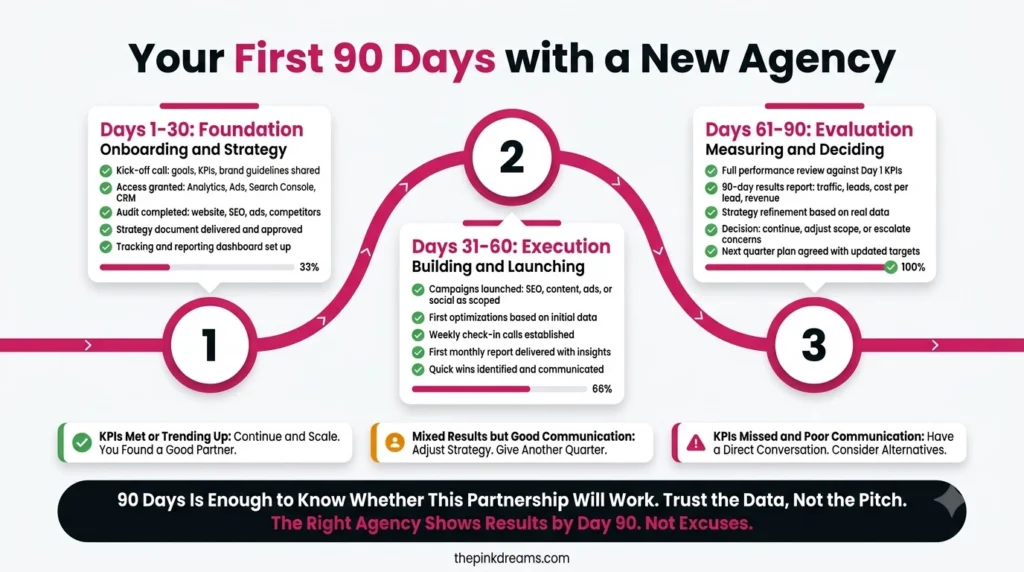
The first ninety days should produce foundations rather than revenue. Expect an audit, tracking properly installed, a documented strategy, and the first executed work. If an agency promises significant results inside ninety days across organic channels, treat that as a warning rather than a selling point.
| Period | What should be delivered | What you should see |
| Days 1 to 30 | Audit, access and tracking setup, goal and KPI agreement, documented plan | A clear baseline you both agree on |
| Days 31 to 60 | First campaigns live, priority fixes shipped, content in production | Early performance data and initial optimisations |
| Days 61 to 90 | Consistent delivery, first full reporting cycle, plan adjusted on evidence | Leading indicators moving, first enquiries from paid channels |
Paid channels can produce enquiries within the first month. Organic search and content typically take longer, which is why blended strategies work better than betting everything on one timeline. Agree these expectations in writing during onboarding so nobody is disappointed by an outcome that was always predictable.
Key Takeaway: Judge the first ninety days on delivery, tracking, and strategy quality. Judge months six to twelve on pipeline.
Tips to Choose the Right Digital Marketing Agency
These are the practical tips to choose the right digital marketing agency that experienced buyers apply almost automatically.
• Start with a small project where possible. A paid audit or a single campaign reveals more than any pitch.
• Talk to two current clients, not the two references offered. Ask what they would change about the relationship.
• Write the brief before the first call. It keeps every conversation comparable.
• Watch how they handle disagreement. An agency that never pushes back will not protect you from a bad idea.
• Never sign in the room. Sleep on it and re-read the scope with fresh eyes.
• Agree the exit before the start. Notice periods and account ownership are far easier to negotiate before you sign.
Key Takeaway: Test with a small piece of work, verify with real clients, and settle the exit terms before the relationship starts.
Finding the Right Digital Marketing Agency for Your Business
Knowing how to find the right digital marketing agency for your business comes down to sequence rather than instinct. Define the goal and the constraint. Source candidates where quality can be verified. Shortlist three to five. Score them against identical criteria. Test how they think before you test how they sell. Then check the contract terms before enthusiasm makes you careless.
None of that requires marketing expertise. It requires a written brief, a scorecard, and the discipline to complete the process rather than shortcut it after a good first meeting. The businesses that get this right are rarely the ones with the biggest budgets. They are the ones that treated the decision like a hire rather than a purchase.
If you take one thing from this guide, make it the scorecard. Comparing agencies against the same weighted criteria, immediately after each conversation, prevents almost every expensive mistake described above.
And if you would rather work with specialists from the start, Pink Dreams can help. Pink Dreams is a digital marketing agency that helps business owners and startups grow online across the US, the UK, Canada, Australia, and Dubai. Our social media marketing services and wider growth work audit your current position, build a customized roadmap, and execute the content marketing services, search, and campaign work that turns visibility into booked revenue. Request a free digital presence audit to see where you stand before you commit to anyone.
FAQ
How do I find the right digital marketing agency for a small business?
Start with a one-page brief covering your goal, budget, and constraint, then source candidates through peer referrals and verified review platforms rather than ads. Shortlist three, score them against identical criteria, and prioritise agencies that ask about your margins and sales process rather than immediately pitching packages.
How much should a digital marketing agency cost?
Costs vary considerably by country, channel, and seniority, so compare quotes within your own market. Rather than benchmarking against published averages, calculate how many additional sales per month would cover the fee using your average sale value and close rate, then judge each proposal against that number.
What are the steps to choose the right digital marketing agency?
Confirm the services you need, shortlist relevant experience, examine case studies with real baselines, check the agency’s own marketing, interrogate their strategy, agree how success is measured, meet the delivery team, review reporting, compare pricing on scope, and check contract terms before signing.
How long should I commit to a digital marketing agency?
Aim for a contract with quarterly review points rather than a long term with none. Three months is rarely enough to judge organic channels, and twelve months without review removes your leverage. A six-month initial term with defined criteria at month three is a reasonable middle ground.
Should I hire a full-service agency or a specialist?
Choose a specialist when one channel needs to be exceptional and you can coordinate suppliers yourself. Choose full-service when several channels need to work together and you lack internal capacity to manage multiple relationships. Businesses with an internal marketing lead often get the best results from a hybrid arrangement.

Digital Marketing Strategist & Business Coach
As a leading digital marketing strategist and business coach, he is responsible for helping entrepreneurs and brands grow faster in a smarter, more scalable way. With over 20 years of experience, Nagarajan specializes in practical coaching, automation-first marketing strategies, and technology-driven growth systems. His work focuses on enhancing brand visibility, improving performance, and building sustainable frameworks that enable long-term business success.